
History
Seguidillas manchegas
Guitars and bandurrias on the plains of Don Quixote
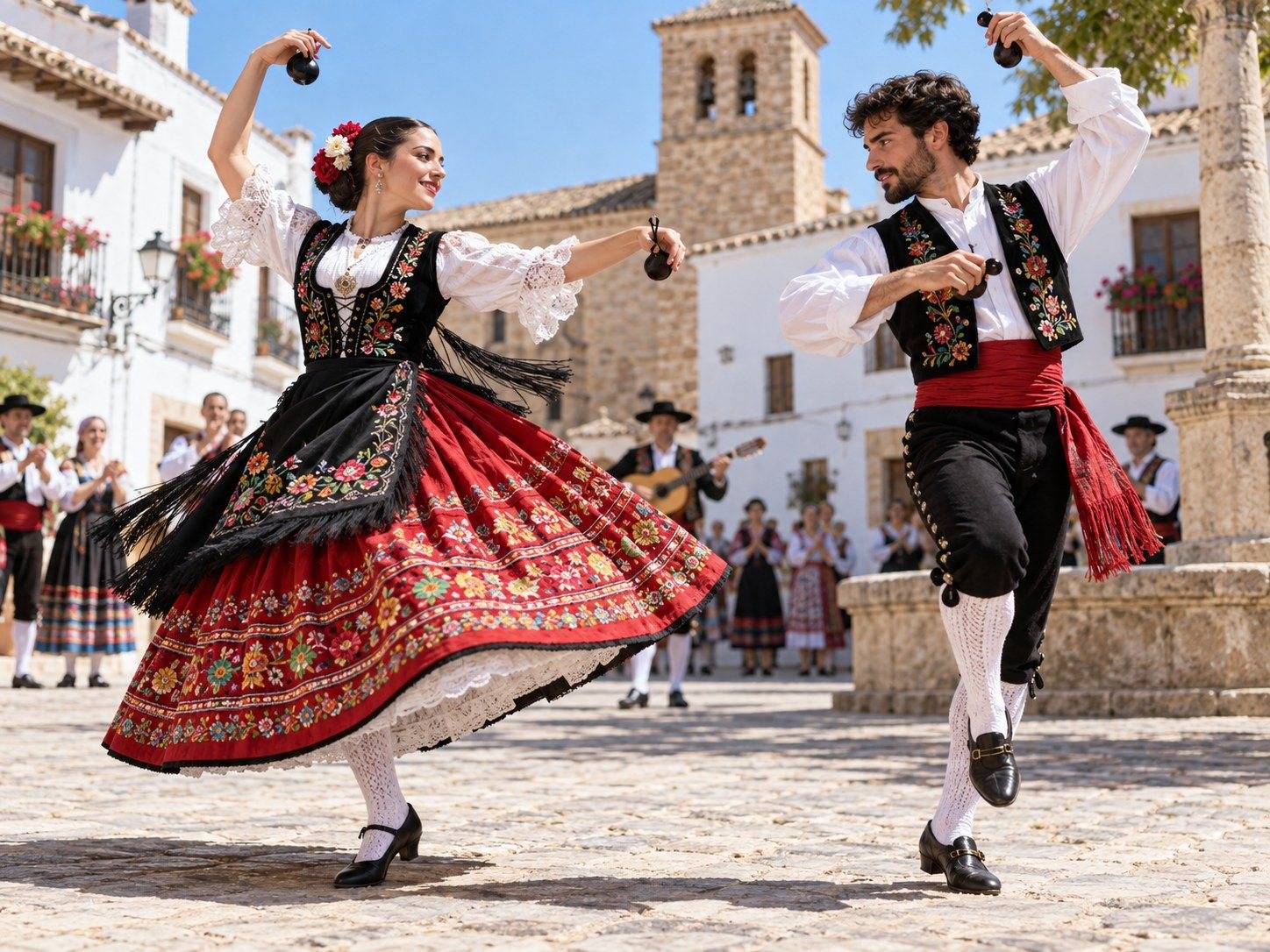
Seguidillas are danced by couples, or by groups of couples, facing each other with castanets in a lively triple time. Each seguidilla has three sung sections (coplas) separated by instrumental interludes, and the dancers change figures with each one, finishing with a sharp stop on the last note. In La Mancha — Ciudad Real, Albacete, Toledo and Cuenca — they are danced with jumps, crossing steps and turns, to a rondalla of guitars, bandurrias and lutes.
Why it matters
The seguidilla is one of the oldest Spanish dance-song forms: its short verses appear in the poetry of the late 16th and 17th centuries, and Cervantes’ era already knew it as a popular dance. From Castile it spread throughout Spain, giving birth to many regional versions — the seguidillas sevillanas, which became today’s sevillanas, and the boleras of the escuela bolera. In La Mancha the seguidilla remains the regional dance par excellence. Coros y danzas groups, cultural associations and schools teach it, and it fills village fiestas, harvest celebrations and folk festivals across Castilla-La Mancha.
Key facts
- Type: Couple or group folk dance with song
- Since: Late 16th – 17th century
- Rhythm: Lively triple time; three coplas
- Music: Guitars, bandurrias, lutes, castanets
- Where: La Mancha (Ciudad Real, Albacete, Toledo, Cuenca)
- Level: Some practice needed
History timeline
- Late 1500s — Seguidilla verses appear in Spanish poetry and song.
- 1700s — Seguidillas spread across Spain and inspire the bolero.
- 1800s — Seville’s seguidillas evolve into the sevillanas.
- Today — The emblematic dance of Castilla-La Mancha’s folk groups.
Did you know?
- The ‘bien parado’ — freezing perfectly still on the final note — is the mark of a good seguidilla dancer.
- Many regions have their own seguidillas, from Murcia to the Canary Islands.
Performances to watch
- Seguidillas manchegas of Albacete — Danzas Magisterio
- Seguidillas manchegas — Coros y Danzas de Lorca
- Celebrating the Fiesta de la Seguidilla Manchega
Related dances
Why this dance?
How it's danced
Schools
Promote
Promote your classes on this page
Dancers