
History
Chotis madrileño
Chulapos, organillo and a dance on one tile
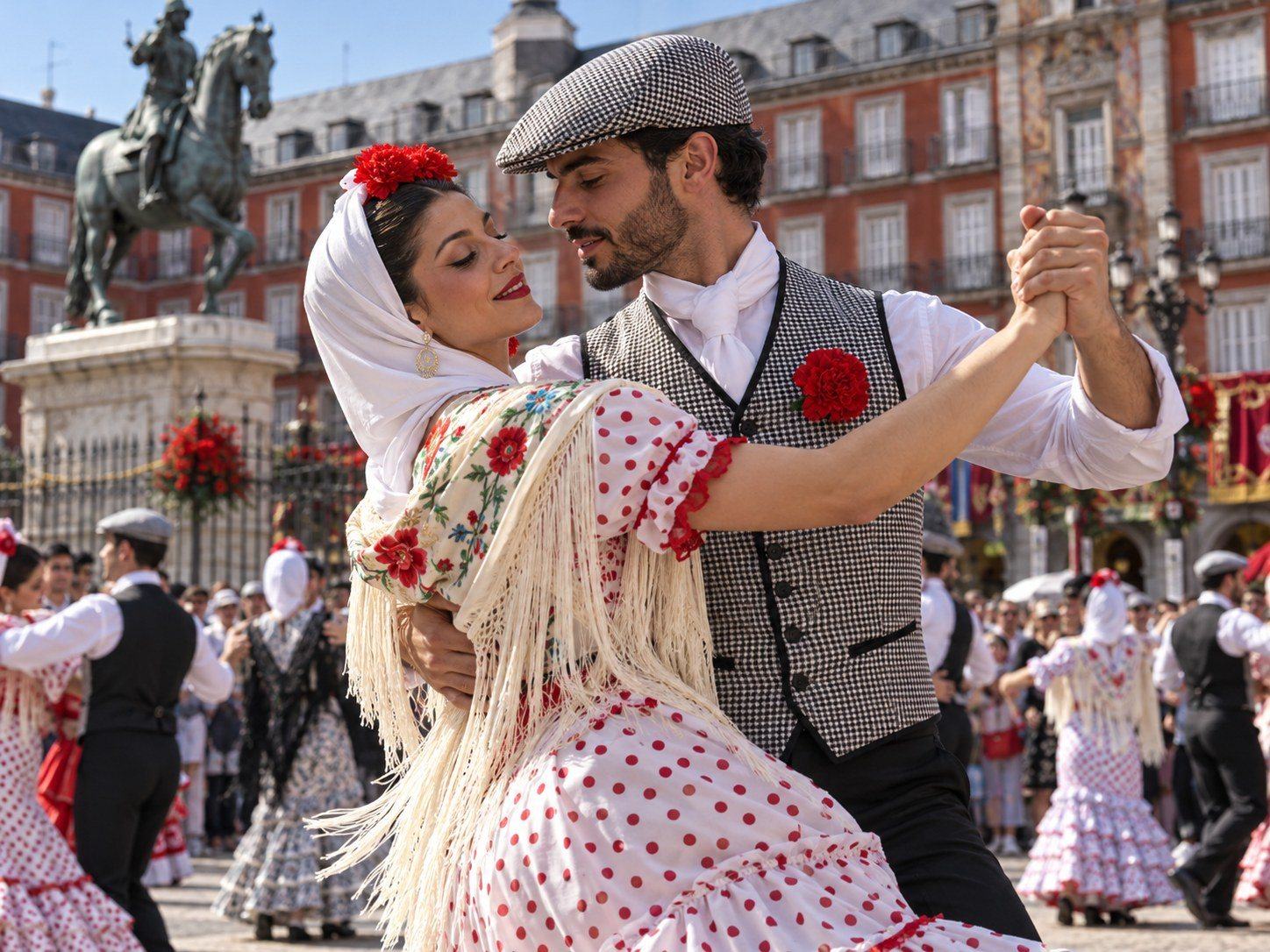
The chotis is a slow, close-hold couple dance. The man (chulapo) turns almost on the spot, as if dancing ‘on a single tile’, while the woman (chulapa) circles around him with small steps; then both walk a few steps side by side before turning again. Dancers wear the traditional castizo costume — flat cap, waistcoat and carnation for him; mantón (shawl), headscarf and carnation for her — and the music is often played by an organillo, a barrel organ.
Why it matters
The chotis came from the Central European ‘schottisch’. According to Madrid’s city council it was first presented in Madrid on 3 November 1850, at a reception in the Royal Palace presided over by Queen Isabel II, as a ‘German polka’. From the court it passed to the popular verbenas and became the dance of Madrid’s castizo neighbourhoods such as Lavapiés and La Latina. The zarzuela theatre and songs like Agustín Lara’s chotis ‘Madrid’ (1948) made it a symbol of the city. Today couples in chulapo costume dance chotis at the Pradera de San Isidro every 15 May and at the August verbenas of San Cayetano, San Lorenzo and La Paloma; in 2025 Madrid celebrated its 175th anniversary.
Key facts
- Type: Close-hold couple dance
- Since: 1850 in Madrid (from the schottisch)
- Rhythm: Slow 2/4 or 4/4
- Music: Organillo (barrel organ), bands, zarzuela songs
- Where: Madrid
- Level: Beginner-friendly
History timeline
- 1850 — The schottisch is presented at Madrid’s Royal Palace (3 November).
- Late 1800s — The chotis becomes the dance of verbenas and the zarzuela.
- 1948 — Agustín Lara writes the chotis ‘Madrid’.
- 2025 — Madrid celebrates 175 years of chotis.
Did you know?
- The Spanish word ‘chotis’ is simply how Madrid pronounced ‘schottisch’.
- The Federación de Grupos Tradicionales Madrileños brings together the groups that keep chotis and Madrid’s fiestas alive.
Performances to watch
- How to dance the Madrid chotis
- Chulapas and chulapos at San Isidro
- Chulapos dancing chotis — San Isidro 2016
Related dances
Why this dance?
How it's danced
Schools
Promote
Promote your classes on this page
Dancers