
History
Flamenco
Song, guitar, palmas and a dancer who answers them all
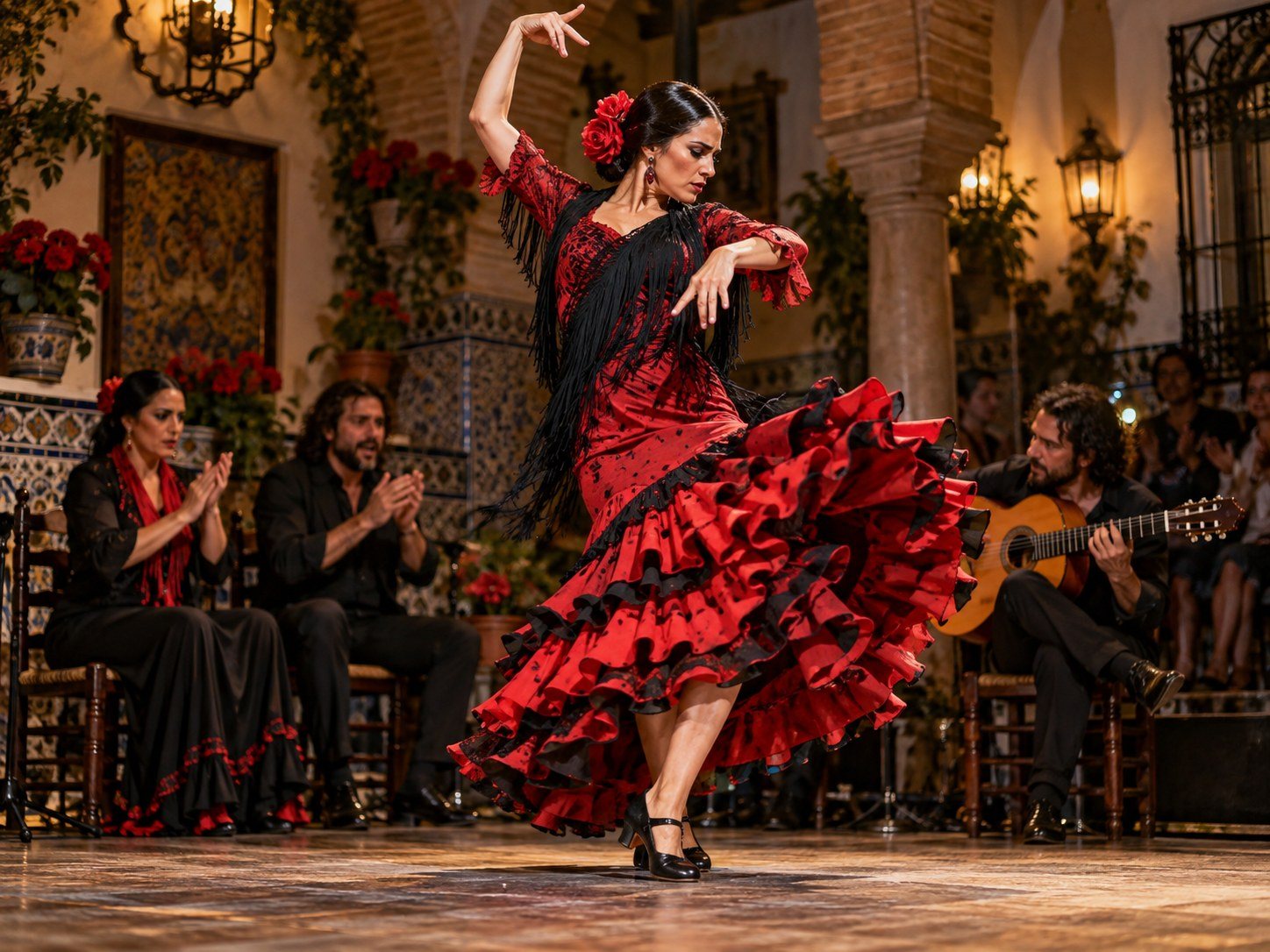
Flamenco is a complete art made of cante (song), toque (guitar), baile (dance), palmas (hand-clapping) and jaleo (shouts of encouragement). It is organised into more than fifty palos — forms such as soleá, bulerías, alegrías, seguiriya, tangos and fandangos — each with its own rhythm (compás), mood and history. A flamenco dancer combines a proud, controlled upper body, expressive arms (braceo) and hands, and precise footwork (zapateado) that turns the feet into a percussion instrument.
Why it matters
Flamenco took shape in Andalusia in the late 18th and 19th centuries, where Gitano (Romani) families, Andalusian rural and urban culture, and older Moorish, Jewish and Castilian musical layers met. Gitano artists were — and remain — central to its creation and transmission, especially in Jerez, Seville’s Triana, Cádiz, Utrera and Granada. From about the 1850s the cafés cantantes turned flamenco into a professional stage art. In 1922 the composer Manuel de Falla and the poet Federico García Lorca organised the Concurso de Cante Jondo in Granada to protect its ‘deep song’. The 20th century brought world tours by Carmen Amaya, the ballets of Antonio Gades, the guitar revolution of Paco de Lucía and the voice of Camarón de la Isla; today artists such as Sara Baras, Israel Galván and Rocío Molina keep reinventing it. In 2010 UNESCO inscribed flamenco on the Representative List of the Intangible Cultural Heritage of Humanity.
Key facts
- Type: Solo or group art of song, guitar and dance
- Since: Late 1700s–1800s, Andalusia; UNESCO 2010
- Rhythm: Many compases; 12-beat soleá and bulerías
- Music: Cante, Spanish guitar, palmas, cajón
- Where: Andalusia (Jerez, Seville, Cádiz, Granada), Murcia, Extremadura, Madrid
- Level: Demanding
History timeline
- Late 1700s — Early flamenco styles grow in Gitano and Andalusian communities.
- c. 1850–1920 — The age of the cafés cantantes makes flamenco a professional art.
- 1922 — Falla and Lorca hold the Concurso de Cante Jondo in Granada.
- 1980 — The Bienal de Flamenco de Sevilla is founded.
- 2010 — UNESCO inscribes flamenco as Intangible Cultural Heritage.
Did you know?
- 16 November is Flamenco Day in Andalusia, marking the date of its UNESCO inscription in 2010.
- The cajón, now a flamenco staple, is a Peruvian box drum brought into flamenco by Paco de Lucía’s group in the late 1970s.
Performances to watch
- Sara Baras dances por soleá
- Rocío Molina — flamenco dance (2011)
- Carmen Amaya dances soleá (1945)
Related dances
Why this dance?
How it's danced
Schools
Promote
Promote your classes on this page
Dancers