
History
Sardana
A circle that anyone may join
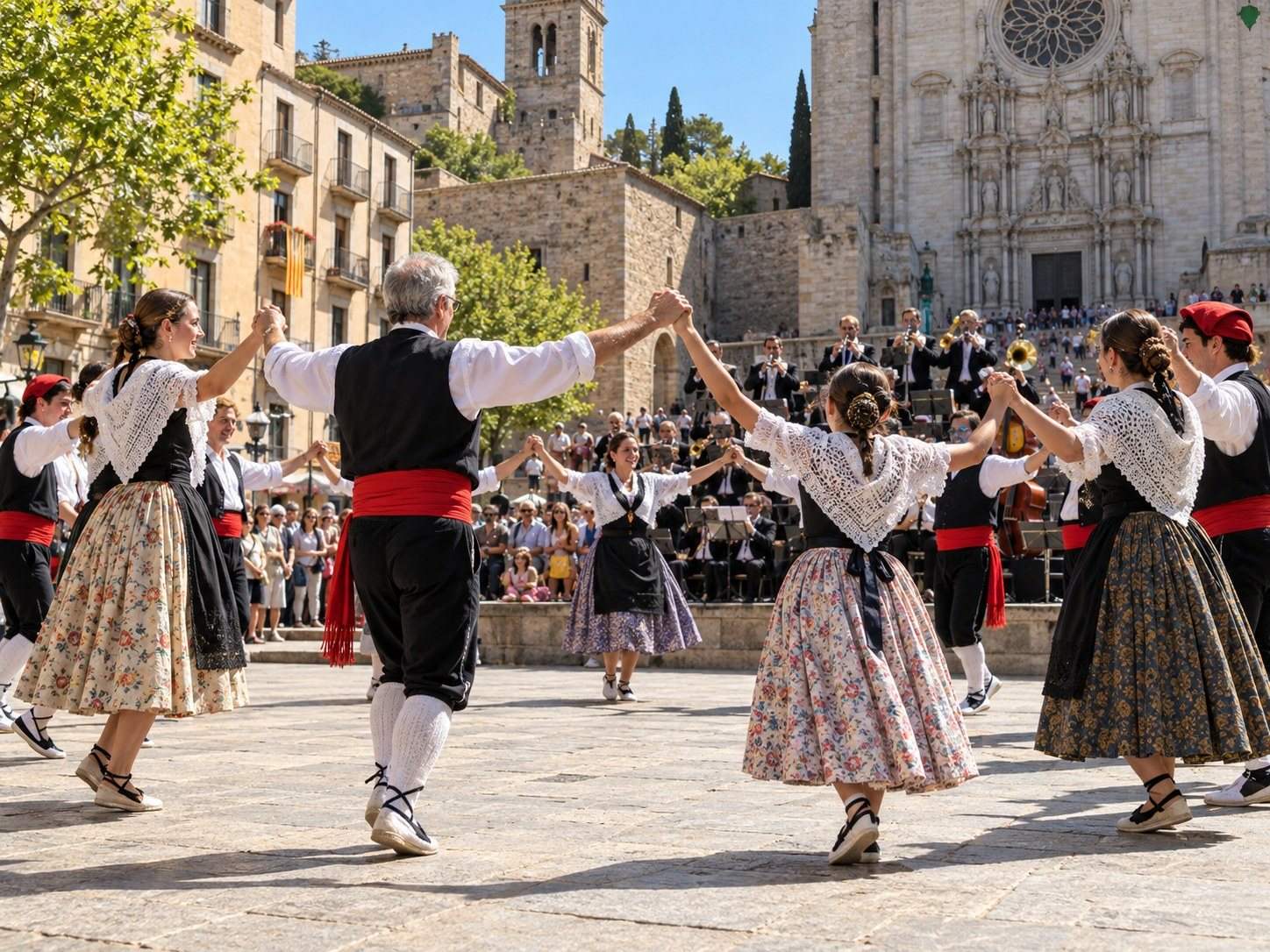
In the sardana, dancers hold hands in a circle — raised at shoulder height for the ‘llargs’ (long steps) and lowered for the ‘curts’ (short steps). The music, played by an eleven-musician band called a cobla, alternates these two sections, and the dancers must count the bars to finish exactly with the music. Circles open to welcome newcomers, who join between a man and a woman, and bags and coats are traditionally piled in the centre.
Why it matters
Circle dances are ancient in Catalonia, but the modern sardana took shape in the Empordà in the mid-19th century. The musician Pep Ventura (1817–1875) developed the ‘sardana llarga’ and reorganised the cobla — adding instruments such as the tenora (a loud double-reed shawm) and brass — into the band still used today: flabiol and tamborí, tibles, tenores, trumpets, trombone, fiscorns and double bass. In the late 19th and 20th centuries the sardana became a symbol of Catalan identity and community. It was danced in defiance of restrictions during the Franco years and remains a living public tradition: every weekend circles form in town squares, and in Barcelona dancers gather in front of the Cathedral on Saturday evenings and Sunday mornings. ‘Aplecs’ — sardana gatherings with several coblas — fill the summer calendar.
Key facts
- Type: Open circle dance, mixed men and women
- Since: Modern form from the mid-1800s (Empordà)
- Rhythm: 6/8 or 2/4; alternating curts and llargs
- Music: Cobla: 11 musicians incl. flabiol, tenora, tible
- Where: Catalonia, also Andorra and Northern Catalonia (France)
- Level: Some practice needed
History timeline
- 1500s–1700s — Early ‘sardanes curtes’ are danced in Catalan towns.
- c. 1850 — Pep Ventura develops the sardana llarga and the modern cobla.
- Early 1900s — The sardana spreads across Catalonia as a symbol of identity.
- Today — Weekend circles in squares and summer aplecs keep it alive.
Did you know?
- The tenora, the sardana’s signature instrument, was developed in the mid-19th century and has a powerful, bright voice.
- Dancers put their bags in the middle of the circle — a tradition that keeps belongings in sight.
Performances to watch
- Sardanes in the Pla de la Catedral, Barcelona
- Locals dance the sardana outside the Cathedral
- Sardana circles in the Cathedral square
Related dances
Why this dance?
How it's danced
Schools
Promote
Promote your classes on this page
Dancers