Türkiye
Where Anatolian stories move through every region
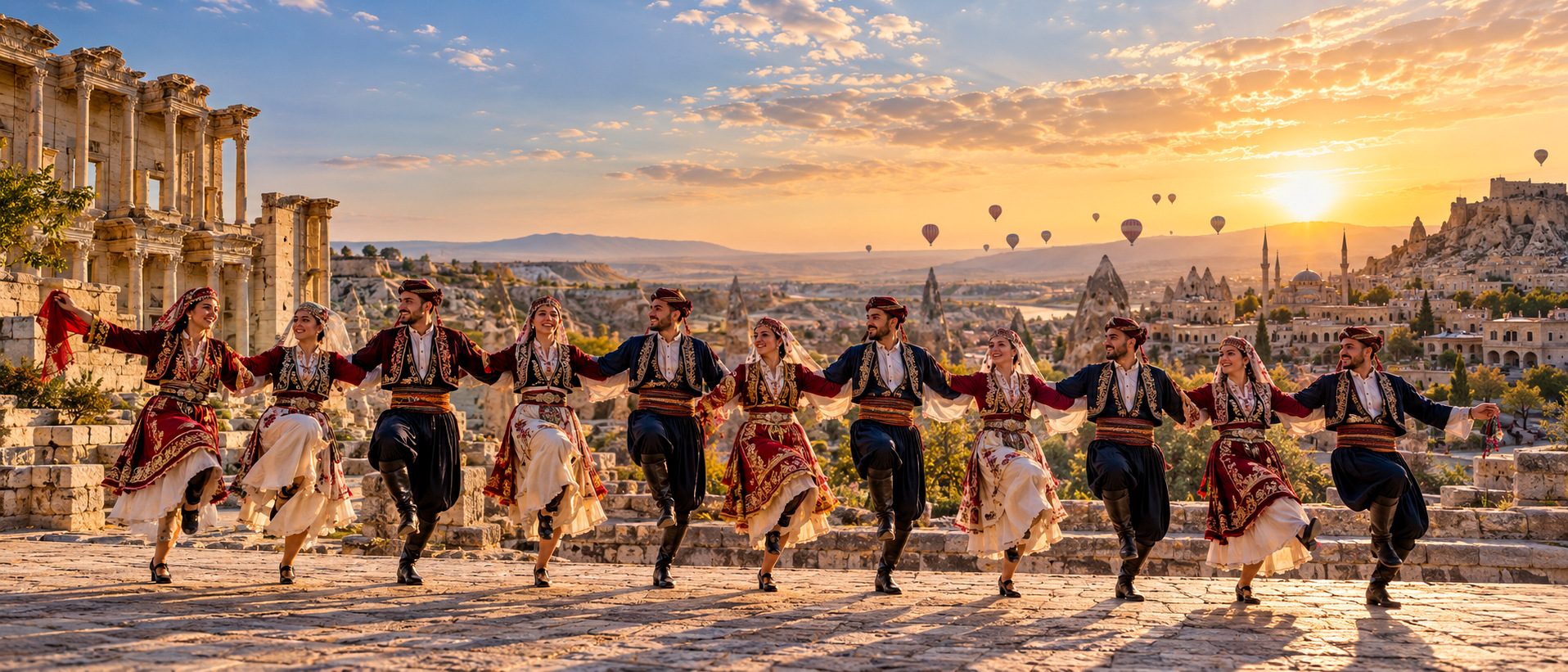
In Türkiye, a wedding line may grow into a Halay, a Black Sea circle may pulse to kemençe, and an Aegean Zeybek dancer may hold a long, dignified pause. Meet the regions and people behind these traditions, from village gatherings to today’s creative stages. The spiritual practices of Sema and Semah have their own sacred contexts.
Traditional dances
- Halay — Shoulder-to-shoulder steps, a leader’s handkerchief and the heartbeat of davul and zurna.
- Horon — Compact formations and quick steps carried by kemençe or tulum.
- Zeybek — Measured solo or group figures associated with Aegean efe culture.
- Bar Dances — Strong collective formations from Erzurum and surrounding areas.
- Karşılama — Expressive facing dances and playful interaction in Thrace.
- Kaşık Oyunları · Spoon Dances — Wooden-spoon rhythms accompany agile communal dancing.
- Hora · Thracian Circle Dances — Linked line and circle dances shared across Balkan communities.
- Kafkas Dances · Caucasian Traditions — Expressive footwork and proud posture from Caucasian-linked communities.
- Çiftetelli — Expressive social-dance styles heard at parties and celebrations.
- Mevlevi Sema Ceremony — UNESCO-listed Mevlevi ceremony; a spiritual practice, not a casual dance lesson.
- Semah · Alevi-Bektaşi Ritual — A sacred element of Cem worship, with distinct community traditions.
- Govend · Kurdish Community Dance — At weddings and Newroz celebrations, the line is more than choreography: people link hands, follow the lead dancer and move as one community. Govend is a broad Kurdish name for communal dancing, with many regional styles.
- Delîlo · Kurdish Govend Variant — Delîlo is recorded in Kurdish dance vocabularies also as Çargeh and Sêgavî in some settings. Community teachers preserve local patterns and tunes; its precise steps should be learned from the dancers of the locality, rather than one invented universal sequence.
- Çepik · Kurdish Folk Dance — Çepik appears in Kurdish-language dance registers across several provinces. The name is sometimes associated with hand or clap accents, but movements differ among communities; local demonstrations are essential to document any exact sequence.
- Şêxanî · Kurdish Line Dance — Şêxanî is a named Kurdish dance practiced in several Kurmanji-speaking communities and also known in neighboring cultural traditions. Field workshops describe distinct variants; its steps are not identical in every village or diaspora gathering.
- Koçerî · Kurdish Dance — Koçerî (also recorded as Dunigî in some vocabularies) belongs to the varied repertoire of Kurdish communal dances. Its local name and its precise pattern should be documented together with the city, musicians and teachers who perform it.
- Temir Axa · Kurdish Dance — Temir Axa, also written Temîlav in a Kurdish-language dance vocabulary, is associated with the Van–Doğubayazıt region. This DANZO entry records its name and regional context; any precise teaching sequence needs confirmation from a practitioner of that local tradition.
Explore
Places
Visit extraordinary places, and discover the communities behind the picture.