Tap a region to read its story
The History of Dance in Türkiye
Eight illustrated stories of music, people and memory
From a wedding in Anatolia to a Sema ceremony in Konya, every dance belongs to a community and a moment. Discover the people rather than a list of empty legends.
A country of many dance stories
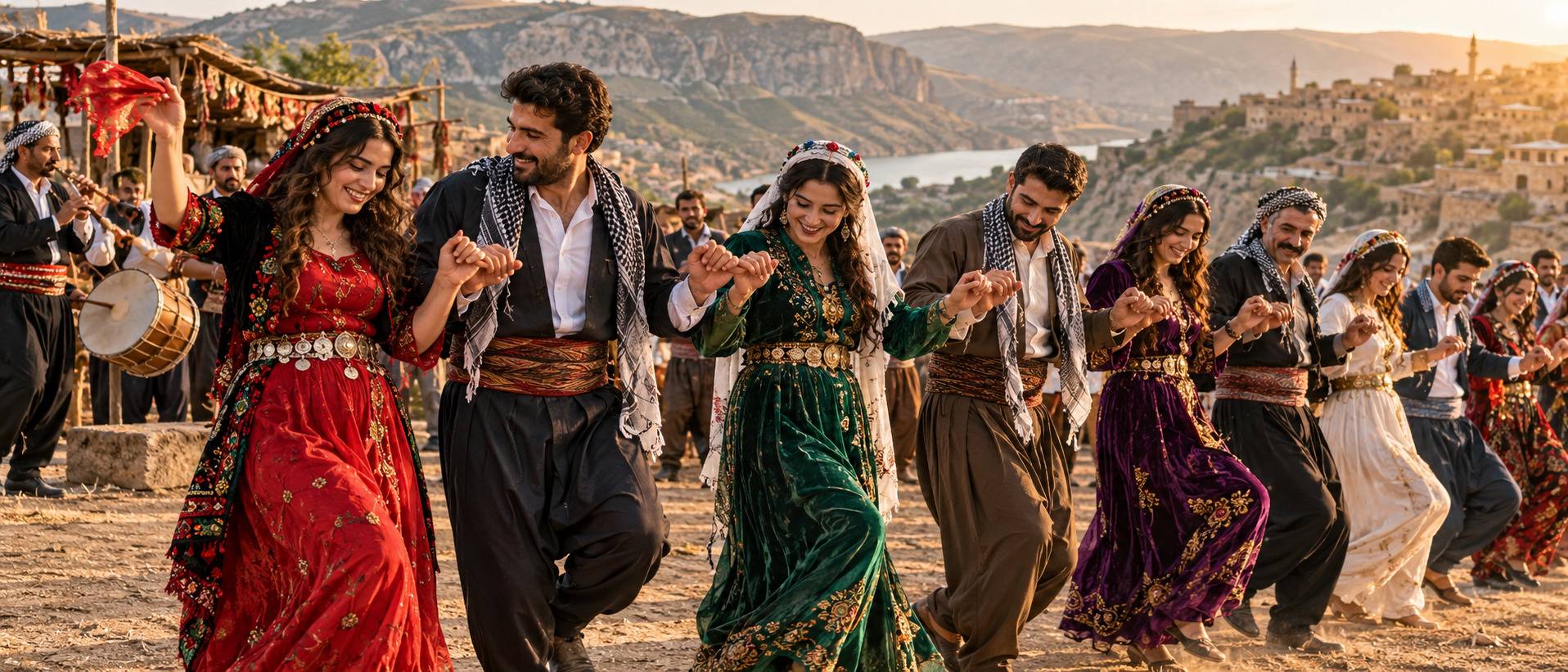
Imagine an evening wedding in Anatolia: chairs move aside, someone starts a line, and the musician sees immediately that more people want to join. Elsewhere, a slow Zeybek pose draws a small circle of attentive faces, and by the Black Sea the beat may quicken until an entire group moves like one. Türkiye cannot be described by a single national dance. Its traditions are local conversations between people, instruments and places.
Anatolia: shared places, different histories
For centuries, Anatolia has been a meeting place of languages, religions and migrations. The dances people practice today are not fossils from a single ancient moment. They have changed through village weddings, military and courtly fashions, trade routes, neighborhood life and modern stages. Every region deserves its own story, and many dance traditions are shared across present-day borders.
Weddings, celebrations and village gatherings
A musician may play the same melody differently depending on the guests, the hour and the place. At a wedding the line often welcomes many generations; an older relative can show a young dancer how to read the leader’s handkerchief. Such gatherings are not merely stages for dance—they are where relationships are renewed and regional knowledge passes naturally between people.
Kurdish Govend: a cultural identity of its own
Across Kurdish-speaking communities in eastern and southeastern Türkiye, dancers join hands at weddings, Newroz and neighborhood gatherings. Govend is not simply another label for Turkish dance: it belongs to Kurdish community life, language and music, with its own named variants such as Delîlo, Çepik and Şêxanî.
Dance names overlap across neighbouring cultures. DANZO uses the names each community gives its own dances, and links every tradition to the people who keep it alive.
Davul, zurna, kemençe and the voice of a region
Dance and music belong together. A powerful davul and piercing zurna can carry an outdoor Halay; in a Black Sea gathering the kemençe or tulum guides compact, rapid steps. The bağlama gives voice to many Anatolian songs and rituals. Türkiye’s musical measures include both familiar and uneven meters, yet the music makes more sense when heard as part of the community rather than reduced to numbers alone.
The Aegean language of courage and dignity
A Zeybek dancer may hold a pose before the next step, allowing the sound of the drum to settle. The tradition draws on memories of Aegean efe and zeybek communities and includes different tempos and local repertoires. From costume to gesture, the story is rooted in the region rather than in a generic idea of “ancient dance”.
Sema and Semah: two distinct living rituals
It is tempting to place all circular or turning movement in one category. That would erase important differences. The Mevlevi Sema ceremony associated with Konya involves a structured path of prayer and music. Alevi-Bektaşi Semah is practiced within the Cem and carries its own teachings and responsibilities. Both are listed by UNESCO, but neither should be presented as a casual dance challenge or stripped of the voices of its practitioners.
From community gatherings to modern stages
Stage choreographers often bring patterns from many Anatolian regions into one large production. That can be visually spectacular and help wider audiences discover dance, but a stage adaptation is not identical to how a family or village practices the tradition. To value both, ask performers to identify what has been adapted, whose heritage is represented and which local teachers contributed.
The next generation is already dancing
A young dancer practicing in a school hall and an elder teaching a wedding step are part of the same future. Federations, cultural groups, universities and local teachers help keep regional knowledge moving. DANZO welcomes schools and festival organizers who can offer accurate descriptions, credited images, real dates and respectful links to the people who continue these traditions.
Frequently asked questions
Is there one national folk dance of Türkiye?
No. Regional traditions differ widely. Halay, Horon, Zeybek, Bar and other dances developed in different communities and settings.
What is the difference between Sema and Semah?
Mevlevi Sema belongs to the Mevlevi spiritual tradition, while Alevi-Bektaşi Semah belongs to Alevi-Bektaşi religious practice. They should not be treated as interchangeable stage dances.
How are folk dances kept alive today?
Through weddings, family gatherings, community ensembles, teachers, conservatories and festivals. Local people remain central to transmitting these traditions.
Where can I explore each tradition further?
Open the individual dance profiles below and consult the linked cultural organizations and sources. Seek qualified local teachers for learning living traditions.
Sources
- Türkiye Ministry of Culture — regional group dances — Ministerio de Cultura — bailes regionales
- Türkiye Ministry of Culture — folk music and rhythm — Ministerio de Cultura — música y ritmos
- UNESCO — Mevlevi Sema — UNESCO — Sema mevleví
- UNESCO — Alevi-Bektaşi Semah — UNESCO — Semah aleví-bektashí
- Türkiye Folk Dance Federation — Federación Turca de Danzas Folclóricas
- Anadolu University — Folk Dance Ensemble — Universidad de Anadolu — grupo folclórico
- Fire of Anatolia — official — Fire of Anatolia — oficial
- Şeb-i Arûs 2026 — Ministry of Culture — Şeb-i Arûs 2026 — Ministerio de Cultura
Traditions through the year
Dance history in numbers
Timeline
Swipe the timeline
Which dance, where?
Questions & answers
Is there one national folk dance of Türkiye?
No. Regional traditions differ widely. Halay, Horon, Zeybek, Bar and other dances developed in different communities and settings.
What is the difference between Sema and Semah?
Mevlevi Sema belongs to the Mevlevi spiritual tradition, while Alevi-Bektaşi Semah belongs to Alevi-Bektaşi religious practice. They should not be treated as interchangeable stage dances.
How are folk dances kept alive today?
Through weddings, family gatherings, community ensembles, teachers, conservatories and festivals. Local people remain central to transmitting these traditions.
Where can I explore each tradition further?
Open the individual dance profiles below and consult the linked cultural organizations and sources. Seek qualified local teachers for learning living traditions.
Sources
- Türkiye Ministry of Culture — regional group dances
- Türkiye Ministry of Culture — folk music and rhythm
- UNESCO — Mevlevi Sema
- UNESCO — Alevi-Bektaşi Semah
- Türkiye Folk Dance Federation
- Anadolu University — Folk Dance Ensemble
- Fire of Anatolia — official
- Şeb-i Arûs 2026 — Ministry of Culture