
History
Kalamatianos
Peloponnese & wider Greece
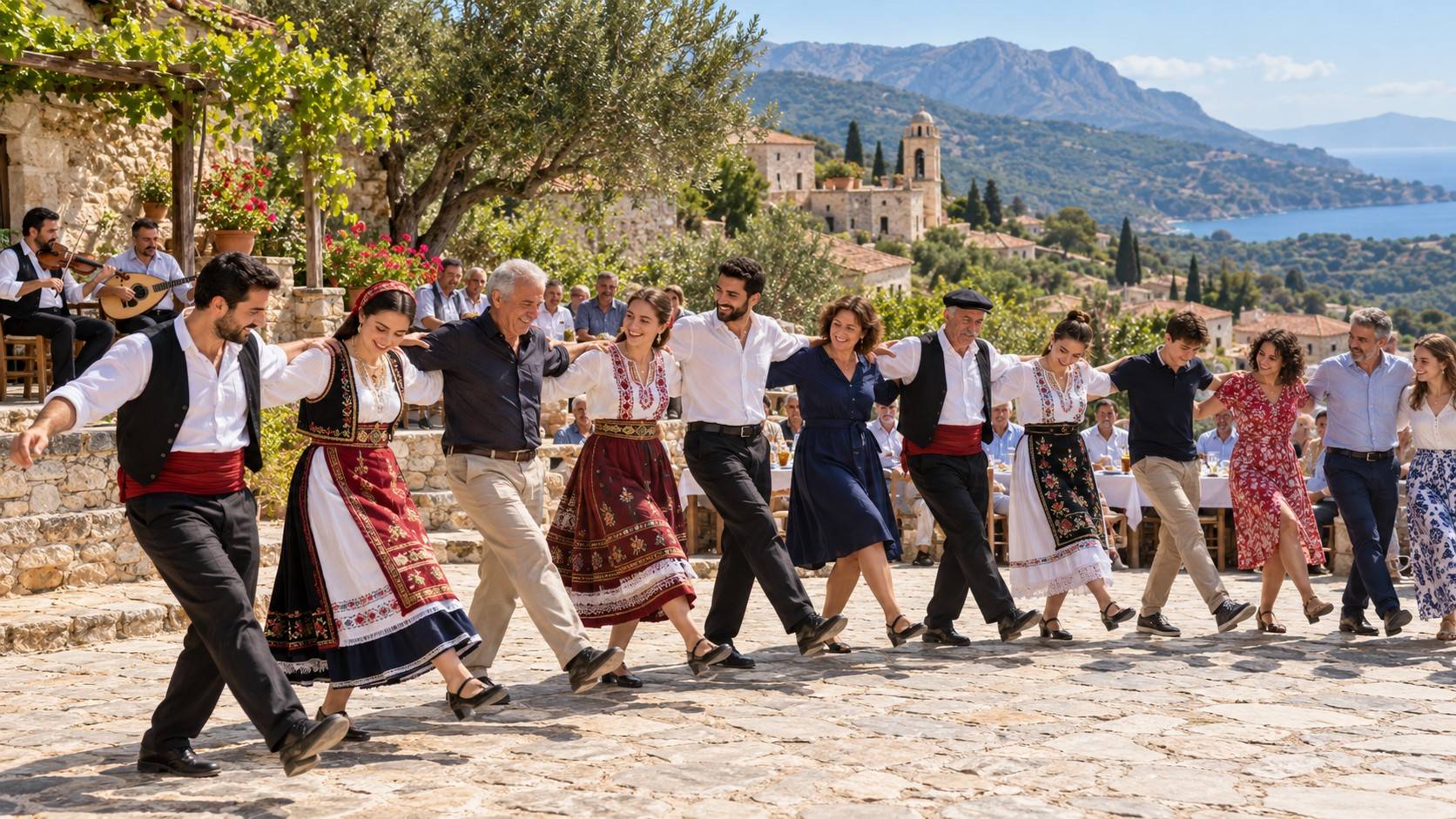
Welcoming seven-beat circle dance, shared across villages and families. Kalamatianos is among the best known Greek communal dances, widely taught and adapted in villages, diaspora gatherings and public celebrations. Its name is associated with Kalamata, but local performers use it across regions. Like other circle dances, it is a way of making room for a changing group of participants rather than presenting a fixed national costume or a single village version.
Why it matters
The dance emphasizes belonging, hospitality and shared time. Rather than asking whether every performance is “the original,” identify its musicians, locality, occasion and teaching lineage. Newcomers are often welcome at public festivities, but should follow local etiquette and ask before filming participants. Its social value lies in the changing group: newcomers can join beside experienced dancers, while a leader helps maintain the shared path.
Key facts
- Type: Open circle dance
- Origin: Kalamata, Peloponnese
- Rhythm: 7/8 (3+2+2)
- Music: Clarinet, violin, laouto, santouri
- Level: Easy · 12-step pattern
- Where: Weddings, festivals, national holidays
History timeline
- Older roots — Grows out of the syrtos family of Greek chain dances.
- 19th century — The name Kalamatianos, after the town of Kalamata, becomes widely used.
- 20th century — Taught in schools and danced at national celebrations across Greece.
- Today — Opens weddings and village feasts in Greece and the diaspora.
Did you know?
- The song “Mantili Kalamatiano” (“A handkerchief from Kalamata”) is one of the best-known tunes for this dance.
- The leader often waves a handkerchief and adds turns and leaps, while the rest of the line keeps the basic steps.
Performances to watch
- Kalamatianos – Live performances
Related dances
Why this dance?
How it's danced
Schools
Promote
Promote your classes on this page
Dancers