History
Syrtos
Mainland & Aegean islands
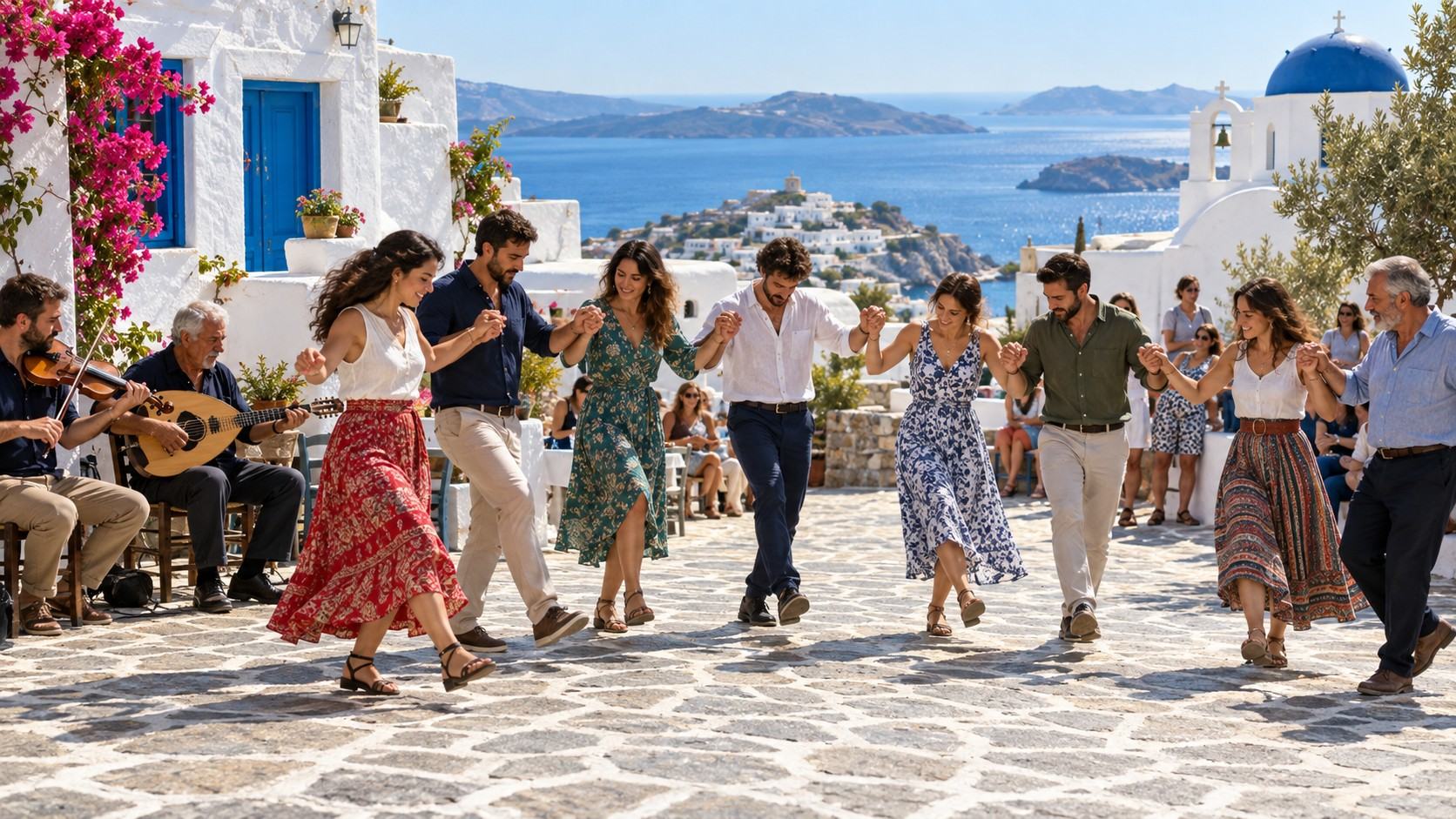
A diverse family of flowing circle and line dances, especially across the islands. Syrtos refers to a family of Greek dances rather than one choreography. The name evokes drawn or gliding steps, and many island and mainland communities have their own tunes and patterns. An island syrtos should be identified by its locality and musicians; the moving circle remains social, but its pace, handhold and movement quality can change markedly from place to place.
Why it matters
The connected line makes a visual image of community continuity and celebrates local differences within a broad dance family. Photographs should name the island or region and not present all whitewashed village festivals as interchangeable. A name does not guarantee a single melody or choreography: island musicians and dancers negotiate pace and style in the moment.
Key facts
- Type: Family of chain dances
- Origin: Mainland and Aegean islands
- Rhythm: Slow-quick-quick, often 2/4 or 4/4
- Music: Violin, laouto, clarinet; tsambouna on islands
- Level: Easy
- Where: Island festivals, weddings
History timeline
- The name — From the Greek verb syro, “to drag”: the feet glide along the ground.
- Islands — Each island develops its own tunes, from the Dodecanese to Crete’s Chaniotikos syrtos.
- 20th century — Recordings of island music (nisiotika) carry syrtos tunes across Greece.
- Today — Danced at nearly every Greek celebration, in Greece and abroad.
Did you know?
- Kalamatianos is often counted as a kind of syrtos and is sometimes called syrtos kalamatianos.
- In Crete, syrtos is often played on the Cretan lyra, a small three-string fiddle.
Performances to watch
- Syrtos – Live performances
Related dances
Why this dance?
How it's danced
Schools
Promote
Promote your classes on this page
Dancers