
What is the Moon Dance?
The Danza de la Luna (Moon Dance) is a prayer ceremony danced by women over four nights, on dates each circle chooses according to the cycle of the moon. Its dancers see it as the feminine counterpart of the Sun Dance, and it centres on the moon, the Earth and feminine strength. It is not a festival or a performance but a closed ceremony that asks for long preparation, guided by elder women known as abuelas, “grandmothers”.
How it began: Teotihuacán, 1992
According to its organisers, the first Moon Dance was held in 1992 by a small group of women on the slopes of Cerro Gordo, the mountain that rises behind the Pyramid of the Moon at Teotihuacán. It grew out of the Mexican ceremonial circles of the Camino Rojo (Red Road), which had begun to hold Sun Dances — a ceremony of the Lakota and other Plains nations. As the dancers tell it, Patricia Guerra, known as Totlalnantzin and partner of the Mexican ceremonial leader Tlakaélel, asked what this path offered women. The Moon Dance came to her in a vision, which she enriched with what she had learned from women of many nations.
Other circles tell the story differently. PachaMama, an eco-village in Costa Rica that hosts the ceremony, writes that the founding grandmothers revived a rite they found in pre-Columbian Mexica codices, which showed women dancing under the moon and praying with tobacco. No pre-Hispanic Moon Dance is documented by historians, so the clearest way to describe it is as a living ceremony of our time, inspired by Mexica and Lakota traditions.
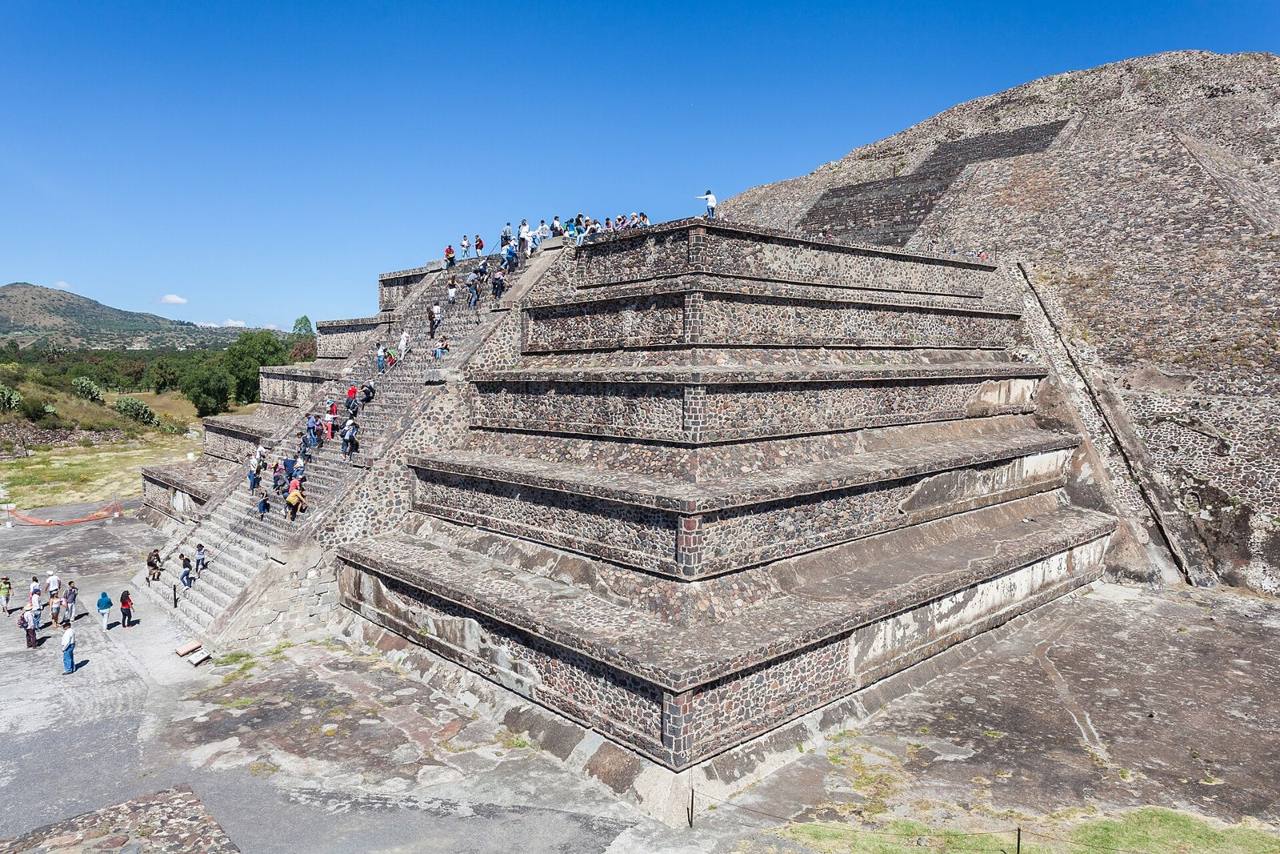
Why Teotihuacán? The moon in Mexica tradition
Teotihuacán, “the place where the gods were made”, is at the heart of the Mexica story of the Sun and the Moon. In the version recorded in the sixteenth century, the gods gathered there in darkness, and two of them leapt into a sacred fire: the humble Nanahuatzin rose as the Sun and the proud Tecciztécatl as the Moon. Dancing on the hill above the Pyramid of the Moon places the ceremony inside that story. In Nahuatl the moon is metztli, and several Moon Dance circles carry the word in their names.
Four nights under the moon
The ceremony lasts four nights. Dressed in long white garments, the dancers move in a circle through the darkness to the heartbeat of the huehuetl, the great ceremonial drum, in rounds of dance and song that each last an hour or more. They fast during the four nights. From the Casa de Cantos, the “house of songs”, singers raise songs in Nahuatl and Lakota to the Creator, the Moon, the Earth and the elements. At dawn the women leave the circle through its northern gate, one by one.
Before the ceremony, women prepare rezos: small bundles of tobacco wrapped in cloth, each holding a prayer, which are tied on strings around a nopal cactus at the centre of the ground. The temazcal, a steam bath heated with stones from the sacred fire, purifies the dancers. Many circles also pray with tobacco and copal, the resin incense of Mexico.
A circle of roles
Everyone has a task. Besides the dancers and singers there are copaleras, women who tend the copal incense; firekeepers, sometimes called the Fire Eagles, who keep the sacred fire alive and heat the temazcal stones; and kitchen and support teams who cook, carry water and gather wood. Men traditionally support the dance from outside the circle: they keep the fire, prepare the sweat lodges and serve tea and hot chocolate. Taking part is not casual — circles ask for a year or more of service and preparation before a woman may enter as a dancer.
Circles across the Americas and beyond
From Teotihuacán, the Moon Dance spread. In Mexico, the circle at Cerro Gordo has been guided for nearly two decades by Abuela Ana Lucía Chinas, while Abuela Tonalmitl (Guadalupe Retíz) leads the Xochimetztli circle, which many regard as a mother circle. Abuela Malinali has led Moon Dances in Mexico, Costa Rica and Colombia, and circles now gather in Central and South America, the United States and Europe. Some communities have created their own forms: at PachaMama in Costa Rica, men were invited into the circle and the ceremony became a “Dual Dance” of men and women.
A prayer, not a show
The Moon Dance is a closed prayer, not a performance, retreat or festival. Do not photograph or film it, and do not go to a ceremonial ground unless you have been invited. Women who feel called to dance should approach a circle directly and accept the preparation it asks for; others can offer help as supporters. Some Lakota leaders object to the Sun Dance being held outside their nations, and the Moon Dance belongs to the same family of ceremonies — one more reason to approach it with humility.
Frequently asked questions
What is the Danza de la Luna?
A four-night prayer ceremony danced by women in a circle, with fasting, songs, a sacred fire and the temazcal, guided by elder women called abuelas.
Is the Moon Dance an ancient Aztec ceremony?
Not as far as history shows. According to its organisers, the first Moon Dance was held in 1992 at Teotihuacán. It draws on Mexica symbols and on the Lakota-inspired ceremonies of the Camino Rojo, and it is a living tradition of today.
Can men take part?
In most circles men support the dance from outside: they keep the fire, prepare the temazcal and serve the dancers. A few communities, such as PachaMama in Costa Rica, hold a “Dual Dance” in which men also dance.
Can I watch or photograph it?
No. The Moon Dance is not public: people attend by invitation, and photography is not allowed during the ceremony.
Explore more on DANZO
Sources
- Tracy L. Barnett, “Four Nights, One Vision: How the Moon Dance Transforms Women at Teotihuacán”, The Esperanza Project (2025)
- Tracy L. Barnett, “Moon Dance: Healing the Mother Wound”, The Esperanza Project (2025)
- PachaMama (Costa Rica), “Moon Dance: A Mystical and Ancient Gathering” (2017)
- PachaMama, Dual Dance with Abuela Malinali and Abuela Ana Itzpapalotl
- Siddharta Carrillo, on the Mexica myth of the creation of the Moon (Tecciztécatl), INAH — Redalyc