
What healing dances have in common
Across very different cultures, researchers see the same elements again and again: an illness understood as a disturbance — often a spirit, a “wind” or a broken relationship; a specialist who diagnoses and leads; powerful rhythm, usually drums, played for many hours; dance that may lead to trance; and the support of the whole community. Healing is social as much as physical: the patient is surrounded, seen and brought back into the group.
1. Guati — Baluchistan, Iran and Pakistan
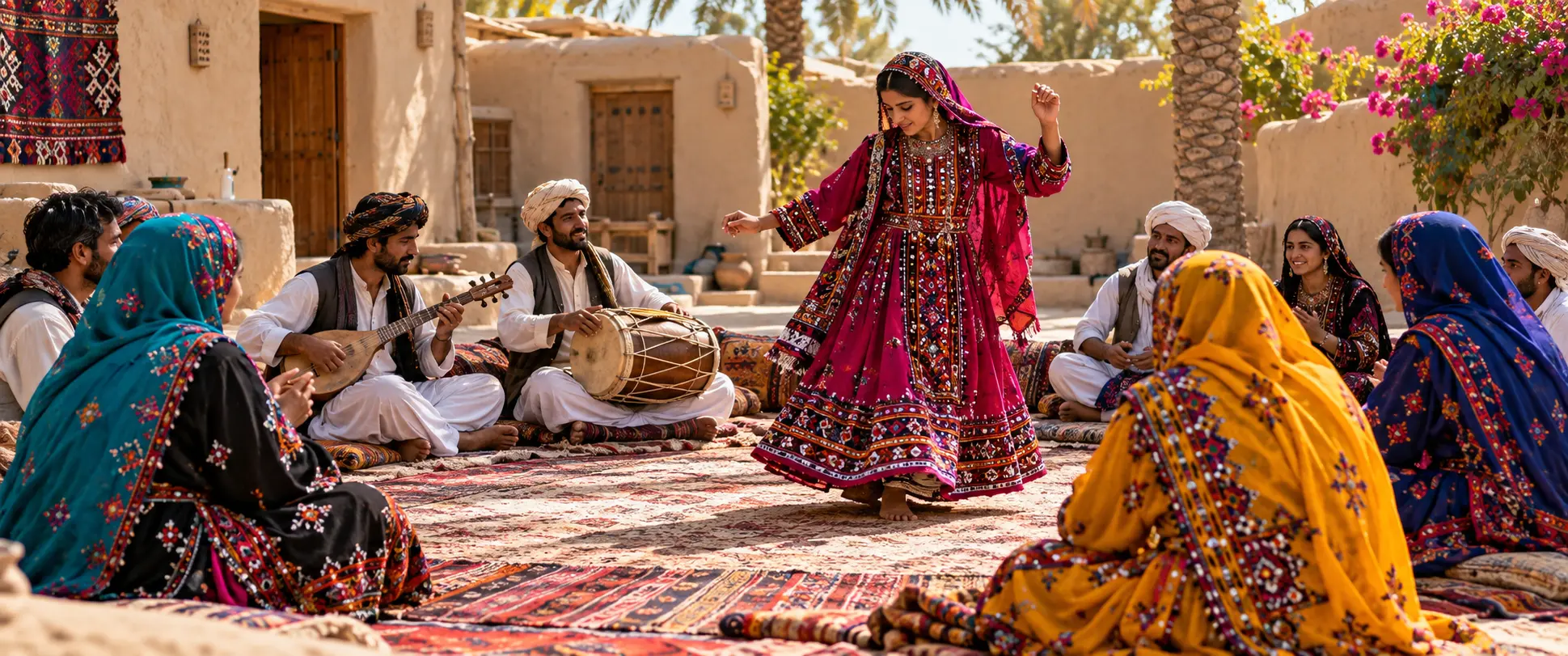
Guati (gwātī) means “windy”: it names both an illness believed to be caused by a spirit called gwāt and the ceremony that cures it. A healer known as the gwātī-e māt (“mother of guati”) diagnoses the spirit and chooses the music. Over three, seven or even fourteen nights, the sorud fiddle and the double flute play while the patient dances the damāl, a whirling dance close to that of the dervishes, until trance drives the spirit out. The ceremony ends with a sacrifice.
2. Zar — the Persian Gulf coast of Iran
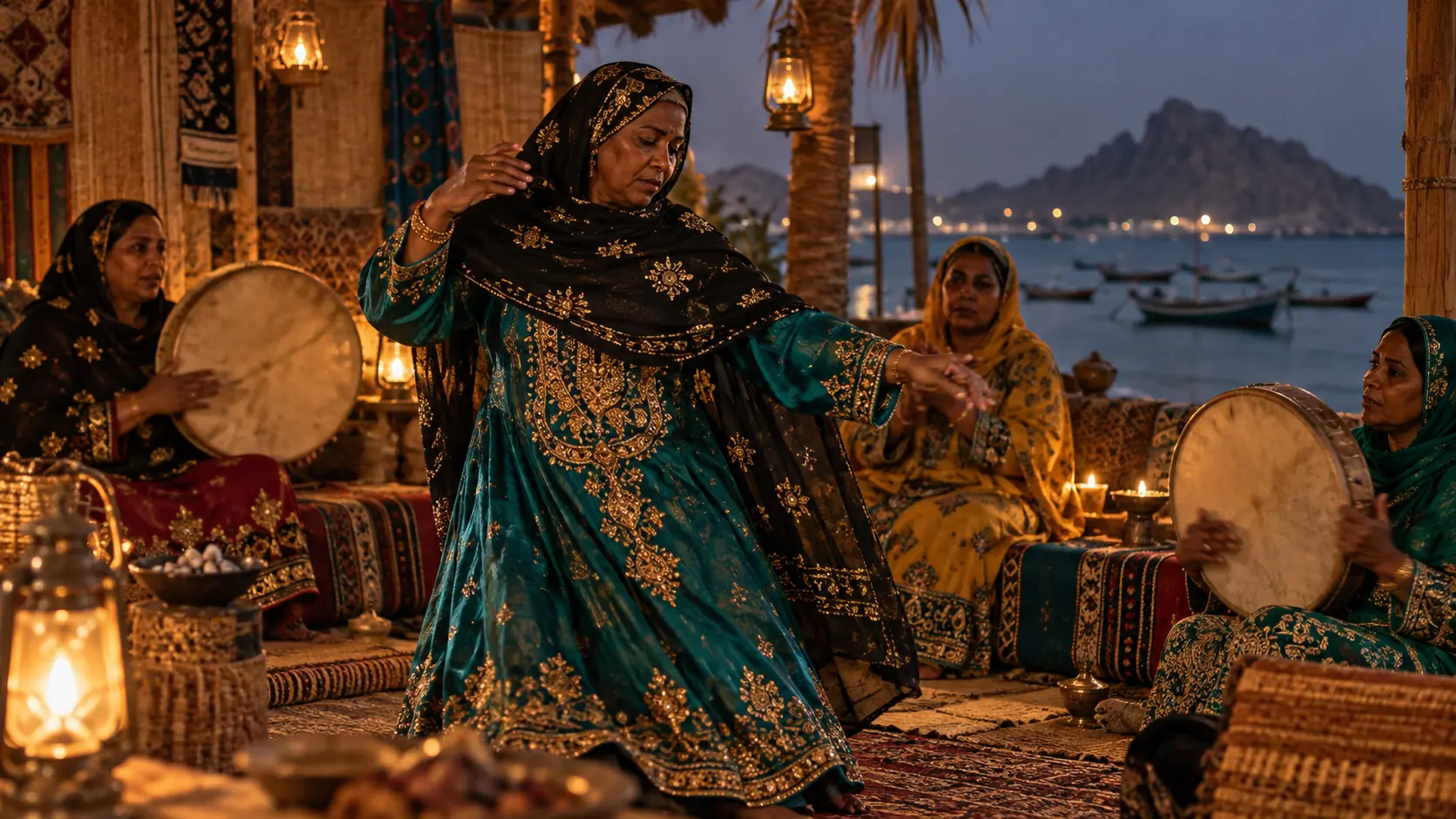
On the coasts and islands of Hormozgan, such as Qeshm and Bandar Abbas, people believe some illnesses are caused by “winds” (bād) that enter the body. Healers called baba and mama lead ceremonies of intense drumming, chanting and dance, with a sacrifice, to calm the wind. Those who have been healed join the community of ahl-e havā, “people of the wind”. Researchers trace zar to East Africa, from where it spread across the Red Sea, Arabia and the Indian Ocean.
3. Kilumi — the Akamba of Kenya
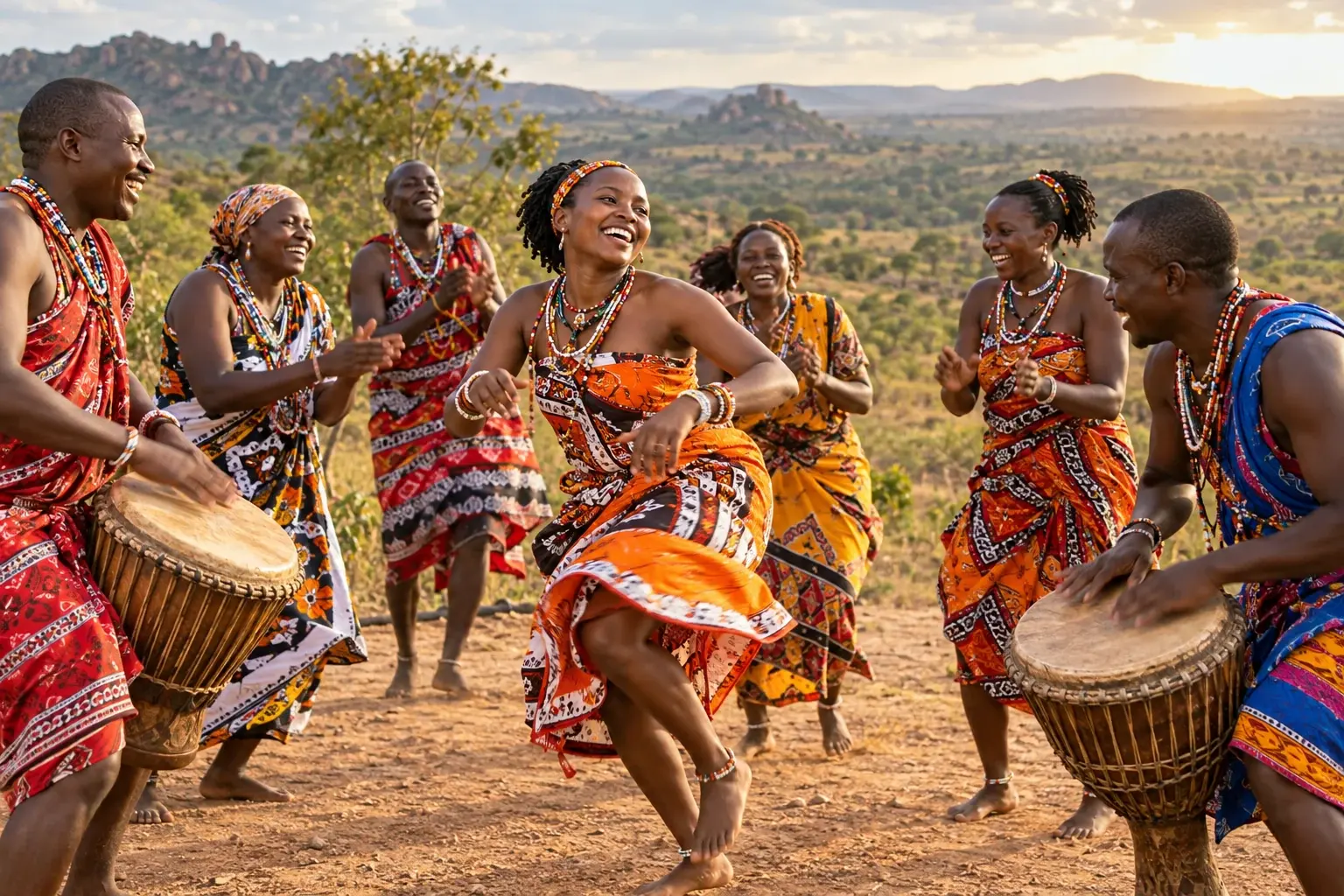
Kilumi is a drum dance of the Akamba people rooted in healing, ritual and community. Elders danced it with sacrifices to Ngai, the creator, before the rains and at harvest thanksgiving. Drums are tuned by warming their skins near a fire, and dancers may enter trance and then be “calmed back to themselves”. Endangered for decades, Kilumi is now revived by a yearly festival organised by the Akamba Cultural Centre.
4. The San healing dance — Kalahari
Among the San (Ju/’hoansi) of Botswana and Namibia, women sit around the fire singing and clapping while healers dance for hours until a healing energy called n/om “boils” up the spine and they enter trance (!kia). In this state they lay their hands on everyone present to draw sickness out. The psychologist Richard Katz described it in Boiling Energy (1982), and archaeologists see scenes of this trance dance in San rock art.
5. Sanni Yakuma — Sri Lanka’s 18 masks of disease
Sanni Yakuma is a Sinhalese ritual of eighteen masked dances, each mask representing a demon linked to an illness — fevers, deafness, blindness, paralysis or madness. Led by a specialist called the yakadura, it lasts from dusk to dawn: the demons appear one by one, frightening at first, then mocked in comic scenes until they promise to leave the patient. It is best preserved on the south-west coast, today often performed as a cultural show.
6. Tarantism — the spider-bite dance of southern Italy
In Apulia, especially the Salento peninsula, people believed the bite of the tarantula caused a crisis of melancholy and agitation that could only be cured by dancing for days to the fast music of the pizzica. Many of those “bitten” were women, and the cure was linked to Saint Paul’s chapel in Galatina. The anthropologist Ernesto de Martino studied it in La terra del rimorso (1961); today the pizzica lives on as a joyful festival dance.
7. The Navajo Nightway — USA
Among the Diné (Navajo), healing is the work of long ceremonies that restore hózhó — harmony and beauty. The Nightway is a nine-night winter ceremony with prayers, chants and sandpaintings, ending with the Yeibichai dance of masked dancers who represent the Holy People. Washington Matthews documented it in The Night Chant (1902). It remains a sacred ceremony, and its private parts are not for outside audiences.
8. Ngoma — “drumming” as healing in Central and Southern Africa
In many Bantu languages ngoma means drum, and it also names a whole way of healing: groups of sufferers and healers who meet to sing, drum and dance, turning affliction into a calling — those who are healed often become healers. The anthropologist John Janzen compared these traditions across the region in Ngoma: Discourses of Healing in Central and Southern Africa (1992).
9. Gnawa lila — Morocco
The Gnawa, whose ancestors came from sub-Saharan Africa, hold an all-night ceremony called the lila. A master musician (maâlem) plays the three-string guembri while iron castanets (qraqeb) keep the rhythm; each spirit has its own colour, incense and songs, and participants may dance into trance for healing and spiritual balance. Gnawa was added to UNESCO’s Intangible Heritage list in 2019.
10. Bori — the Hausa of Niger and Nigeria
Bori is the spirit-possession tradition of the Hausa, older than Islam in the region. Adepts, many of them women, dance to the music of the goge fiddle and calabash drums until a spirit “mounts” them; the ceremonies are used to diagnose and treat illness and misfortune and to keep good relations with the spirits.
11. Gut — Korean shamanic ritual
In Korea, a shaman (mudang) performs the gut, a ritual of songs, dances, costumes and offerings, to heal illness, bring fortune or guide the souls of the dead. Spinning, jumping and drumming help the shaman communicate with the spirits. Korean shamanic rituals are still practised; the Jeju Chilmeoridang Yeongdeunggut, a sea ritual of Jeju Island, was inscribed by UNESCO in 2009.
12. Theyyam — northern Kerala, India
In the villages of northern Kerala, Theyyam dancers in towering headdresses and painted faces are believed to become the deity they represent. During the performance, devotees come forward to receive blessings and ask for help with their troubles, including illness, so the dance is both worship and a source of protection and healing for the community.
A note on respect and health
These are living, often sacred traditions. DANZO describes what communities believe and what researchers have recorded; we do not make medical claims, and these rituals are not a replacement for medical care. Some ceremonies are private — please follow the guidance of the community and never film or join without permission.
Frequently asked questions
What is a healing dance?
A traditional dance performed to treat illness or misfortune, usually led by a specialist, with long drumming or music, community participation and often trance.
Are there healing dances in Iran?
Yes. Guati in Baluchistan and Zar on the Persian Gulf coast are healing ceremonies with music, dance and trance that are still remembered and sometimes performed.
Do healing dances really heal?
Communities experience them as healing, and studies show that rhythm, movement and social support can reduce stress and improve wellbeing. They are not a substitute for medical treatment.
Explore more on DANZO
Sources
- Encyclopaedia Iranica — Baluchistan iv. Music of Baluchistan
- The Comparative Study of Zār Ceremony in Iran and Sudan (University of Tehran)
- Jean During, African Winds and Muslim Djinns: Trance, Healing and Devotion in Baluchistan (Yearbook for Traditional Music, 1997)
- Kilumi, the dance saving a fading tradition among the Akamba (Citizen Digital)
- Sanni Yakuma (Wikipedia)
- UNESCO — Jeju Chilmeoridang Yeongdeunggut (2009)
- UNESCO — Gnawa (2019)
- Richard Katz, Boiling Energy: Community Healing among the Kalahari Kung (Harvard University Press, 1982)
- John M. Janzen, Ngoma: Discourses of Healing in Central and Southern Africa (University of California Press, 1992)