
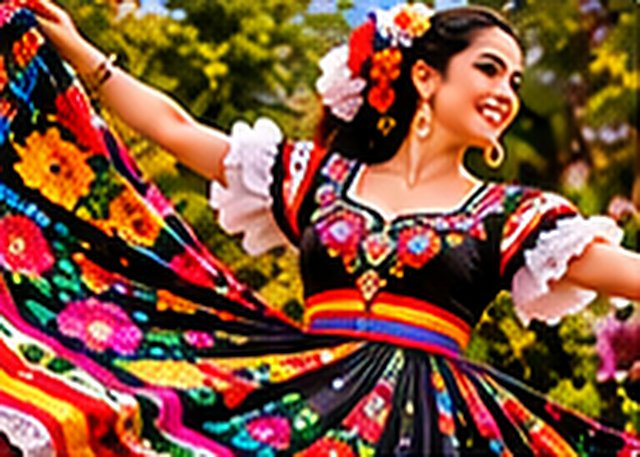
Jalisco: the Jarabe Tapatío
Women wear a wide, one-piece ranchera dress in bright colours decorated with rows of ribbons (listones) and lace, with braids tied with ribbons; the skirt is held and swirled during the dance. Men wear the charro suit: a short jacket and fitted trousers with silver buttons (botonadura), a bow tie (moño) and a wide sombrero. It is the costume of Mexico’s national dance and of mariachi.
Veracruz: the jarocho costume
For son jarocho and La Bamba, women wear a white dress with lace and ruffles, a small black velvet apron embroidered with flowers, a lace shawl or rebozo, a fan and flowers and a comb in the hair. Men wear white: a guayabera shirt, trousers, a red bandana (paliacate) at the neck and a straw hat. The white costume shines while the dancers stamp on the wooden tarima.
Oaxaca: the Tehuana and the Guelaguetza
Oaxaca has many costumes, shown each July at the Guelaguetza festival. The most famous is the Tehuana dress of the Isthmus of Tehuantepec: a short velvet huipil (blouse) richly embroidered with large flowers, a long skirt (enagua) with a white lace ruffle, and sometimes a lace headdress called resplandor. In the Flor de Piña dance from Tuxtepec, women wear colourful huipiles and carry a pineapple on the shoulder.
Chiapas: the Chiapaneca dress
The Chiapaneca dress from Chiapa de Corzo has a black blouse and a wide skirt of tulle embroidered with bright flowers in many colours. In the Fiesta Grande de Enero, the Parachicos dancers wear carved wooden masks, ixtle (fibre) headdresses and colourful shawls; this festival is on UNESCO’s Intangible Heritage list.
Yucatán: the terno and the jarana
For the jarana, women wear the terno: a white hipil with a lace-edged under-skirt, embroidered with cross-stitch flowers, a rebozo, gold jewellery and flowers in the hair. Men wear white trousers, a white guayabera or filipina, a red bandana and a jipi hat. The light, white clothing suits the hot climate of the peninsula.
Nuevo León and the north: norteño style
For the polka norteña and redova, women wear a full skirt and blouse, often in checked fabric or suede with fringes, and short boots. Men wear jeans, a checked shirt or a suede jacket, boots and a cowboy-style hat. The costume reflects ranch life and the European polka that arrived in northern Mexico in the 19th century.
Michoacán, Puebla and Sonora
In Michoacán, the Danza de los Viejitos uses smiling masks of old men, straw hats with long ribbons, white clothes, a serape and a wooden cane. Puebla is linked to the china poblana: an embroidered white blouse and a skirt (castor) decorated with sequins, worn with a rebozo. In Sonora, the Yaqui deer dancer (Danza del Venado) wears a deer head on the forehead and rattles made of cocoons around the legs.
Glossary of costume pieces
Rebozo — long shawl. Huipil — embroidered blouse or tunic. Enagua — skirt or under-skirt. Listones — ribbons. Botonadura — row of silver buttons on the charro suit. Paliacate — bandana. Guayabera — light pleated shirt. Tarima — wooden platform for stamping.
Frequently asked questions
What do folklórico dancers wear?
Each region has its own costume: the ranchera dress and charro suit of Jalisco, the white jarocho costume of Veracruz, the Tehuana dress of Oaxaca, the Chiapaneca dress and the terno of Yucatán are the best known.
Why are folklórico skirts so wide?
Dancers hold and swirl the skirt to draw shapes that are part of the choreography, like waves or wings.