
Can we date the oldest dance?
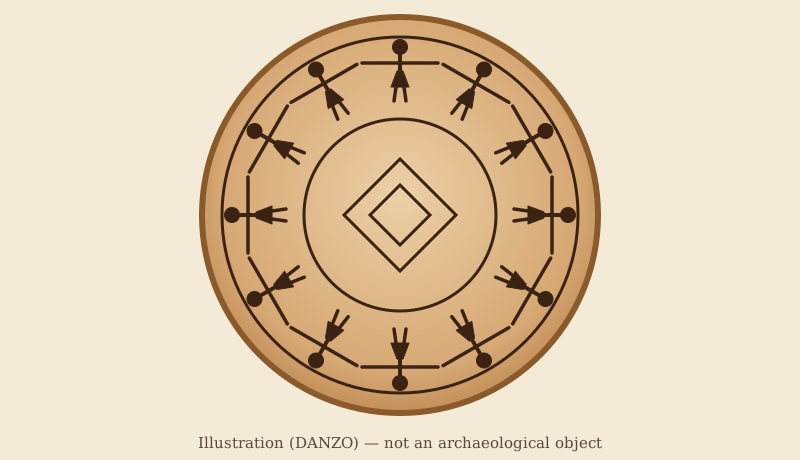
Dance leaves no bones and no ruins, so no one can measure the age of a dance directly. Archaeologists study its traces instead: images of dancers painted on pottery, carved on rock or modelled as figurines. The archaeologist Yosef Garfinkel collected hundreds of such dance scenes from the Near East and south-eastern Europe in his book Dancing at the Dawn of Agriculture (2003), showing that dancing in rows and circles was a central activity of the first farming villages, roughly 9,000 to 6,000 years ago.
The evidence from the Zagros: dancers on painted pottery
Some of the clearest early dance images come from the Iranian plateau and the Zagros. Painted bowls and jars from prehistoric sites such as Tepe Sialk near Kashan, Cheshmeh Ali near Tehran, Tepe Musiyan and Chogha Mish on the south-western edge of the mountains, and Tepe Giyan near Nahavand — in the historical land of Luristan — show stylised human figures in rows or circles, often holding hands. These painted wares date mostly to the 5th millennium BCE, about 7,000 to 6,000 years ago; in the neighbouring lowlands of Mesopotamia, bowls of the Samarra culture already show circles of dancers around 6000–5500 BCE, about 7,500 years ago.
People lived in these valleys even earlier: Neolithic villages of the central Zagros, such as Ganj Dareh near Kermanshah, go back to around 8000 BCE. The mountains of Lorestan are therefore one of the places where the story of settled human communities — and of dancing together — can be followed over the longest time.
From the Bronze Age to the Luristan bronzes
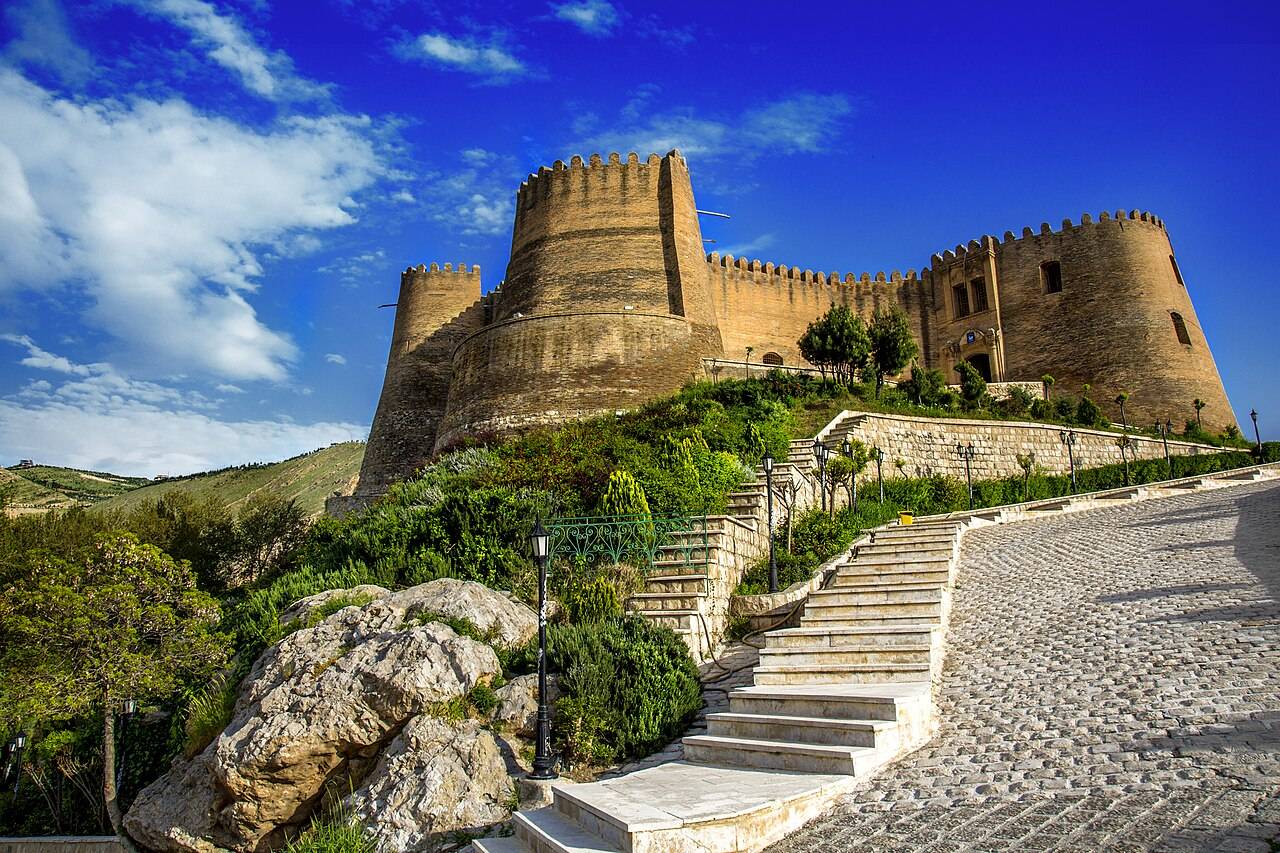
Later cultures of the region kept music and procession at the centre of ritual life. Elamite rock reliefs at Kul-e Farah near Izeh show ceremonial processions with musicians, and the famous Luristan bronzes (about 1000–650 BCE) testify to a rich mountain culture of horses, feasts and ritual. The written record of the Lurs themselves appears much later, in the Islamic period, but the mountains, the herding life and the communal celebrations remained.
The living dance: Chupi and the Luri tradition
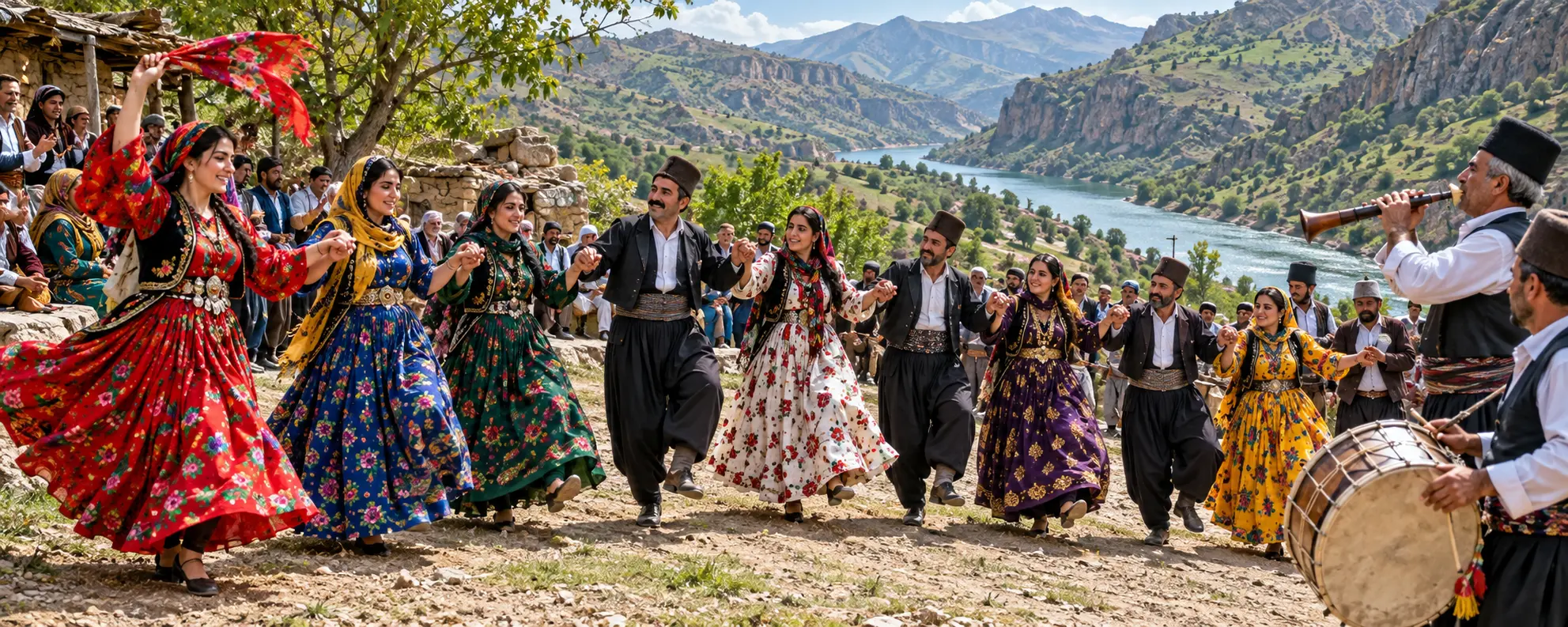
Chupi (also written chopi) is a chain or circle dance led by a leader, the sarchupi, who waves a scarf (dasmal) while the line keeps the shared pulse with linked hands or arms. It moves through changes of energy known by names such as sangin-sama (the heavy, slow dance), se-pa (three steps) and do-pa (two steps, faster), accompanied by the sorna (a loud double-reed pipe) and the dohol (a large double-headed drum). It is danced at weddings, harvests and family celebrations, and anyone can join the line.
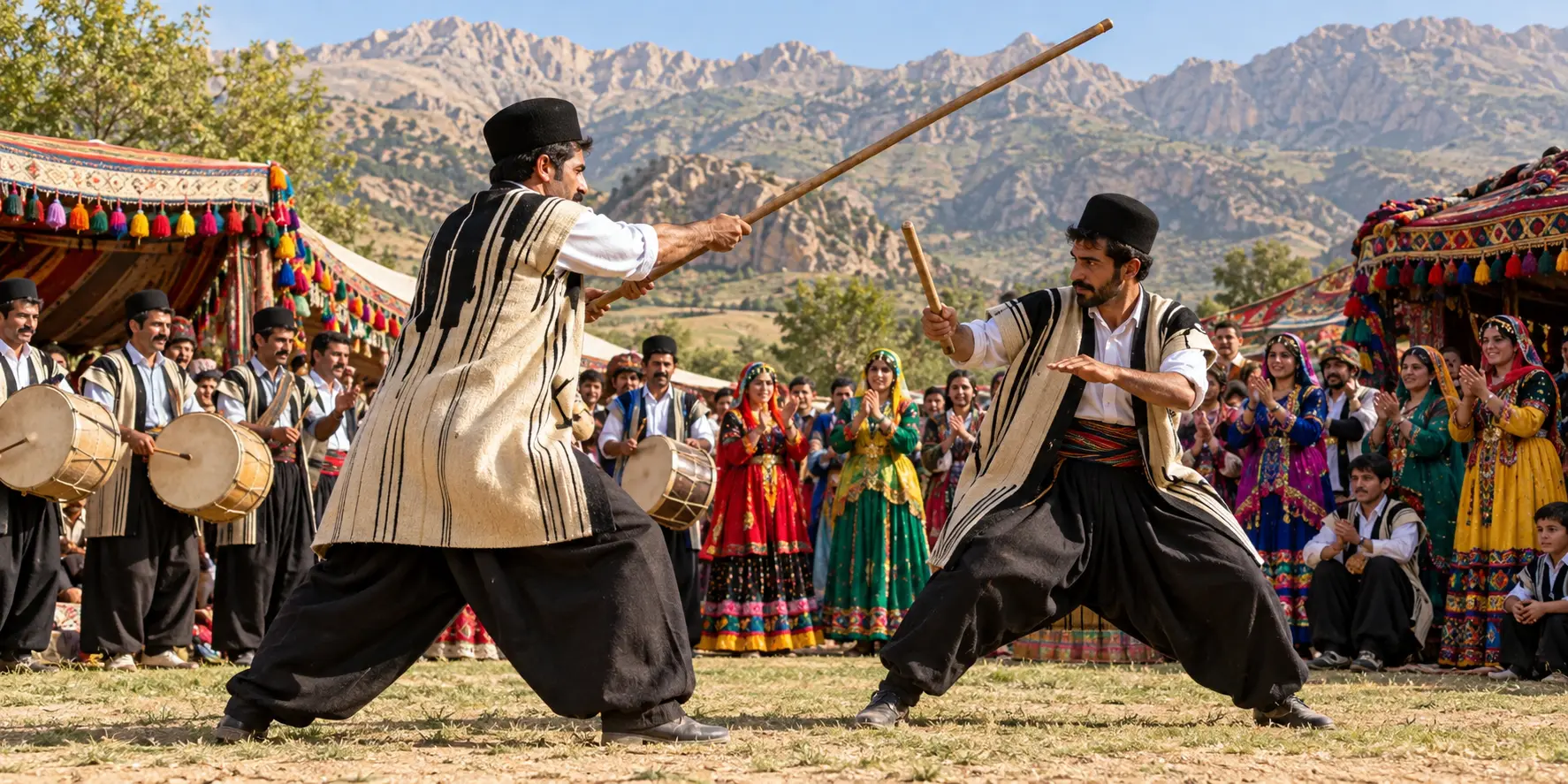
The Luri tradition also includes choob-bazi, a stick dance in which two men duel with a heavy stick and a light switch (tarka), showing skill and bravery; dasmal-bazi, the scarf dance shared with Bakhtiari communities; and chamari, which belongs to mourning and memorial ceremonies. Chamari expresses grief and solidarity and must never be presented as a festive dance.
Is Luri dance the oldest dance in the world?
The honest scientific answer has two parts. First, the form of Chupi — a chain of people holding hands and moving together in a circle or line — is the same form painted on pottery in the Zagros and Mesopotamia 6,000 to 7,500 years ago, and Lorestan lies at the heart of the region where these images were found. In that sense, Luri dance belongs to one of the oldest documented dance forms of humanity, and it is still alive in the same mountains.
Second, images alone cannot prove an unbroken line from a painted bowl to a modern wedding, and circle and chain dances also live on among Kurdish, Armenian, Assyrian, Greek and Balkan communities. What we can say with confidence is that Luri dance is one of the oldest living dance traditions in the world, rooted in a landscape where people have danced together for thousands of years. Future research — oral histories with elders and musicians, ethnomusicology and new archaeological finds — can tell us even more.
Frequently asked questions
How old is Luri dance?
The circle and chain form it belongs to appears on painted pottery of the Zagros and Mesopotamia about 6,000 to 7,500 years ago. The named Lur dances, such as Chupi, are documented in recent centuries and are still danced today.
What is the oldest dance in the world?
No single dance can be proven to be the oldest. The earliest clear images of people dancing together, mostly in rows and circles, come from the first farming villages of the Near East, including the Zagros region where Luri dance lives today.
What instruments accompany Luri dance?
Mainly the sorna (a double-reed pipe) and the dohol (a large drum); the kamancheh and tombak are also used in Lur music.