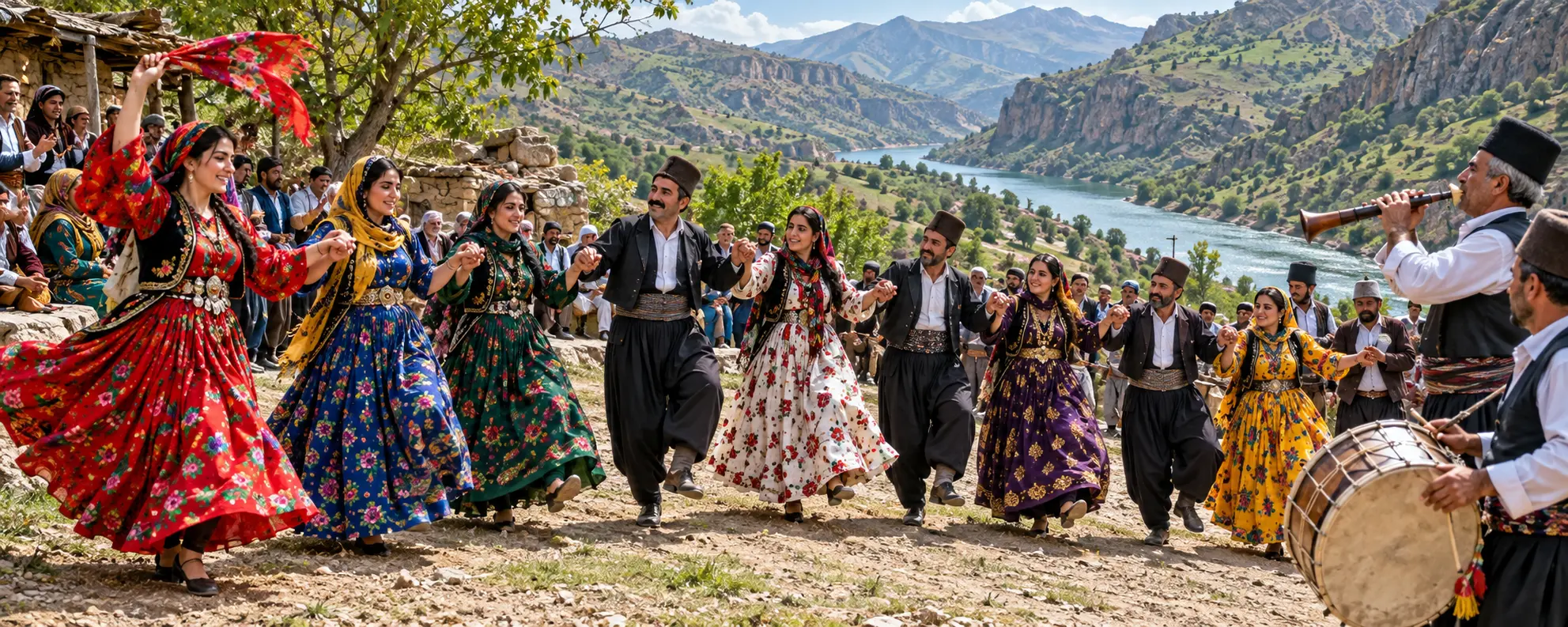
Dance may accompany weddings and gatherings; separate local mourning practices such as chamari must be documented in their own ritual context, never reduced to festive choreography.
Sangin-samâ, se-pâ and do-pâ can mark changing energy in Chupi; Chamari mourning must not be confused with wedding dance. Among Lur communities of the Zagros, a connected line can hold more than dancers: it holds the memory of families, mountain journeys and generations gathering under the sound of sorna and dohol. Chupi is a living social form, carried through weddings and celebrations by people who know each other. Names such as do-pâ, se-pâ and sangin-samâ point to differences of rhythm and stepping that must be checked with the specific Lur or Laki locality. The person at the front may display agility and carry a cloth while the rest of the line keeps the collective pulse. Skill is not only a spectacular leap: it is knowing how tightly to hold, how to yield space, how to listen for a musical change and how to welcome a newcomer into the chain. One troupe’s matching costumes are a stage choice, not an obligation for every Lurish gathering. In parts of Lorestan and neighbouring Zagros communities, Chamari belongs instead to mourning. Its music and collective bearing respond to loss and solidarity. It cannot responsibly be illustrated with a joyful Chupi image and captioned as the same dance. The distinction between celebrating together and standing together in grief reveals why movement is cultural history, not merely entertainment. The video selected by DANZO’s Lurish founder is offered as one visible encounter with this heritage, not as the final authority on all Lur communities. The deepest archive includes the voices of musicians, elders, women and younger dancers explaining when, why and how their own families move.