
Tap a region to read its story
The History of Dance in Japan
Ritual, remembrance, theatre, community and invention
Japan’s dance heritage does not begin or end with one festival. Read nine illustrated chapters, from Obon communities and shrine performance to regional, Indigenous, classical and experimental arts.
Many dance histories in one archipelago
Original editorial illustration · not an archival photograph
Japan’s islands hold many different communities and performing traditions. Festival circles, ancient shrine arts, classical narrative movement and new experimental choreography do not share one origin. The Ainu of Hokkaidō and people of the Ryūkyū Islands preserve histories that must be described in their own voices.
This atlas follows concrete dance communities, seasons and sources. A photograph of a costume cannot by itself prove which ritual or dance is represented; each entry should connect movement with identifiable people, place and purpose.
Bon Odori: shared remembrance
Original editorial illustration · not an archival photograph
Bon Odori is not a single choreography. During Obon, communities remember ancestors and gather around music and dance. Many summer gatherings form circles around a raised yagura platform, yet the melody, tempo, lyrics and sequence of gestures differ across towns. The practice belongs to participating families and local associations, not to a universal tourist routine.
Dance here makes remembrance visible through shared movement. Visitors may be invited into an open public circle, but should ask before recording people or joining a more intimate ceremony. Respect the local meaning of Obon, do not assume that every region has the same steps, and credit the community if a video is later used for teaching.
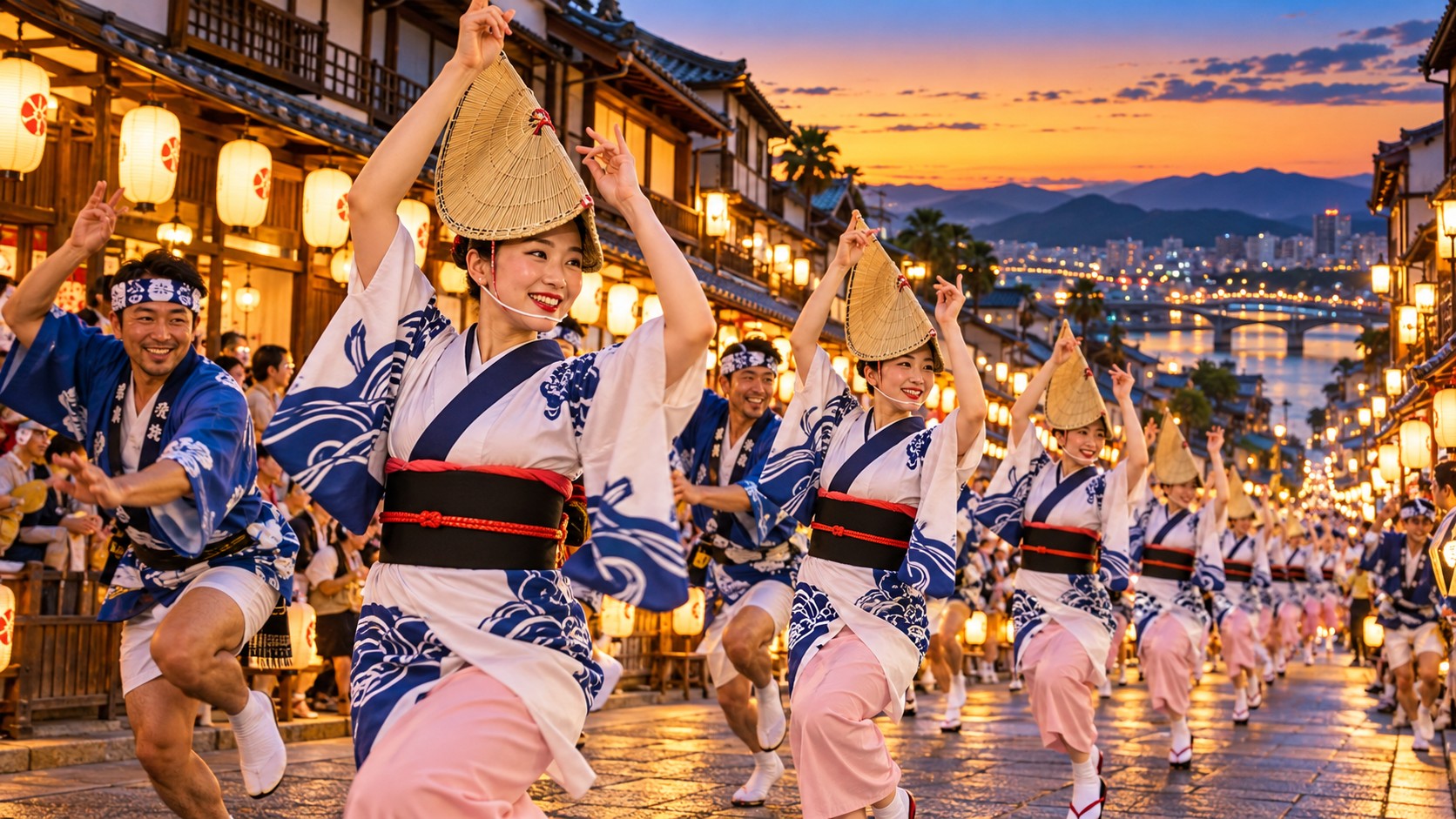
Street dances: Tokushima and Kōchi
Original editorial illustration · not an archival photograph
Awa Odori is closely associated with the city of Tokushima and the former Awa region of Shikoku. Its exuberant summer parades have grown over centuries; several origin stories circulate, including links with Bon dancing and other folk performance. Dancing troupes called ren maintain their own artistic styles, rehearsal cultures and music, and their identities deserve individual credit.
Yosakoi developed as a modern festival-dance movement in Kōchi and spread to cities across Japan. It combines regional folk references with inventive music, choreography and team identities rather than claiming to preserve one unchanging ancient step sequence. Sapporo’s Yosakoi Sōran Festival, launched in 1992, brings this energetic team format together with Hokkaido folk melodies.
Nihon Buyō and theatrical storytelling
Original editorial illustration · not an archival photograph
Nihon Buyō is a family of Japanese classical dances closely connected to the techniques and expressive language of Kabuki dance. The Nihon Buyo Association explains that the form developed through a complex theatrical history rather than being simply the daily folk dance of all Japanese people. Different schools transmit repertoire, stage manners, musical phrasing and finely articulated gesture.
Its expressive force often comes from disciplined understatement. The same choreography may be read differently when sung text, role and musical cue are understood. DANZO directs learners to recognized school and association resources instead of presenting a short online clip as a complete lesson in classical Japanese movement.
Kagura: sacred regional performance
Original editorial illustration · not an archival photograph
Kagura is a broad family of sacred and community performance practices associated with Shinto shrines, mythological stories and seasonal rites. Local lineages are highly varied: a Shonai Kagura performance in Ōita is not identical to Kagura of other provinces. Some pieces narrate legends with masks and theatrical roles; others are solemn offerings and should not be detached from their ritual hosts.
Kagura carries relationships between performers, shrine communities and sacred narratives. Its visual beauty is only part of its meaning. When documenting a piece, identify the local tradition and venue, and explain whether the event is an invited public performance or a rite for its own community; do not market sacred choreography as generic entertainment.
Indigenous Ainu dance and knowledge
Original editorial illustration · not an archival photograph
The Ainu are Indigenous people with their own cultural histories, languages and worldviews, especially associated today with Hokkaidō. UNESCO inscribed Traditional Ainu Dance in 2009, describing forms performed for ceremonies, gatherings, daily enjoyment and relationships with nature. It is not a single “Japanese folk dance” that outsiders may copy without context: communities preserve distinct songs, occasions and responsibilities.
Dance can sustain relationships to land, spiritual life, family memory and other northern Indigenous cultures. Ainu communities remain the authorities on what may be taught, recorded and represented. DANZO therefore treats cultural attribution, consent and the distinction between open public performance and sacred ceremony as part of the dance story itself, not an optional footnote.
Okinawa and the Ryūkyū heritage
Original editorial illustration · not an archival photograph
Eisa belongs to Okinawa’s distinctive island cultural history and is strongly associated with Obon remembrance. Local youth associations and community groups preserve drumming, song and choreographed movement; styles differ among neighborhoods and islands. The tradition is not merely a tropical version of mainland Japanese bon dancing: Okinawan language, music and family history give it a separate identity.
Ryūkyū Buyō belongs to the distinctive performing-arts histories of the Ryūkyū Islands. Courtly styles developed around the former kingdom and interacted with music, poetry and diplomacy; later popular-stage forms portray different experiences of island life. Okinawa’s official tourism authority distinguishes classical dance, popular zō-odori and dance-drama Kumiodori rather than combining them as one generic “Japanese dance.”
Festival variations: hats and umbrellas
Original editorial illustration · not an archival photograph
Hanagasa Odori is a festive parade-dance associated with Yamagata in Japan’s Tōhoku region. Its signature broad straw hats decorated with flowers create a moving ribbon of color during the annual summer festival. The modern Yamagata Hanagasa Festival began in 1965 according to Japan’s tourism authority, so the present mass parade should be distinguished from older work songs and regional performance roots.
The Tottori Shan Shan Festival features local umbrella dances within the summer Obon season. Japan’s national tourism organization identifies these as Kasa Odori and Suzukko Odori. A colorful umbrella fitted with small bells creates both a visual pattern and a ringing sound. Local stories connect umbrella dancing with prayers for rain; the tradition must be named for Tottori rather than conflated with Yamagata’s floral-hat parade.
Contemporary choreographers and stages
Original editorial illustration · not an archival photograph
Japan’s contemporary dance landscape ranges from experimental independent choreography and physical theatre to ballet-based creation and hybrid forms. It should not be collapsed into the 1950s avant-garde art of Butoh alone; Butoh is one significant historical current within a much larger field. Major urban venues, universities, independent artists and regional festivals have different roles in sustaining new choreography.
An example is the National Ballet of Japan’s DANCE to the Future series at the New National Theatre, which presents new choreography by company artists. Other venues and independent groups pursue different aesthetics. A good profile documents a particular work and credits its choreographer rather than presenting an abstract rehearsal image as evidence of a named production.
Frequently asked questions
Is Bon Odori the same across Japan?
No. Music, circles and steps vary by town and lineage.
Are Ainu and Ryūkyū dances simply variants of mainland dance?
No. They belong to distinct Indigenous and regional cultural histories.
Sources
- Japan National Tourism Organization — Dance & Festivals — Japan National Tourism Organization — Dance & Festivals
- JNTO — Awa Odori in Tokushima — JNTO — Awa Odori in Tokushima
- JNTO — Yosakoi Sōran in Sapporo — JNTO — Yosakoi Sōran in Sapporo
- Nihon Buyo Association — Nihon Buyo Association
- UNESCO — Traditional Ainu Dance — UNESCO — Traditional Ainu Dance
- UNESCO — Kumiodori — UNESCO — Kumiodori
- Official Okinawa Tourism — Traditional Performing Arts — Official Okinawa Tourism — Traditional Performing Arts
- JNTO — Tottori Shan Shan — JNTO — Tottori Shan Shan
- JNTO — Yamagata Hanagasa — JNTO — Yamagata Hanagasa
- New National Theatre, Tokyo — Ballet & Dance — New National Theatre, Tokyo — Ballet & Dance
Traditions through the year
Dance history in numbers
Timeline
Swipe the timeline