
Origins: a meeting of cultures
Between 1880 and 1900, millions of European immigrants, criollos from the countryside and Afro-Argentine and Afro-Uruguayan communities lived side by side in the port cities. Tango grew from their meeting: the rhythms of candombe, the Cuban habanera and the local milonga, danced in patios, dance halls and the crowded tenement houses called conventillos.
The bandoneón and the Paris craze
Early tango was played by guitar, flute and violin. The bandoneón, a German button accordion, arrived around 1900 and gave tango its deep, melancholic voice. Around 1912–1913 tango became a sensation in Paris, and its success in Europe made it respectable at home.
Carlos Gardel and the Golden Age (c. 1935–1955)
The singer Carlos Gardel made the tango-canción (tango song) famous from 1917 and became its greatest idol until his death in 1935. In the Golden Age, large orquestas típicas led by Juan D’Arienzo, Aníbal Troilo, Carlos Di Sarli and Osvaldo Pugliese filled the dance halls of Buenos Aires every night; most of the music played at milongas today comes from this era.
Piazzolla, the revival and UNESCO
After 1955 tango lost ground to new music, but Astor Piazzolla created nuevo tango, mixing it with jazz and classical music. The stage show “Tango Argentino” (Paris 1983, Broadway 1985) started a worldwide revival of the social dance. In 2009 UNESCO inscribed tango, shared by Argentina and Uruguay, on the list of the Intangible Cultural Heritage of Humanity.
How tango is danced
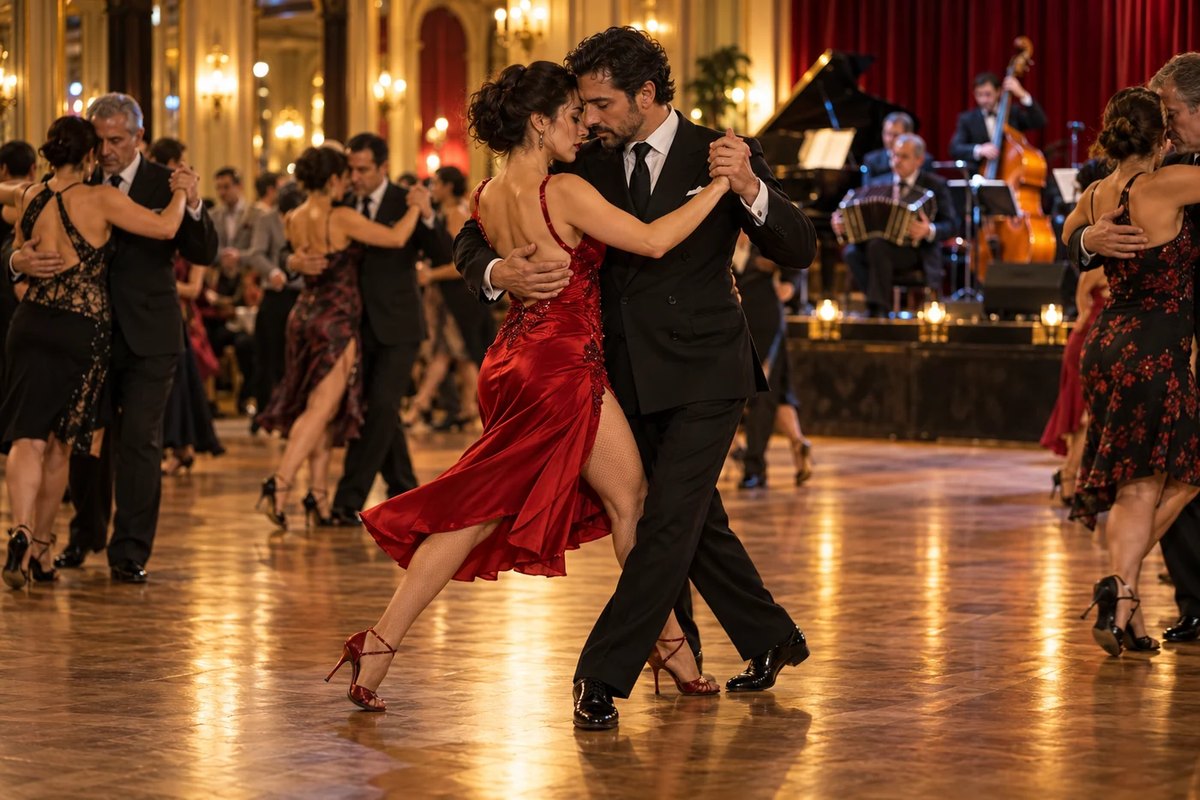
Argentine tango is improvised in a close embrace (abrazo). The leader proposes and the follower interprets; together they walk (caminata), pivot, pause and decorate the music with figures such as ochos, giros, boleos and ganchos. At a milonga, couples move counter-clockwise around the floor (the ronda), dances are played in sets called tandas separated by a cortina, and partners are often invited with a glance and a nod — the cabeceo.
Frequently asked questions
Where was tango born?
In the Río de la Plata region — Buenos Aires (Argentina) and Montevideo (Uruguay) — in the late 19th century.
Is tango UNESCO heritage?
Yes, since 2009, as shared heritage of Argentina and Uruguay.
What is a milonga?
Both a lively musical style related to tango and the name of a social event where people dance tango.