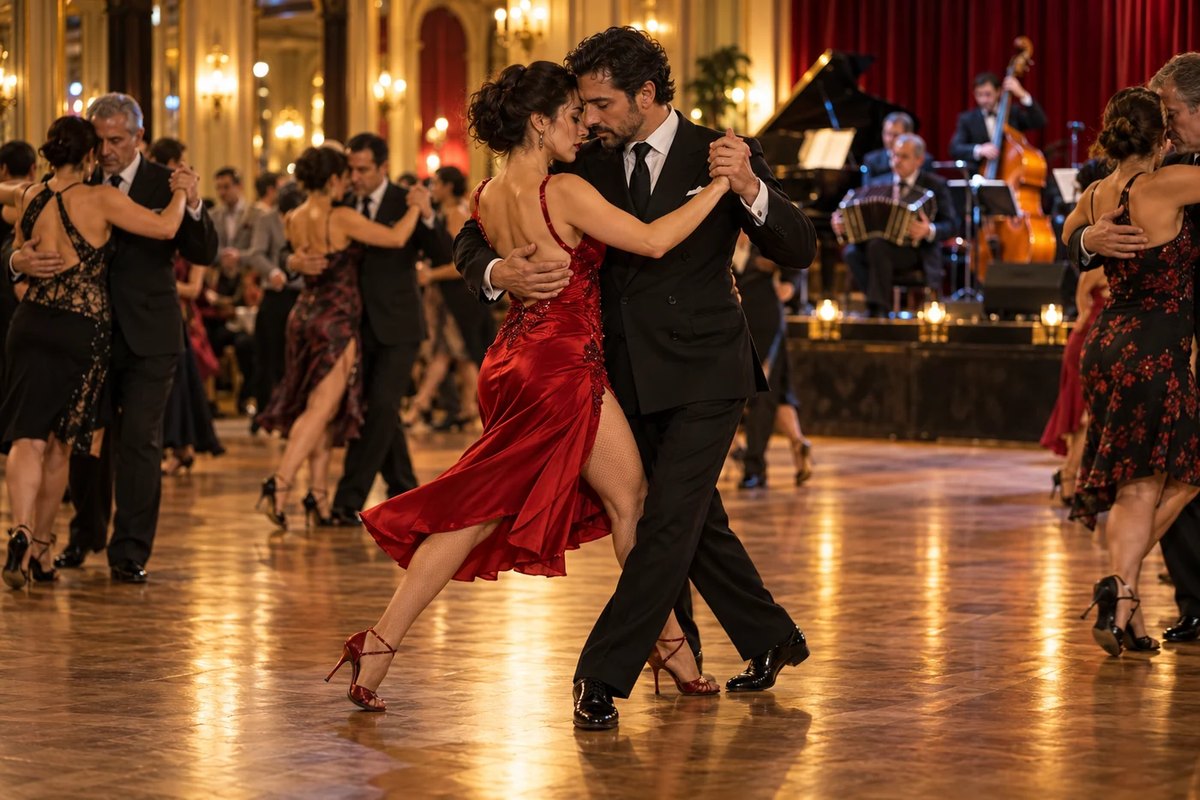
Argentine tango is an improvised partner dance in a close embrace: the leader proposes, the follower interprets, and together they walk, pivot, pause and decorate the music. At a milonga (a tango dance event) couples move counter-clockwise around the floor in tandas of three or four songs. Tango was inscribed by UNESCO in 2009 as shared heritage of Argentina and Uruguay.
Tango was born at the end of the 19th century in the working-class neighbourhoods (arrabales) and port districts of Buenos Aires and Montevideo, where Afro-Argentine and Afro-Uruguayan candombe, the Cuban habanera, the rural milonga and the music of millions of European immigrants — Italian, Spanish and others — met. The bandoneón, a German concertina, became its voice. After conquering Paris and the world around 1913, tango had its Golden Age in Buenos Aires from about 1935 to 1955, when great orchestras such as those of Juan D’Arienzo, Carlos Di Sarli, Aníbal Troilo and Osvaldo Pugliese played for huge dance halls. Astor Piazzolla later reinvented it for the concert stage. Today Buenos Aires has milongas every night, the Tango BA Festival y Mundial (since 2003) crowns world champions in ‘pista’ and ‘escenario’, and queer tango, with open roles, has grown since La Marshall opened as the city’s first queer milonga in 2002. National Tango Day is 11 December.