
Origins in Andalusia
The Roma people reached Spain in the 15th century and settled in large numbers in Andalusia, a region already shaped by centuries of Muslim, Jewish and Christian life. Their music and dance mixed with local songs, rhythms and religious chants. Flamenco did not have a single inventor: it was created by families and communities in cities such as Seville, Jerez de la Frontera, Cádiz and Granada.
The first written descriptions of this music appear in the late 18th century, and the word “flamenco” for the art became common in the 19th century. Its oldest and deepest songs are called cante jondo, “deep song”.
The golden age of the cafés cantantes (c. 1860–1910)
In the second half of the 19th century, flamenco moved from family gatherings and taverns to the cafés cantantes: venues with a small stage where audiences paid to hear professional singers, guitarists and dancers. The singer Silverio Franconetti opened one of the most famous in Seville. These cafés turned flamenco into a profession, fixed many of its song forms and made dance a central part of the show.
1922: the Cante Jondo contest in Granada
By the early 20th century many artists feared the oldest songs were being lost to lighter, commercial styles. In 1922 the composer Manuel de Falla and the poet Federico García Lorca organised the Concurso de Cante Jondo in Granada to protect and celebrate deep song. In the following decades the theatrical “ópera flamenca” brought flamenco to large stages, and dancers such as Carmen Amaya became international stars.
Paco de Lucía, Camarón and new flamenco
From the 1950s, festivals, recordings and flamenco studies gave the art new respect. In the 1970s the guitarist Paco de Lucía (1947–2014) and the singer Camarón de la Isla (1950–1992) changed flamenco forever, opening it to jazz, Latin and pop influences; Camarón’s album “La leyenda del tiempo” (1979) is a landmark. Dancers such as Antonio Gades, Joaquín Cortés, Sara Baras and Israel Galván later took flamenco dance to theatres around the world.
UNESCO heritage (2010) and flamenco today
In 2010 UNESCO inscribed flamenco on the Representative List of the Intangible Cultural Heritage of Humanity. Today it lives in family celebrations in Andalusia, in tablaos and peñas, in conservatories and dance academies, and in the work of new artists who mix it with contemporary dance and urban music.
The elements of flamenco: cante, toque, baile and palos
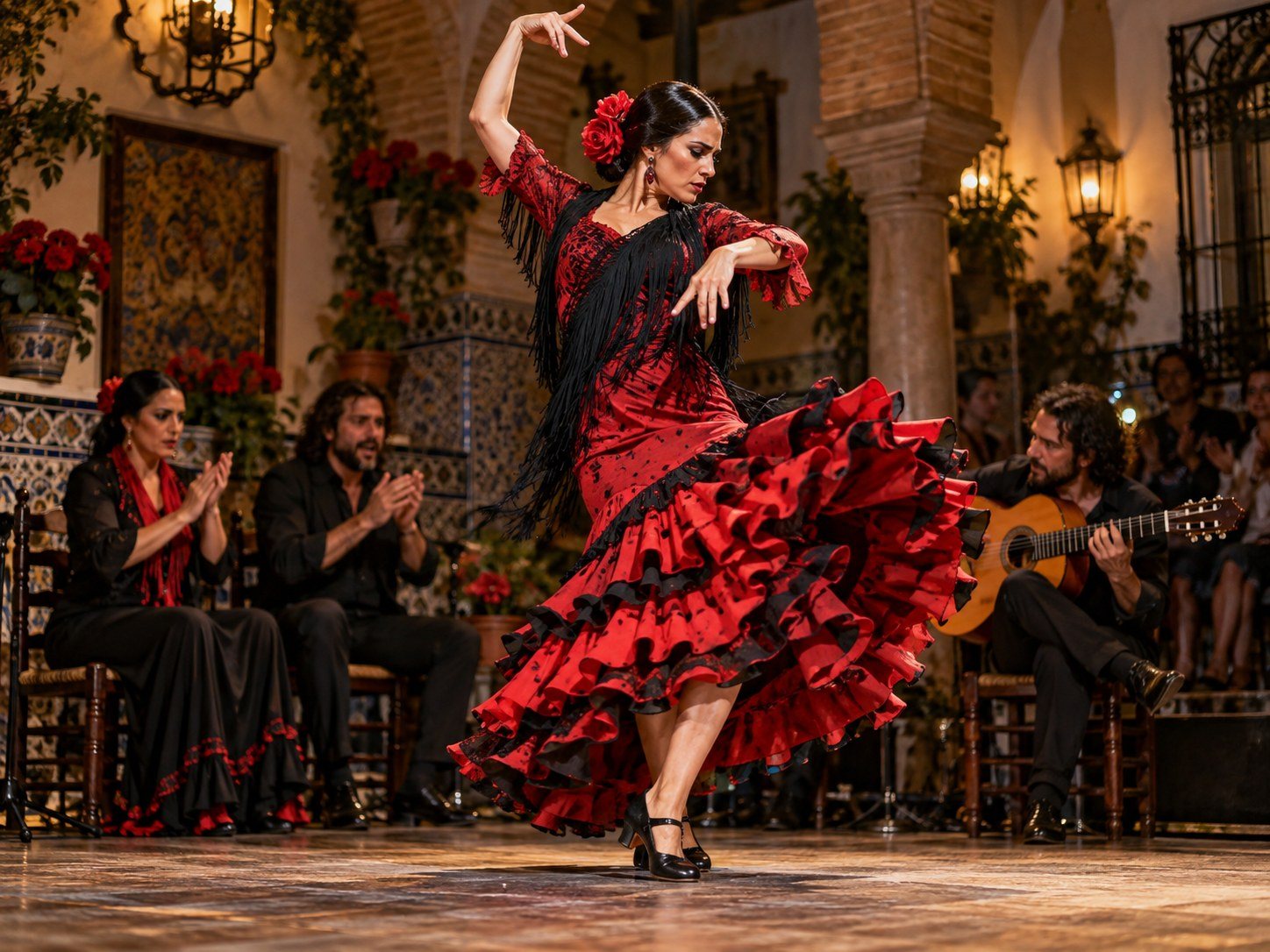
Flamenco has three pillars: cante (song), toque (guitar) and baile (dance), supported by palmas (rhythmic hand-claps) and jaleo (shouts of encouragement). Its many styles are called palos. Some are solemn, such as soleá and seguiriya; others are festive, such as alegrías, bulerías, tangos and fandangos. Many palos use a 12-beat rhythm called compás, which dancers mark with powerful footwork (zapateado).
Where to see flamenco
The best places are in Andalusia: the tablaos of Seville and the Triana district, the peñas of Jerez de la Frontera, and the cave performances (zambras) of Sacromonte in Granada. Madrid also has historic tablaos. Major festivals include the Bienal de Flamenco in Seville (even years), the Festival de Jerez (February–March) and the Festival del Cante de las Minas in La Unión (summer).
Frequently asked questions
Where does flamenco come from?
From Andalusia in southern Spain, where Gitano (Roma) families and local communities created it from many musical traditions.
How old is flamenco?
Its roots go back centuries; written descriptions appear from the late 18th century and the art took its modern form in the 19th century.
Is flamenco UNESCO heritage?
Yes. UNESCO added flamenco to the Intangible Cultural Heritage of Humanity list in 2010.