
Kenya
From western drum traditions to Indian Ocean celebrations: the many living rhythms of Kenya.
Kenya is not one rhythm. From Isukuti drums in the green western highlands to Luo music near Lake Victoria, from the movement vocabularies of the coast to the social dance floors of Nairobi, dancing marks belonging, dialogue and change. The country’s many communities carry distinct histories; some dances are public celebrations, while others belong to spiritual or age-set settings with protocols of their own. Discover the performers, landscapes, institutions and living heritage behind the movement.
Traditional dances
- Isukuti — A powerful ensemble tradition of the Isukha and Idakho communities: accelerating drums, call-and-response singing and collective energy. UNESCO inscribed it for urgent safeguarding in 2014.
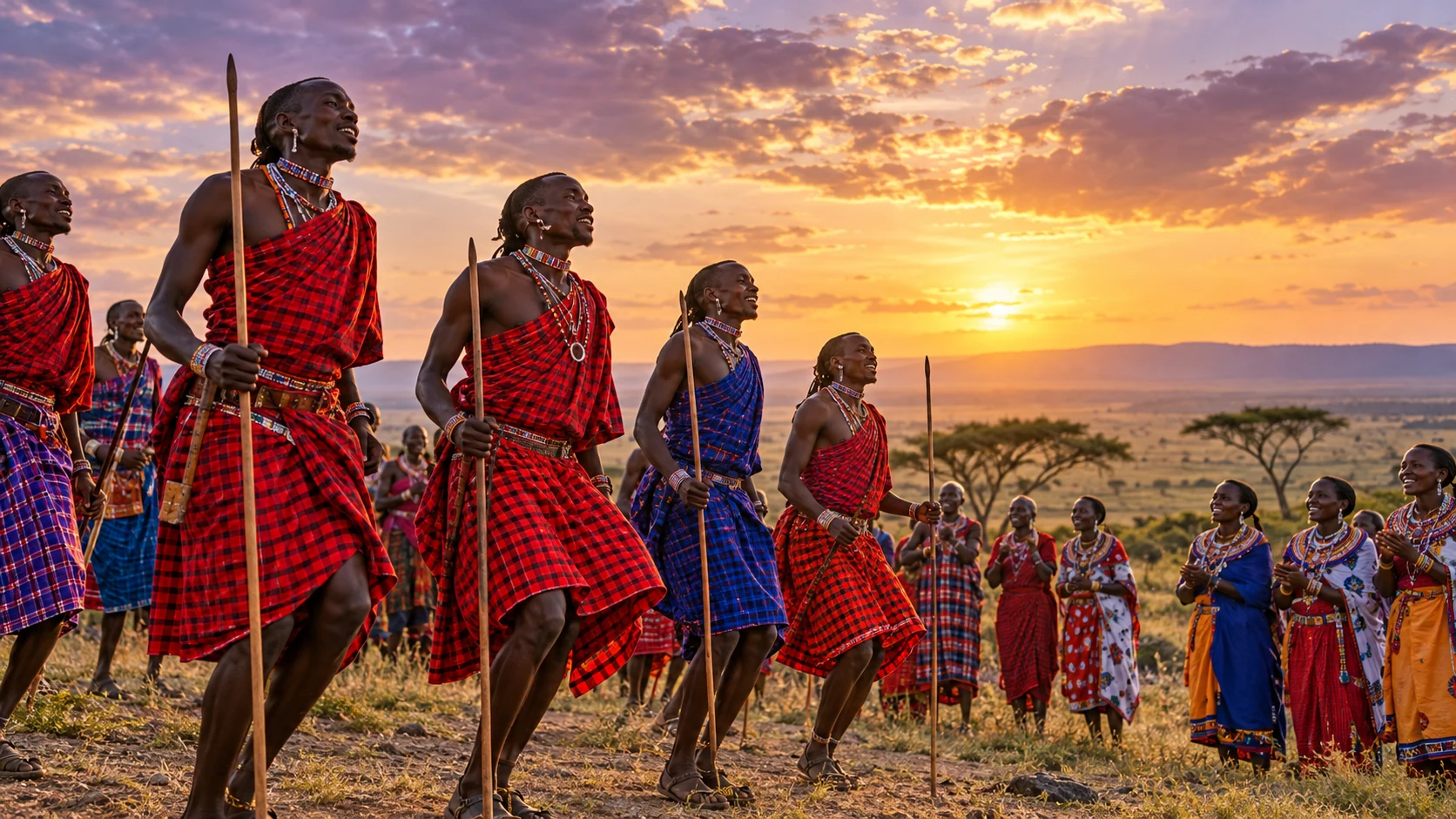
- Adumu (Maasai) — Often photographed as the Maasai jumping dance, Adumu belongs to particular Maa-speaking cultural and age-set contexts. The circle, chanting and upright jumping carry local meanings beyond tourism.
- Ohangla Social Dance — A celebrated Luo social music and dance world in western Kenya, associated with a driving percussion feel and responsive dance-floor expression. Its sound has evolved through popular performers.
- Mwomboko (Agikuyu) — A partner dance shaped in central Kenyan social history through adaptation and exchange. University research documents its music, poetry and role in Agikuyu social life.
- Kilumi (Akamba) — A spiritually significant Akamba music-and-dance tradition linked in research to community healing and religious life. Its ceremonial forms are not free choreography for visitors to copy.
- Sengenya (Digo) — A named dance-music tradition among Digo communities on Kenya’s south coast, documented in African Music scholarship. Performances appear at weddings and community celebrations.
- Chakacha — A distinctive Swahili coastal movement vocabulary associated historically with women’s social occasions and weddings. Its controlled hip and torso articulation belongs to local customs, not a single broad caricature.
- Edong’a (Turkana) — A named Turkana dance documented by Kenya’s State Department for Culture as part of the Tobong’u Lore cultural festival. Public interpretation should remain grounded in its local meaning.
- Dhaanto (Kenyan Somali communities) — A sung group dance in Somali cultural life across the Horn of Africa, including Kenyan Somali communities. It is a shared cross-border heritage, not an exclusively Kenyan invention.
- Kirumbizi — A staged combat-style dance associated with the Lamu coast and Bajuni cultural heritage. Public festival versions feature skillful stick or sword-like mock exchanges, with safety and permission paramount.
- Mugithi Social Dance — Mugithi combines live Kenyan popular music and participatory social dancing, often in linked or following lines. It reflects modern urban and central highland histories rather than a fixed ancient rite.
- Kenyan Hip-Hop Street Dance — Kenyan crews develop breaking, freestyle and hip-hop vocabularies in neighborhoods, studios and online spaces. This is a contemporary transnational culture localized through Kenyan music and stories.
Explore
- History & Heritage — A profound journey through Indigenous knowledge, Indian Ocean exchange, Isukuti, colonial change and living dance cultures.
- Regions & Traditions — Explore eight distinct cultural landscapes from Lake Victoria and the western highlands to the coast and northern territories.
- Festivals & Events — Actual upcoming dates where published, clearly marked unconfirmed times, official event sources and community festivals.
- Schools & Organizations — Find researched teaching programs and submit your dance school for DANZO’s review.
Places
Six famous landscapes and landmarks reveal the country beyond any single postcard. Explore Kenya’s places with cultural respect.