··EN · ES · FA
Tap a region to read its story
Swipe the timeline
No single dance represents the United States. Its dance history is a long conversation — sometimes joyful, often unequal — between Native Nations, Africans brought in slavery and their descendants, European and Latin American immigrants and the people of Hawaiʻi. Out of that conversation came styles that conquered the world: tap, jazz, swing, hip-hop and more.
More than 570 federally recognized tribal Nations live in the United States, each with its own songs, ceremonies and social dances. Some dances are sacred and shared only within the community; others, like powwow dancing, are public celebrations that welcome visitors.
In the late 19th and early 20th centuries the U.S. government banned many Native ceremonies. Communities kept dancing in secret or adapted dances for fairs and celebrations; from this resilience grew the modern intertribal powwow. The American Indian Religious Freedom Act of 1978 finally protected Native spiritual practice.
Gathering of Nations in Albuquerque, held from 1983, became North America’s largest powwow; its organizers held the final edition in April 2026. Hundreds of other powwows continue every year.
Enslaved Africans brought polyrhythm, call-and-response, improvisation and a grounded, bent-knee way of moving. Where drums were banned, they created rhythm with the body — patting juba on the thighs and chest — and with the feet.
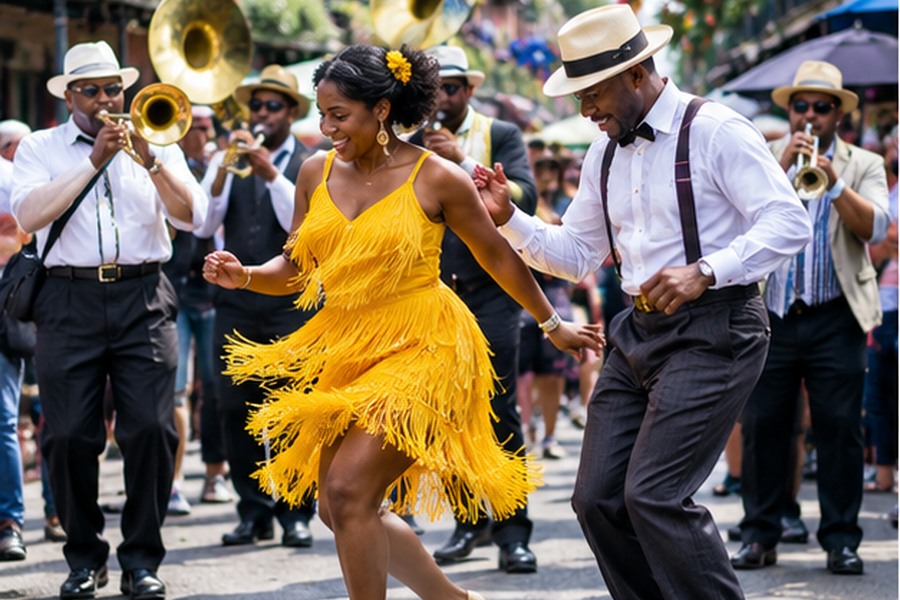
In New Orleans, Congo Square was one of the few places where enslaved and free people of African descent could gather on Sundays to drum and dance. Its traditions live on in second lines and Mardi Gras Indian processions.
The cakewalk was created by enslaved people to parody the manners of plantation owners; after the Civil War it was appropriated by white minstrel performers, and Black artists such as George Walker reclaimed it on stage.
Settlers from the British Isles, France, Germany and Central Europe brought reels, jigs, quadrilles, polkas and waltzes. On the frontier, a caller began to shout the figures so that anyone could join — the birth of the American square dance.
In the Appalachian mountains, step dancing met African American buck dancing and became flatfooting and clogging. In Louisiana, French-speaking Acadians (Cajuns) and Black Creoles created their own accordion dance music.
A 1999 resolution in Congress proposed making the square dance the national folk dance; it was never adopted, but more than 30 states have named it their official dance.
In the 1920s the Great Migration brought African Americans from the South to Chicago, New York and Detroit, and jazz music with them. The Charleston swept the nation, and in Harlem’s Savoy Ballroom dancers created the Lindy Hop.
Tap dancers such as Bill ‘Bojangles’ Robinson and the Nicholas Brothers became stars of vaudeville and Hollywood, while big bands — Chick Webb, Duke Ellington, Count Basie — played for dancers every night.
The swing era was also an era of segregation: many ballrooms excluded Black dancers, which made the integrated Savoy remarkable.
American modern dance began with pioneers such as Isadora Duncan, Martha Graham and Katherine Dunham, who broke with ballet to express new ideas. In 1958 Alvin Ailey founded his company, and ‘Revelations’ (1960) became one of the most-seen dance works in the world.
On Broadway and in Hollywood, choreographers Jack Cole, Jerome Robbins and Bob Fosse created theatrical jazz dance, and stars like Gene Kelly and Fred Astaire made tap and musical dance a global language.
Schools such as Broadway Dance Center (1984) and festivals such as Jacob’s Pillow keep training new generations.
Puerto Rican and Cuban musicians transformed New York in the 1940s–50s. At the Palladium Ballroom, mambo bands led by Tito Puente, Machito and Tito Rodríguez drew dancers of every background.
In the 1970s Fania Records turned ‘salsa’ into a worldwide sound. Later, Miami’s Cuban community brought casino and rueda, and Mexican American communities kept folklórico, cumbia and banda dancing alive across the Southwest.
The ‘mambo craze’ also inspired ballroom versions such as the cha-cha-chá that spread through American dance studios.
In the 1970s, while Los Angeles invented locking and Fresno popping, Black and Puerto Rican youth in the Bronx created hip-hop: DJs looped the breaks of funk records and b-boys and b-girls invented breaking.
At the same time, Harlem’s Black and Latino LGBTQ+ ballroom houses developed voguing. Television (Soul Train), films and music videos carried all these styles around the planet.
Each city added its style — Chicago footwork, Oakland turf, Memphis jookin, D.C.’s beat ya feet, L.A. krump — and in 2024 breaking reached the Olympic Games in Paris.
Hula was suppressed after 1830, revived by King Kalākaua in the 1880s and transformed by tourism in the 20th century. In the 1970s the Hawaiian Renaissance brought back the Hawaiian language, voyaging and ancient hula.
The Merrie Monarch Festival in Hilo, founded in 1964, holds the most prestigious hula competition each week after Easter.