
Tap a region to read its story
Dance Regions & Traditions of Spain
Ten landscapes, ten ways to move
Spain’s regions have their own languages, music and dances. Here are ten dance landscapes, from flamenco Andalusia to the bagpipes of the north and the islands.
Andalusia: flamenco, sevillanas and fandangos
Andalusia
The south is the cradle of flamenco — Jerez, Seville, Cádiz, Granada and Málaga each have their own styles and families of artists. Andalusians dance sevillanas at the April Fair and El Rocío, Málaga’s pandas play verdiales, Huelva sings and dances its fandangos and Granada’s Sacromonte keeps the zambra.
Seville’s April Fair has over a thousand casetas.
Catalonia: sardana circles and rumba
Catalonia
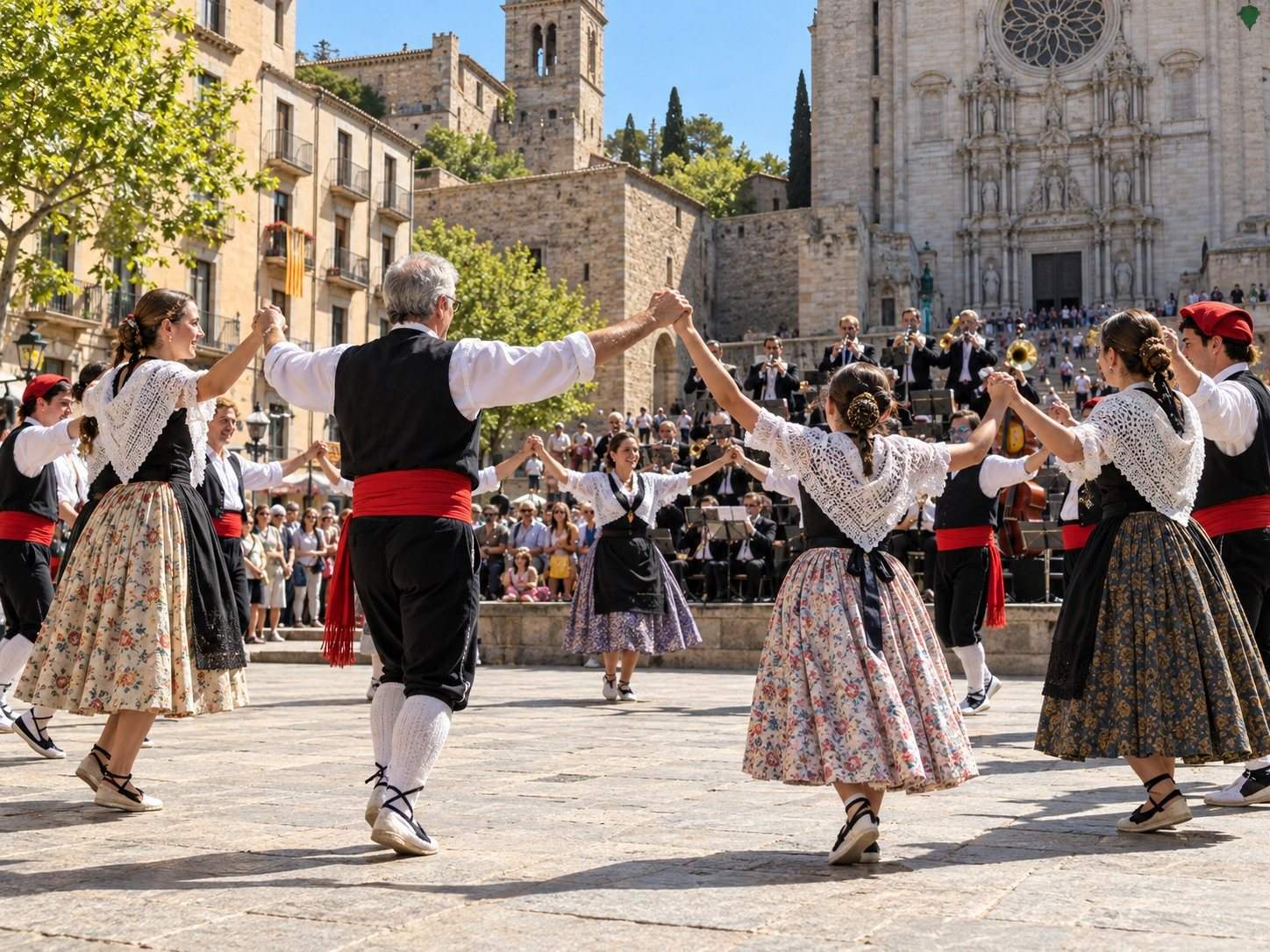
Catalans dance the sardana in town squares every weekend to the sound of the cobla, and Barcelona’s Gitano neighbourhoods gave birth to the rumba catalana. Catalonia also has a strong contemporary scene around the Mercat de les Flors and the Institut del Teatre, and festivals such as the Patum of Berga.
Sardanas are danced in front of Barcelona Cathedral every weekend.
Aragon: the jota and the dances of the saints
Aragon
Aragon’s jota, with its leaps, castanets and powerful sung coplas, is the soul of Zaragoza’s Fiestas del Pilar. In the villages of Huesca, Zaragoza and Teruel, the ‘dances’ combine stick and sword dances with spoken verses for the patron saint.
Huesca’s danzantes perform for Saint Lawrence every 10 August.
Galicia: gaita, pandeireta and muiñeira
Galicia
Green, rainy Galicia dances the muiñeira, the jota galega and the ribeirana to the gaita bagpipe and the pandeireta. Village romerías, gaita schools and the Ortigueira festival keep its Atlantic, ‘Celtic’-flavoured folk culture alive.
Santiago de Compostela is the end of the Camino de Santiago pilgrimage.
Basque Country: aurresku and dantzak
Basque Country & Navarre
Basque culture has hundreds of dances (dantzak): the aurresku of honour, chain and sword dances, carnival dances and the energetic jumps of the ‘ezpatadantza’. Dance groups teach them from childhood, and the txistu and drum, or the trikitixa accordion and tambourine, sound at every fiesta.
Basque (euskara) is unrelated to any other known language.
Madrid: chotis, tablaos and national companies
Madrid
The capital dances the chotis at San Isidro and the August verbenas, but it is also a great flamenco city, with tablaos, the Amor de Dios studios and the Suma Flamenca festival, and home to the Ballet Nacional de España, the Compañía Nacional de Danza and major conservatories.
The Paseo del Prado and the Retiro became a UNESCO World Heritage Site in 2021.
La Mancha and Castile: seguidillas and paloteos
La Mancha & Castile
On the plains of La Mancha, groups dance the seguidillas manchegas with guitars, bandurrias and castanets; across Castile and León, villages keep stick dances (paloteos), jotas and charradas for their patron saints.
La Mancha is the land of Don Quixote and its famous windmills.
Asturias: danza prima and the gaita
Asturias
Asturias dances the ancient sung danza prima, the ‘baile llano’ and the ‘xiringüelu’ to the gaita asturiana and drum. Summer fiestas and romerías, especially in eastern towns such as Llanes, keep these participatory dances alive.
Asturias is also famous for its cider, poured from above the head.
Canary Islands: isa, folía and timple
Canary Islands
The seven islands dance the isa, the folía, the malagueña and the seguidilla to rondallas with the timple. Romerías such as San Benito Abad in La Laguna bring out carts, oxen and folk groups in traditional ‘magos’ dress.
Mount Teide (3,715 m) on Tenerife is Spain’s highest peak.
Balearic Islands: ball pagès and boleros
Balearic Islands
Ibiza and Formentera keep the archaic ball pagès with flute, drum and giant castanets, while Mallorca and Menorca have their own boleros, jotas and ‘mateixes’, danced by local groups at village fiestas.
Ibiza’s Dalt Vila (old town) is a UNESCO World Heritage Site.
Frequently asked questions
Where should I go to see traditional dance in Spain?
Seville in April for sevillanas, Jerez in February–March for flamenco, Barcelona on weekends for sardanas, Zaragoza in October for the jota and Madrid on 15 May for chotis — plus village fiestas all summer.
Sources
- Flamenco — UNESCO Intangible Cultural Heritage (2010)
- Patum of Berga — UNESCO Intangible Cultural Heritage (2005/2008)
- Almeida celebra los 175 años del chotis — Ayuntamiento de Madrid
- XXIV Bienal de Flamenco de Sevilla — Festivales de España
- 31.º Festival de Jerez 2027 — Vida Flamenca
- Fecha de la Feria de Sevilla — iCalendario
- Fiesta Mayor de los Verdiales — Festivales de España
- Suma Flamenca 2026 — esMadrid
- Festival Internacional del Cante de las Minas — Festivales de España
- Josep Maria Ventura i Casas — Wikipedia
- Music of the Canary Islands — Wikipedia
- Institut del Teatre — Wikipedia
Traditions through the year
Dance history in numbers
Timeline
Swipe the timeline