
Tap a region to read its story
Famous Places in Spain
Where Spain’s history and dance meet
Eight places where Spain’s history and dance meet: the Alhambra, Seville, Barcelona, Madrid, Santiago de Compostela, Córdoba, Bilbao and Tenerife.
The Alhambra and Granada
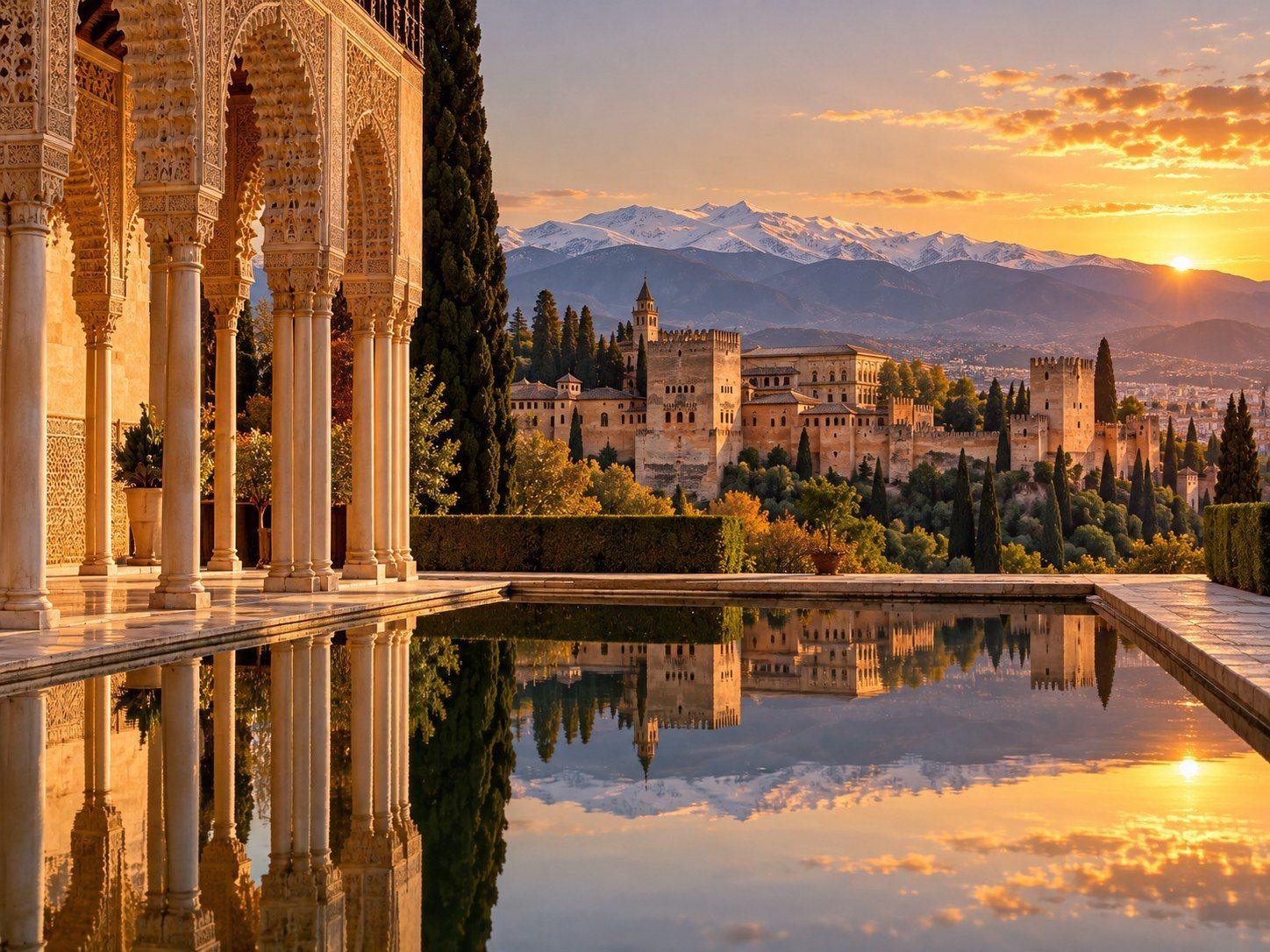
Alhambra, Granada
The Alhambra, the palace-city of the Nasrid sultans (13th–15th centuries), and the Albaicín quarter form a UNESCO World Heritage Site. Its courtyards, fountains and carved stucco are among the great works of Islamic art.
Across the valley, the cave-houses of Sacromonte host nightly zambras, and the Granada International Festival of Music and Dance stages performances inside the Alhambra each summer.
The Alhambra was declared a World Heritage Site in 1984.
Seville: the city of sevillanas
Seville & the Giralda
Seville’s cathedral, the Alcázar and the Archivo de Indias are a UNESCO World Heritage Site; the Giralda bell tower began life as the minaret of the 12th-century mosque. The Plaza de España was built for the 1929 Ibero-American Exposition.
Seville is the capital of sevillanas and a great flamenco city: visit Triana across the river, see a show in a tablao or the Museo del Baile Flamenco, and come in April for the Feria or in even years for the Bienal.
Seville’s cathedral is one of the largest Gothic cathedrals in the world.
Barcelona: sardanas, rumba and Gaudí
Barcelona & Sagrada Família
Antoni Gaudí began work on the Sagrada Família in 1883, a year after the first stone was laid, and it is still being completed; seven of his works are a UNESCO World Heritage Site.
For dance, join the sardana circles in front of the Cathedral on Saturday evenings and Sunday mornings, hear rumba catalana in Gràcia, and see contemporary work at the Mercat de les Flors and the Grec festival in July.
Its central Tower of Jesus Christ is designed to make the Sagrada Família the tallest church in the world.
Madrid: museums, tablaos and chotis
Madrid, Prado & Retiro
The Prado (opened 1819) holds masterpieces by Velázquez and Goya — including Goya’s scenes of popular dances and fiestas — and the Paseo del Prado and Retiro became a UNESCO World Heritage Site in 2021.
Madrid is a great place to watch Spanish dance: flamenco tablaos, the Teatros del Canal, the Ballet Nacional and CND seasons, and chotis among the chulapos at the Pradera de San Isidro on 15 May.
Goya’s tapestry cartoons in the Prado show majos and majas dancing.
Santiago: pilgrims, gaitas and muiñeiras
Santiago de Compostela
The old town of Santiago and its Romanesque cathedral, goal of the Camino de Santiago pilgrimage since the Middle Ages, are a UNESCO World Heritage Site.
Gaiteiros often play under the arches near the cathedral, and Galicia’s summer romerías and folk festivals are the best places to see the muiñeira danced by local groups.
Santiago’s old town became a World Heritage Site in 1985.
Córdoba: the Mezquita and the patios
Córdoba’s Mosque–Cathedral
Begun in 785 and enlarged over two centuries, Córdoba’s Great Mosque — later a cathedral — is famous for its red-and-white double arches. The historic centre is a UNESCO World Heritage Site.
Each May the city’s flower-filled courtyards open for the Fiesta de los Patios (UNESCO 2012), and Córdoba’s flamenco tradition is celebrated at its own festivals and peñas.
The Mezquita has more than 850 columns.
Bilbao: Guggenheim and Basque dance
Bilbao & the Basque Country
Frank Gehry’s titanium-clad Guggenheim, opened in 1997, transformed Bilbao into an international art city, while the Casco Viejo keeps its old streets, pintxo bars and the Basilica of Begoña above.
Basque dance groups perform at the city’s great August fiesta, Aste Nagusia, and the aurresku of honour opens many Basque ceremonies and weddings.
Begoña’s aurresku is one of Bilbao’s best-known dance traditions.
Tenerife: Teide and the romerías
Tenerife & the Canary Islands
Mount Teide, a volcano rising 3,715 m above the Atlantic, is Spain’s highest peak; its national park and the colonial town of La Laguna are both UNESCO World Heritage Sites.
In July La Laguna’s Romería of San Benito Abad fills the streets with carts, oxen and folk groups dancing isas and folías in traditional dress.
Measured from its base on the ocean floor, the Teide is one of the tallest volcanoes on Earth.
Frequently asked questions
Are dance shows included in monument tickets?
Usually not. Flamenco shows, zambras and festival performances are ticketed separately; village fiestas and sardanas in squares are free.
Sources
- Flamenco — UNESCO Intangible Cultural Heritage (2010)
- Patum of Berga — UNESCO Intangible Cultural Heritage (2005/2008)
- Almeida celebra los 175 años del chotis — Ayuntamiento de Madrid
- XXIV Bienal de Flamenco de Sevilla — Festivales de España
- 31.º Festival de Jerez 2027 — Vida Flamenca
- Fecha de la Feria de Sevilla — iCalendario
- Fiesta Mayor de los Verdiales — Festivales de España
- Suma Flamenca 2026 — esMadrid
- Festival Internacional del Cante de las Minas — Festivales de España
- Josep Maria Ventura i Casas — Wikipedia
- Music of the Canary Islands — Wikipedia
- Institut del Teatre — Wikipedia
Traditions through the year
Dance history in numbers
Timeline
Swipe the timeline