
Tap a region to read its story
The History of Dance in Spain
From the dancers of Gades to flamenco and the new stages
Spain’s dances carry the memory of Romans, Andalusi musicians, Golden Age theatres, Gitano artists, village fiestas and modern stages. This is their story, chapter by chapter.
Ancient roots and al-Andalus
Ancient roots and al-Andalus
Dance in Iberia has a long memory. In Roman times the dancing girls of Gades — today’s Cádiz — were famous in Rome for their castanet-like clappers and lively movement. From 711 to 1492 al-Andalus brought Arabic and Berber music, instruments and court entertainment, while Christian, Jewish and Muslim communities shared streets, songs and celebrations for centuries.
After 1492 many of these traditions survived in new forms. The word ‘zambra’, once a Moorish music-and-dance gathering, lived on in Granada’s Sacromonte, and scholars still debate how much of al-Andalus echoes in later Andalusian music.
Roman poets such as Martial wrote about the dancers of Gades.
The Golden Age: seguidillas, zarabandas and fandangos
The Golden Age: seguidillas, zarabandas and fandangos
In the 16th and 17th centuries Spain’s theatres, streets and courts danced lively new forms. The zarabanda and chacona were so energetic that moralists condemned them — before they became slow, noble dances in the courts of Europe. Seguidillas, with their short sung verses, spread from Castile everywhere.
In the 18th century the fandango swept Spain and fascinated foreign visitors, while the popular ‘majos’ and ‘majas’ of Madrid — painted by Goya — made castanets, seguidillas and boleros the height of fashion.
The sarabande, Spanish in origin, became a movement of Bach’s suites.
The bolero and the escuela bolera
The bolero and the escuela bolera
Around 1780 dancing masters refined the seguidillas with the technique of French ballet and created the bolero. This ‘escuela bolera’ — jumps, beats and castanets with rounded arms — conquered European stages in the 19th century and inspired romantic ballets such as Fanny Elssler’s ‘Cachucha’.
Families of teachers such as the Pericet kept the style alive, and today it is one of the four forms of Spanish dance taught in Spain’s conservatories and danced by the Ballet Nacional de España.
Spanish dance in conservatories has four branches: escuela bolera, folklore, flamenco and stylised dance.
The birth of flamenco
The birth of flamenco
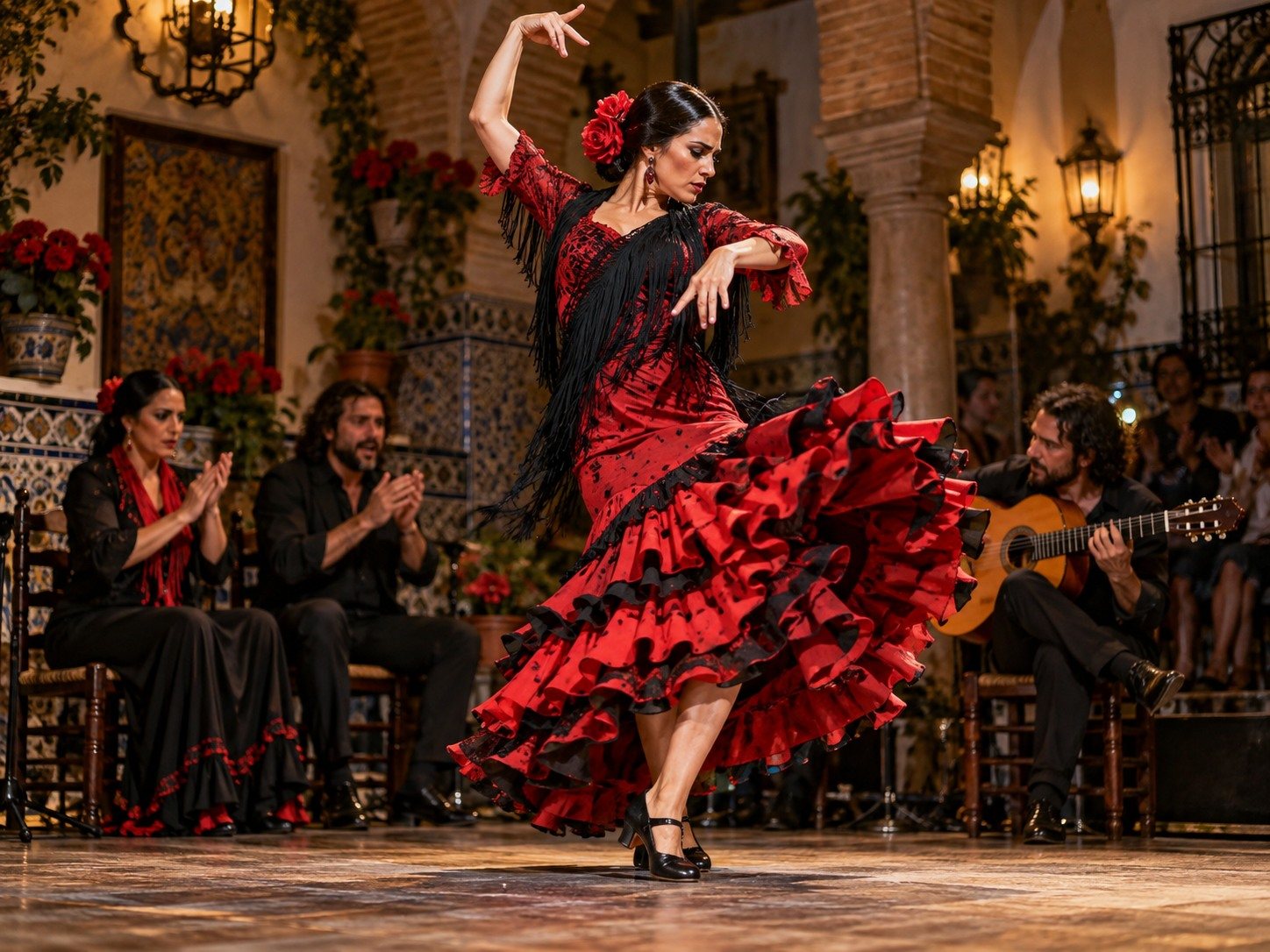
In the late 18th and 19th centuries flamenco took shape in Andalusia, where Gitano (Romani) families and Andalusian communities created new songs and dances in places such as Jerez, Triana in Seville, Cádiz and Granada. From the 1850s the cafés cantantes turned it into a professional art with stars of cante, toque and baile.
In 1922 Manuel de Falla and Federico García Lorca organised the Concurso de Cante Jondo in Granada; the 20th century brought Carmen Amaya, Antonio Gades, Paco de Lucía and Camarón. In 2010 UNESCO inscribed flamenco as Intangible Cultural Heritage of Humanity.
16 November is Flamenco Day in Andalusia.
A mosaic of regional dances
A mosaic of regional dances
Every region of Spain kept its own dances, music and costume: circle and chain dances such as the sardana and the danza prima, leaping couple dances such as the jota and the muiñeira, stick and sword dances for patron saints, and the Basque ceremonial dances. In the 19th century Romantic travellers and folklorists began to collect them.
In the 20th century folk groups documented and staged hundreds of regional dances; since the return of democracy, local associations, schools and festivals have revived many village traditions in their original settings.
Spain has 17 autonomous communities, and many have their own language as well as their own dances.
Island worlds: the Canaries and the Balearics
Island worlds: the Canaries and the Balearics
Islands kept distinctive traditions. In the Canary Islands, mainland jotas and seguidillas became the isa, the folía and the Canarian malagueña, played by rondallas with the little timple and danced at romerías in ‘magos’ costume.
In the Balearics, Mallorca has its boleros and jotas, while Ibiza and Formentera preserve the archaic ball pagès, with flute, drum and giant castanets — a world apart from the islands’ modern club culture.
The timple has five strings and a rounded back.
Fiestas, pilgrimages and UNESCO heritage
Fiestas, pilgrimages and UNESCO heritage
Much of Spain’s dance lives in fiestas: the April Fair and the Rocío pilgrimage with sevillanas, Zaragoza’s Pilar with jotas, Madrid’s San Isidro with chotis, and patron-saint feasts with stick dances and processions. UNESCO has recognised several Spanish traditions that include dance — flamenco (2010) and the Patum of Berga in Catalonia (2005), a Corpus Christi festival of dancing giants, eagles and dragons.
These celebrations are not shows put on for visitors: they belong to local communities, who decide how they are danced, dressed and passed on.
The Patum of Berga was proclaimed a UNESCO Masterpiece in 2005.
New stages: national companies, rumba and breaking
New stages: national companies, rumba and breaking
Since the 1970s Spain has built national companies — the Ballet Nacional de España (1978) for Spanish dance and flamenco and the Compañía Nacional de Danza (1979) — together with conservatories, a National Dance Award and festivals in every major city. Choreographers such as Nacho Duato, Israel Galván, Rocío Molina and Marcos Morau tour the world.
Popular culture keeps evolving too: the rumba catalana born in Barcelona in the 1950s, and a strong breaking scene that celebrated the dance’s Olympic debut at Paris 2024.
Antonio Gades was the first director of the Ballet Nacional de España.
Timeline
- {'en': '1st c. AD', 'es': 'Siglo I', 'fa': 'سدهٔ یکم میلادی'} — The dancers of Gades (Cádiz) are famous in Rome.
- 711–1492 — Al-Andalus: Arabic and Berber music shape the south.
- {'en': 'c. 1780', 'es': 'h. 1780', 'fa': 'حدود ۱۷۸۰'} — The bolero is created from the seguidillas.
- 1850 — The chotis is presented at Madrid’s Royal Palace.
- {'en': 'c. 1850–1920', 'es': 'h. 1850–1920', 'fa': 'حدود ۱۸۵۰–۱۹۲۰'} — Age of the flamenco cafés cantantes.
- 1922 — Falla and Lorca’s Concurso de Cante Jondo in Granada.
- 1978–79 — Ballet Nacional de España and Compañía Nacional de Danza are founded.
- 2005 — UNESCO proclaims the Patum of Berga.
- 2010 — UNESCO inscribes flamenco.
- 2024 — Breaking debuts at the Olympic Games.
Frequently asked questions
Is every Spanish dance flamenco?
No. Flamenco comes from Andalusia; Spain also has dozens of regional dances — the sardana, jota, muiñeira, aurresku, chotis, isa and many more — plus the classical escuela bolera and contemporary dance.
Are sevillanas flamenco?
Sevillanas are a popular folk dance from Seville, derived from the old seguidillas, often danced with flamenco flavour — but they are not one of flamenco’s palos.
Is flamenco UNESCO heritage?
Yes. UNESCO inscribed flamenco on the Representative List of the Intangible Cultural Heritage of Humanity in 2010.
Sources
- Flamenco — UNESCO Intangible Cultural Heritage (2010)
- Patum of Berga — UNESCO Intangible Cultural Heritage (2005/2008)
- Almeida celebra los 175 años del chotis — Ayuntamiento de Madrid
- XXIV Bienal de Flamenco de Sevilla — Festivales de España
- 31.º Festival de Jerez 2027 — Vida Flamenca
- Fecha de la Feria de Sevilla — iCalendario
- Fiesta Mayor de los Verdiales — Festivales de España
- Suma Flamenca 2026 — esMadrid
- Festival Internacional del Cante de las Minas — Festivales de España
- Josep Maria Ventura i Casas — Wikipedia
- Music of the Canary Islands — Wikipedia
- Institut del Teatre — Wikipedia
Traditions through the year
Dance history in numbers
Timeline
Swipe the timeline