
Tap a region to read its story
Dance Regions & Traditions of Portugal
A living map of mainland and island identities
Travel from Minho’s green hills to Miranda’s stick dancers, through Ribatejo and the Algarve, then across the Atlantic to Madeira and the Azores. Portugal’s regions are cultural landscapes, not interchangeable choreography.
Minho: village squares, Vira and embroidered dress
Original editorial illustration · not a historical photograph
Northern green hills and granite towns are associated with bright folklore costumes, community celebrations, turning couples and regional singing. The Vira is widely recognized, but Malhão, Chula and Cana-Verde also have local versions.
Local repertoire and presentation can change by town and organizer. Confirm the group, date and permission before publishing a performance as historical evidence.
Trás-os-Montes: Miranda’s stick dances
Original editorial illustration · not a historical photograph
The northeastern uplands include Mirandese-speaking communities whose Pauliteiros dance to striking stick rhythms and bagpipes. Their practice should be described by local group and occasion rather than reduced to a tourist demonstration.
Local repertoire and presentation can change by town and organizer. Confirm the group, date and permission before publishing a performance as historical evidence.
Beiras and Douro: crossings, songs and rural life
Original editorial illustration · not a historical photograph
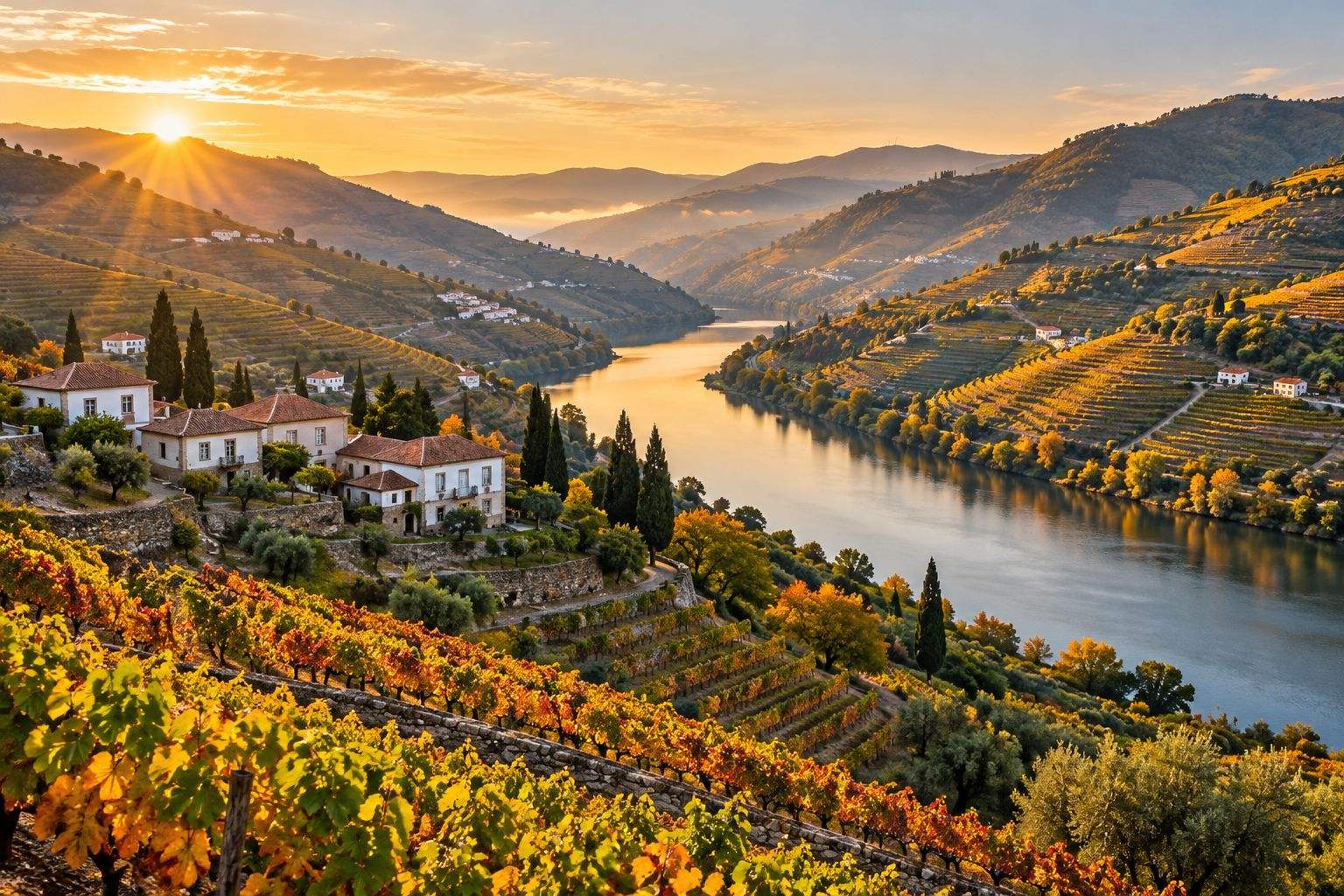
Central and northern inland landscapes sustain multiple community repertoires. Wine-growing, agricultural calendars, local processions and shared singing shape public celebration. Dance labels may cross district boundaries while steps and melodies remain locally distinct.
Local repertoire and presentation can change by town and organizer. Confirm the group, date and permission before publishing a performance as historical evidence.
Ribatejo: skill and Fandango
Original editorial illustration · not a historical photograph
Across Ribatejo’s plains and river towns, the Portuguese Fandango is performed with quick footwork and expressive face-to-face exchanges. Contemporary festivals highlight it as one element of regional identity alongside crafts and music.
Local repertoire and presentation can change by town and organizer. Confirm the group, date and permission before publishing a performance as historical evidence.
Alentejo: music, feast days and social gatherings
Original editorial illustration · not a historical photograph
Alentejo is famous for its collective singing traditions, but song and dance must not be treated as interchangeable categories. Village celebrations may include social dancing, processions and music in distinct settings. Respect for the event’s own participants is essential.
Local repertoire and presentation can change by town and organizer. Confirm the group, date and permission before publishing a performance as historical evidence.
Algarve: Corridinho and southern celebrations
Original editorial illustration · not a historical photograph
The coastal and inland Algarve has festive paired dances, with Corridinho among its recognizable folk-stage repertoires. Quick musical phrases and turns bring couples together. Specific steps should be learned from a local group, not generalized across the coast.
Local repertoire and presentation can change by town and organizer. Confirm the group, date and permission before publishing a performance as historical evidence.
Madeira: Bailinho and island instruments
Original editorial illustration · not a historical photograph
Madeira’s official tourism service emphasizes the lively Bailinho, the voice and characteristic instruments including braguinha, rajão and the percussion brinquinho. Casas do Povo support ensembles that transmit different local repertories.
Local repertoire and presentation can change by town and organizer. Confirm the group, date and permission before publishing a performance as historical evidence.
Azores: Chamarrita across the Atlantic
Original editorial illustration · not a historical photograph
The Azores are not a single undifferentiated island. Chamarrita appears in several folklore traditions with distinct group figures and singing. An identified São Miguel troupe was filmed performing in Viana do Castelo in 2019, offering one documented example to study.
Local repertoire and presentation can change by town and organizer. Confirm the group, date and permission before publishing a performance as historical evidence.
Lisbon and Porto: independent stages and studios
Original editorial illustration · not a historical photograph
Professional education, independent studios, ballet and experimental dance coexist in the major cities. Lisbon hosts institutions such as Forum Dança and Escola Superior de Dança; Porto and neighboring Gaia and Matosinhos jointly stage the international DDD Festival.
Local repertoire and presentation can change by town and organizer. Confirm the group, date and permission before publishing a performance as historical evidence.
Sources
- Federação do Folclore Português — association map — Federação do Folclore Português
- Pauliteiros de Miranda / Miranda do Douro — Turismo de Portugal
- Folklore and Bailinho da Madeira — Madeira Tourism Board
- Traditional instruments of Madeira — Madeira Tourism Board
- Fandango celebrations of Ribatejo — Turismo de Portugal
- Fado, urban popular song — not a dance genre — UNESCO Intangible Heritage
- Federation cultural safeguarding — UNESCO
- DDD Festival official programme — DDD / Ágora Porto
- DDD Festival 2027 dates — Ágora Porto
- Forum Dança contemporary programmes — Forum Dança
- Escola Artística de Dança do Conservatório Nacional — EDCN
- Escola Superior de Dança — Instituto Politécnico de Lisboa
- PortDanceFest official festival site — PortDanceFest
- Andanças — 2027 edition postponed — Andanças
- Festa dos Tabuleiros — next in 2027 — Turismo de Portugal
Traditions through the year
Dance history in numbers
Timeline
Swipe the timeline