
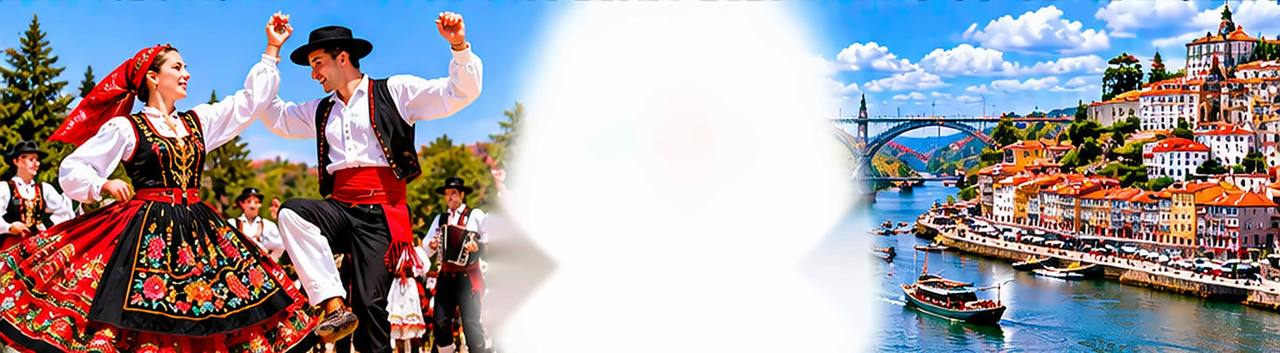
Tap a region to read its story
The History of Dance in Portugal
Village squares, Atlantic islands, cultural memory and new movement
Portugal cannot be reduced to one picturesque folk dance. Its movement heritage belongs to many communities: the turning steps of Minho, Miranda’s stick dancers, the Ribatejo Fandango, Algarve partner dances, island singing and modern experimental stages. Each chapter below tells its own story.
Before a single nation: diverse local rhythms
Original editorial illustration · not a historical photograph
Portugal’s present borders do not tell the whole story of movement. Rural communities, seafaring towns, mountain villages and island settlements developed music and gatherings for work, courtship, feasts and religious calendars. The forms now displayed by folklore ensembles were shaped by many generations, and their names often vary from place to place.
The Portuguese Folklore Federation documents hundreds of local groups and encourages careful attention to clothing, repertoire and community memory. A staged “typical dance” can be valuable, but it should never erase differences between the villages that transmit it.
A living atlas names its communities, not just its country.
Northern village squares: Vira, Malhão and Chula
Original editorial illustration · not a historical photograph
In Minho and nearby northern regions, turning couples, group formations, embroidered dress and strong shared singing form an unmistakable public folklore image. The Vira, Malhão, Chula and Cana-Verde are not one choreography: local groups select different figures, tunes and performance styles.
Ranchos folclóricos help sustain and teach these repertoires. Visitors should look beyond the costume to the people organizing rehearsals, preserving lyrics and negotiating what may be performed for public audiences.
Miranda do Douro: the sound of sticks and bagpipes
Original editorial illustration · not a historical photograph
In Portugal’s northeastern borderlands, the Pauliteiros de Miranda dance with carefully coordinated wooden sticks and regional musical accompaniment, including bagpipes. Their dress and choreography belong to the culture of the Mirandese-speaking area. Repertoires, membership and occasions may differ among local groups.
Tourism Portugal describes the tradition as a distinctive feature of Miranda do Douro. Its striking stage appearance should not invite unsafe imitation; careful transmission, local credit and the integrity of the choreography matter most.
Ribatejo: Fandango as a dialogue of feet
Original editorial illustration · not a historical photograph
The Ribatejo Fandango is known for rapid, expressive footwork and a face-to-face dialogue between performers. Portugal’s national tourism agency lists the Fandango among the cultural expressions celebrated in the Salvaterra de Magos area. This Portuguese form has its own history; sharing a word with Iberian dances does not make it Spanish flamenco.
In contemporary folklore shows, the dance can communicate virtuosity and regional identity. Descriptions should acknowledge that choreographic interpretations and the social roles associated with performance change over time.
The Algarve: Corridinho and the dance of celebration
Original editorial illustration · not a historical photograph
Southern Portugal preserves lively social dances in which partners and groups move through quick turning figures. Corridinho has become a recognizable name in Algarve folklore presentations, often accompanied by accordion-based ensembles. The appearance of a festival performance is one window into local social history, not a universal pattern for every village.
Music, costume and public celebrations connect coastal communities to inland villages. A good field record notes who taught the steps, which event hosted them and whether photographs were made with permission.
Atlantic islands: Madeira and the Azores
Original editorial illustration · not a historical photograph
Madeira’s Bailinho is celebrated as a hallmark of its folklore by the island’s tourism board. Voices and string instruments such as the rajão and braguinha create a distinctive musical world. Local Casas do Povo support groups that teach and perform the tradition.
Across the Azores, Chamarrita survives in different local forms. An identifiable public performance by a São Miguel folklore group was documented in 2019; it is one example, not the only authentic island interpretation. Geography has helped communities develop their own dancing and singing languages.
Song, ritual, and the boundary of dance
Original editorial illustration · not a historical photograph
Fado is central to Portuguese cultural identity, but it is principally an urban song genre, not a folk dance to be presented as a choreographic type. UNESCO inscribed Fado on the Representative List of Intangible Cultural Heritage in 2011 and describes its multicultural musical sources, including links to sung dances.
Carnival characters and processions also involve movement, rhythm and sacred or civic meaning. They need to be described as social practices in their full context rather than automatically catalogued as “dance steps” for tourists to copy.
From the rancho to the contemporary stage
Original editorial illustration · not a historical photograph
Today the Portuguese dance landscape includes local folklore federations, vocational schools, independent studios, ballet institutions and experimental choreographers. Forum Dança, founded in 1990, is one important contemporary training and research association. The Escola Superior de Dança and Conservatório Nacional help prepare new generations.
DDD — Festival Dias da Dança connects Porto, Matosinhos and Vila Nova de Gaia through contemporary performance. Its organizers announced 7–17 April 2027 for the next edition. In the same cultural landscape, local rehearsals and rural gatherings continue: heritage and innovation are not competing destinations.
Timeline
- Traditions — Local singing, feasts and social dance are transmitted across generations
- 1990 — Forum Dança established
- 2011 — UNESCO recognizes Fado as an intangible song tradition
- 2016 — DDD contemporary-dance festival begins
- 2027 — DDD announces a new edition for 7–17 April
Frequently asked questions
Is Fado a traditional dance?
No. Fado is primarily an urban sung music tradition. It has historical links to other song-and-dance genres, but should not be mislabeled as a dance.
Does Portugal have one national dance?
Portugal has multiple regional dance traditions rather than one style that speaks for everyone.
Where can I find folk-dance groups?
Consult the Portuguese Folklore Federation’s directory and contact the group about performances, permissions and classes.
Sources
- Federação do Folclore Português — association map — Federação do Folclore Português
- Pauliteiros de Miranda / Miranda do Douro — Turismo de Portugal
- Folklore and Bailinho da Madeira — Madeira Tourism Board
- Traditional instruments of Madeira — Madeira Tourism Board
- Fandango celebrations of Ribatejo — Turismo de Portugal
- Fado, urban popular song — not a dance genre — UNESCO Intangible Heritage
- Federation cultural safeguarding — UNESCO
- DDD Festival official programme — DDD / Ágora Porto
- DDD Festival 2027 dates — Ágora Porto
- Forum Dança contemporary programmes — Forum Dança
- Escola Artística de Dança do Conservatório Nacional — EDCN
- Escola Superior de Dança — Instituto Politécnico de Lisboa
- PortDanceFest official festival site — PortDanceFest
- Andanças — 2027 edition postponed — Andanças
- Festa dos Tabuleiros — next in 2027 — Turismo de Portugal
Traditions through the year
Dance history in numbers
Timeline
Swipe the timeline