··EN · ES · FA
Tap a region to read its story
Swipe the timeline
In Mexico many dances are not performances but prayers. They are offered to the saints, to the sun and the rain, to the dead who return each November, or to the animals and forests that feed the people. Each belongs to a particular people — Yoeme, Totonac, Rarámuri, Zapotec, Afro-Mexican and many more — who decide how it is danced and who may watch. This page introduces some of the best-known ceremonies, with their meaning and how to be a respectful guest. It ends with two famous ceremonies from neighbouring North America that are often confused with Mexican ones.
The Deer Dance belongs to the Yoeme, the people known as the Yaqui, who live in eight pueblos in the Río Yaqui valley of Sonora and in Arizona, and to their neighbours and relatives the Yoreme, or Mayo, of southern Sonora and northern Sinaloa. For the Yoeme the deer, maso, is a 'little brother' who comes from the flower world, sea ania — a sacred, enchanted world of the wilderness. The dancer does not imitate a deer for show: through the dance he brings the deer into the human world and thanks it for giving its life so that the people may live.
The deer dancer dances barefoot and in silence, wearing a real deer head tied on top of his head and decorated with coloured ribbons like flowers, deer hooves on his belt, strings of butterfly-cocoon rattles (tenábaris) around his ankles and a gourd rattle in each hand. Beside him two singers sing the deer songs, maso bwikam, in an old form of the Yoeme language, to a water drum that is the deer's heartbeat and scraped wooden rasps that are its breathing. With him dance the pascolas, the 'old men of the fiesta': hosts and ritual clowns in small wooden masks of a goat or coyote, who joke and make the people laugh to harp, violin, flute and drum. During Lent and on Holy Saturday deer and pascolas confront the masked chapayekas, and the Yoeme say that 'the flowers kill the Judases'.
The Ceremony of the Voladores, the 'flyers', is a fertility ritual performed by several peoples of Mexico and Central America, and today above all by the Totonac of Veracruz. Its aim is to show respect for nature and the spiritual world and to live in harmony with them: each flight retells the creation of the universe and is said to bring prosperity and open communication with the gods. The ritual probably began among the Huastec, Nahua and Otomí of the Sierra de Puebla and the Veracruz mountains. Even the pole has its rite: the tree is chosen in the forest and raised with a ceremony of its own. UNESCO inscribed the ritual on its Intangible Cultural Heritage list in 2009.
Four men climb a wooden pole 18 to 40 metres high, cut from the forest. On the tiny platform at the top a fifth man, the caporal, plays a cane flute and a small drum at the same time, bending backwards to salute the sun and the four winds and directions. Then the four flyers, tied by the waist, let themselves fall backwards and spin, head down and arms open like birds, slowly unwinding their ropes until they touch the ground. The flyers become birds — in the old belief, the birds of the sun, sacred symbols of the solar god. In Papantla the Council of Totonac Elders allows only men to fly; in Cuetzalan, Puebla, women voladoras have flown since the end of the 20th century.
Every January the people of Chiapa de Corzo, the first Spanish town founded in Chiapas, hold their Fiesta Grande in honour of three patron saints: Our Lord of Esquipulas, Saint Anthony Abbot and, above all, Saint Sebastian. The dance of the Parachicos is the heart of the feast and a communal offering to these saints. Day after day, from morning to night, the dancers accompany the images of the saints through the streets and visit the town's churches and chapels. UNESCO inscribed the Parachicos on its Intangible Cultural Heritage list in 2010.
The Parachicos wear carved and lacquered wooden masks, tall headdresses, serapes, embroidered shawls and many coloured ribbons, and they shake rattles called chinchines as they dance. They are led by the Patrón, who wears a stern mask, carries a guitar and a whip and plays a flute, with one or two drummers beside him. The Patrón sings praises to the saints, and the dancers answer him with loud cheers. Children learn the steps by joining the adults in the street, and families of craftsmen pass down the art of the masks — from cutting and drying the wood to carving and painting it.
The Concheros dance was born shortly after the Spanish conquest, when Indigenous peoples of the Bajío and Querétaro adapted the old mitote dances to Catholic worship. For the Concheros, dancing is an act of devotion: groups are organised as 'mesas' under a captain, with officers and a malinche, and before each dance they say 'Él es Dios' — 'He is God'. Their great pilgrimages go to the Basílica de Guadalupe on 12 December, to Chalma, Los Remedios and Amecameca, and before some dances they keep an all-night vigil (velación) in which a form of flowers is laid out on the ground. From the 1950s and 1960s the movement known as Mexicanidad inspired new Mexica (neo-Aztec) groups, who leave aside the Catholic elements and dance to honour the sun and the old gods at sites such as Teotihuacan and Cholula.
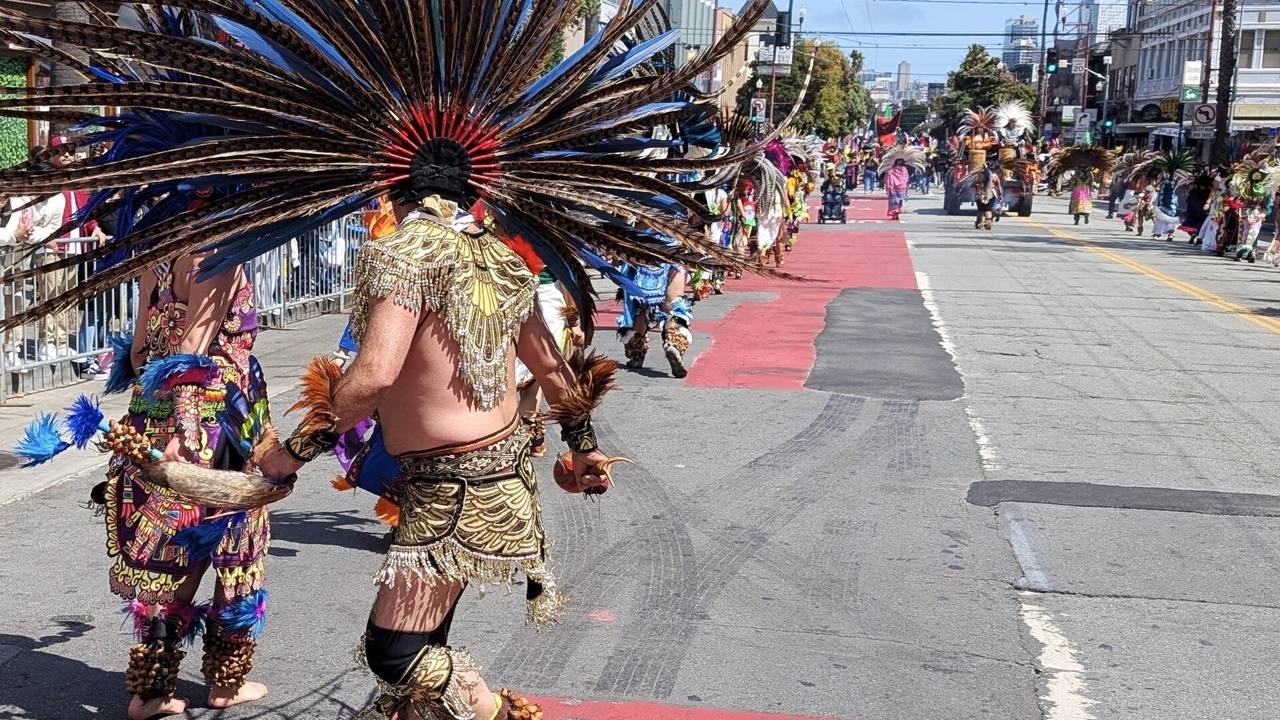
The dancers form a circle around the huéhuetl, the great upright wooden drum, often with a teponaztli slit drum beside it, and the air fills with the smoke of copal incense. They wear rattles of seeds or shells (ayoyotes) on their ankles and tall feather headdresses — ostrich feathers among traditional Concheros, pheasant feathers more often among Mexica groups. The name 'Conchero' comes from the concha, a lute made from an armadillo shell that the Concheros play and sing with; Mexica groups have dropped it as a Spanish instrument. Many Mexica circles also offer the temazcal, the steam bath of purification, and gather at Teotihuacan to dance at the equinoxes and solstices: in 1991 some 500,000 people climbed there at dawn for the spring equinox.
The Rarámuri, also called Tarahumara, live in the mountains and canyons of the Sierra Tarahumara in Chihuahua. Their religion joins Indigenous beliefs with Catholicism: God, Riosi, is often identified with Onorúame, the 'Great Father' linked to the sun, and for the Rarámuri dancing is a form of prayer. The great ceremonies are shared with batári, or tesgüino, a fermented corn drink that binds the community together. In the winter cycle, from October to February, the matachines dance at dawn before the great feasts — in Norogachi on 12 October, 12 December, 24 December, 6 January and 2 February — and it is said that there is no solemn Rarámuri occasion without matachines. Older, native ritual dances such as the yúmari are danced for healing and fellowship, and can be combined with the matachines.
The matachines wear lavish, brightly coloured clothes and shake rattles as they dance to the violin through the night vigils that precede the feasts. At Holy Week, around the old mission churches, the whole sierra fills with drums and cane flutes. Groups of pintos, fariseos and soldados dance for days around the church; in Norogachi the men paint their bodies with white spots of lime and water, and the celebration opens with a bonfire on the top of the mountain. At the end a figure of Judas, dressed as a mestizo, is burned — the victory of good over evil, which protects the community from misfortunes such as floods or droughts.
The Danza de la Pluma, 'dance of the feather', is danced by the Zapotec and other communities of the Central Valleys of Oaxaca. It tells the story of the conquest of Mexico: on one side Moctezuma and his warriors, on the other Hernán Cortés and Pedro de Alvarado, with the Malinche between them. Cuilápam de Guerrero is widely regarded as its birthplace, where it is thought to have taken shape around the Dominican convent in colonial times. Yet in the Zapotec town of Teotitlán del Valle, where it is called Guyach, the dancers also see an older cosmic meaning: Moctezuma is the sun and the dancers around him are the planets. There, men promise to dance it for three years in honour of the town's patron, and some migrants return from the United States just to fulfil their vow.
The dancers' great headdress is a semicircle of coloured feathers on a wicker frame, decorated with ribbons, mirrors and tassels, and it turns with every leap and spin. In the right hand they carry a tin rattle, which stands for a weapon, and in the left a small shield or club. The dance is accompanied by a wind band, or in some places by flute and drum, and a complete performance with all its episodes can last up to three days. It is so loved that it traditionally closes the Guelaguetza in Oaxaca city, but in the villages it remains a vow and a prayer offered at the patron saint's fiesta.
On the Costa Chica, the Pacific coast shared by Guerrero and Oaxaca, live many of Mexico's Afro-descendant communities — the 'third root' of the nation, together with the Indigenous and the Spanish. Their best-known tradition is the Danza de los Diablos, the dance of the devils. Here the devils are not demons: they are the dead, who leave the cemeteries on 31 October and return to them on 2 November, visiting the living during the Day of the Dead. According to local tradition the dance was born in colonial times among enslaved Africans, who danced it to mock the masters who punished them and to ask their god Ruja for freedom; over time it joined the Catholic Day of the Dead. Today it is a proud symbol of Afro-Mexican identity.
A group of about a dozen dancers is led by the Diablo Mayor, called Tenango or Pancho, who marks the steps, and by his wife, la Minga, the 'mother of the devils', played by a man in women's clothes who carries a baby doll and dances with the audience. The masks range from elaborate ones of leather with goat horns and long horsehair to simple ones of cardboard. The music is unique: a harmonica, the charrasca — the jawbone of a donkey or horse scraped with a stick — and the bote or tigra, a friction drum of African origin played by rubbing a waxed stick. The devils dance through the streets and the cemetery, between laughter and respect, while families wait for their dead at home.
The Sun Dance is the most important religious ceremony of the Plains nations of North America — among them the Lakota, Cheyenne, Arapaho, Blackfoot, Plains Cree and Shoshone of the United States and Canada. It was a time when separate bands came together to renew their bonds with the universe and the sacred through personal and communal sacrifice. Around a cottonwood tree set up as a pole inside a circular arbour, dancers fast from food and water and dance almost without rest for several days and nights; in some nations, such as the Lakota, Cheyenne and Arapaho, dancers offer their own flesh by being tied to the pole. Both the United States and Canada once passed laws to suppress such ceremonies; in the United States the American Indian Religious Freedom Act of 1978 was passed to protect them.
The Sun Dance is not a pre-Hispanic Mexican tradition, but since about the 1990s it has also been danced in Mexico. Leaders of the Mexicanidad movement such as Tlakaelel (Francisco Jiménez) brought the Lakota Sun Dance into Mexican ceremonial circles; a Sun Dance at Ajijic, Jalisco, has been held every summer since 1991, led by people who had danced for years on the Lakota Rosebud reservation; and the network known as the Camino Rojo ('Red Road') holds Sun Dances in places such as Zacualpan in the State of Mexico during Holy Week and in Nayarit, with four days of dancing and fasting from food and water. Mexican leaders such as Tlakaelel held that the Sun Dance 'is not only Lakota — it is also Mexican'. Some Lakota leaders disagree: in 2003 Arvol Looking Horse, Keeper of the Sacred White Buffalo Calf Pipe, asked that only Native people take part at the centre of the Sun Dance and that non-Natives respect this decision. Both views are presented here as they stand.
The Danza de la Luna is a contemporary women's ceremony that grew out of the same Mexican ceremonial circles as the Sun Dance, and its dancers see it as the Sun Dance's feminine counterpart. According to its organisers, the first Moon Dance was held in 1992 by a small group of women on the slope of Cerro Gordo — which they call the Cerro del Tonan, the hill of the Mother — overlooking the ancient city of Teotihuacan, and it was born from a vision of one of its founders, Patricia Guerra (Totlalnantzin). The ceremony centres on the moon and on feminine energy. Scholars of the Camino Rojo note how these circles join Lakota-inspired ceremonies with Mexica symbols; the Moon Dance is not a documented pre-Hispanic ceremony, but a living tradition of today.
The ceremony lasts four nights. The women dance through the night on the hill and fast during the four nights, while men take part only as helpers — the 'eagles of fire' who keep the sacred fire burning and look after the temazcal, the steam bath in which the dancers purify themselves; the men do not dance. Unlike the Sun Dance, which chooses a chief each year, the Moon Dance is guided by an elder woman, an abuela, who serves until she retires.
Visitors often ask about the Bear Dance and the Wolf Dance, but neither is Mexican: both come from Indigenous nations of the United States and Canada, and they are included here only for context. The Bear Dance is one of the oldest ceremonies of the Ute people of Colorado and Utah. Ute tradition says that a she-bear taught the dance to a young hunter; it is held in spring, traditionally after the first thunder. A new corral of brush is built each year with its entrance facing east, singers play notched wooden rasps, and the women choose their male partners. Today the dance usually lasts four days, and when it ends the corral is burned and returned to the earth.
Wolf dances belong to the nations of the Pacific Northwest coast. Among the Nuu-chah-nulth, Makah and Quileute, the Wolf Ritual is considered the most sacred ceremony: young novices are 'kidnapped' by supernatural wolves and then captured and tamed again by the initiated members of the Wolf society, an encounter that brings gifts of power, songs and regalia such as carved wolf masks. Among the Kwakwaka'wakw of British Columbia, groups of dancers and singers wearing wooden wolf headdresses perform the wolf dance as part of the great winter ceremonies and potlatch. These ceremonies survived decades of prohibition — the Canadian ban on the potlatch was lifted only in 1951 — and they belong to their nations: they are not performed in Mexico.