··EN · ES · FA
Tap a region to read its story
Swipe the timeline
Mexico is not one dance country but many. Deserts and sierras in the north, volcanoes and lakes in the centre, tropical coasts on two oceans and the Maya lowlands in the south each grew their own music and their own way of moving — Indigenous, Spanish and African roots mixed differently in every valley. Use the map to choose a region, or travel from the Pacific west to the Caribbean east.
Most historians place the birth of modern mariachi in Cocula, Jalisco, in the 19th century, where it grew out of the older son jalisciense; the town calls itself the “world cradle of mariachi”, although Colima, Nayarit and Michoacán have claimed it too. In 2011 UNESCO inscribed mariachi — string music, song and trumpet — on its list of the Intangible Cultural Heritage of Humanity, noting the regional costumes and Indigenous languages of western Mexico in its songs.
Jalisco also gave Mexico its national dance. “Tapatío” means from Guadalajara, and the jarabe tapatío — the Mexican hat dance — is a dance of flirtation between a bold man and a coy woman, who in some versions dances around the sombrero he throws on the floor. In the Golden Age of radio and film, mariachis adopted the charro suit and added trumpets, and on stage they often share the boards with ballet folklórico.
In the Sotavento — the lowlands shared by southern Veracruz, Tabasco and Oaxaca — the son jarocho was born in colonial times among peasants, fusing Spanish, African and Indigenous music with verses inherited from Spain's Golden Age. Its heart is the fandango: a community fiesta of music, food and improvised verse where dancers drum the zapateado with their feet on a wooden platform, the tarima, to the strum of the jarana.
Further north, the Huasteca — a region shared by six states of north-eastern Mexico — has its own son huasteco, or huapango: a trio of violin, jarana huasteca and huapanguera guitar, singers who leap into falsetto, and couples answering with quick zapateado.
Veracruz is also the best-known home of the Voladores, inscribed by UNESCO in 2009. Among the Totonac, a pole 18 to 40 metres tall is cut fresh from the forest after asking the mountain god's forgiveness; four young men tied by ropes “fly” down around it while a fifth, the caporal, plays flute and drum on the top — a fertility rite that re-enacts the birth of the universe.
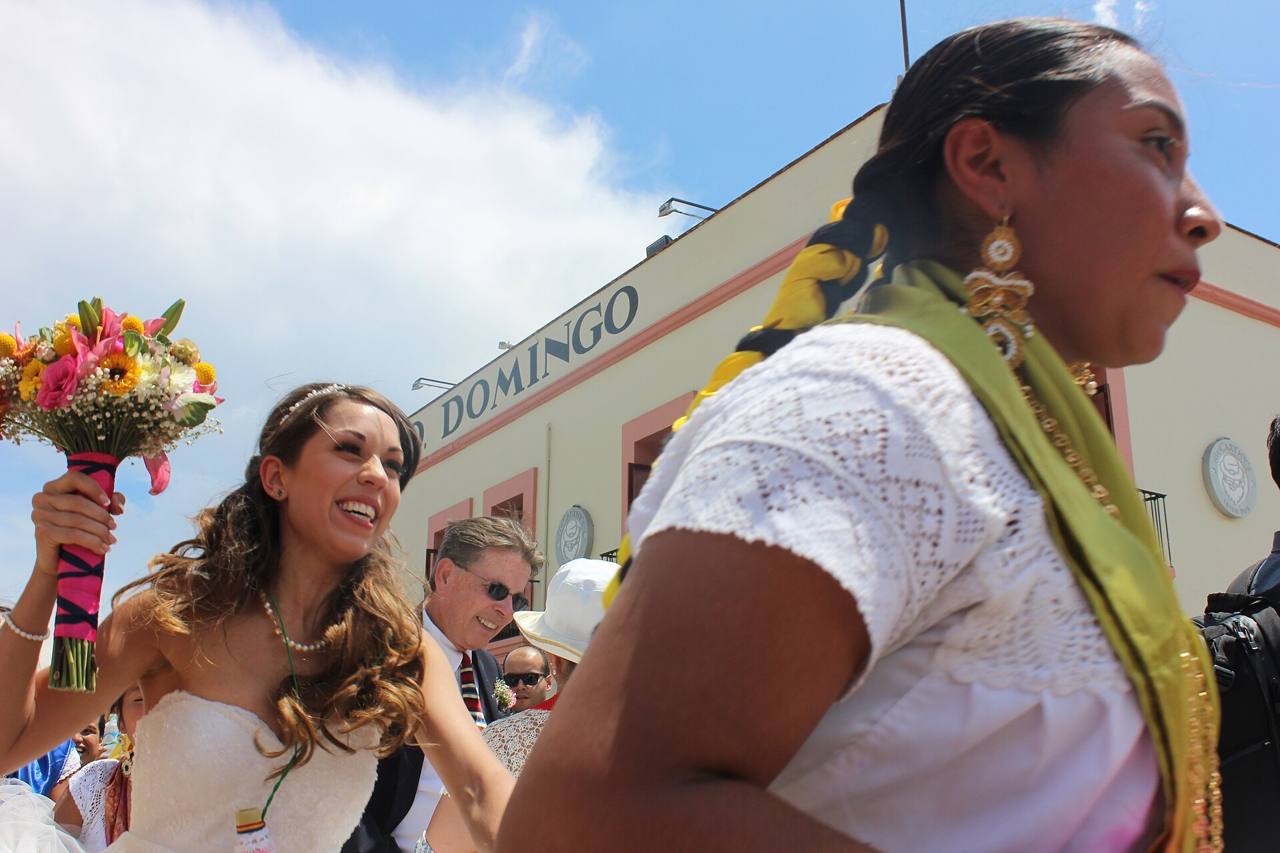
Every July, Oaxaca City turns into a stage for the whole state. The Guelaguetza — a Zapotec word for offering, gift and mutual help — fills two weeks of Lunes del Cerro, the “Mondays on the Hill”, with the main day on the first Monday after 16 July and an octave a week later, on the Cerro del Fortín. Delegations from the state's eight regions, representing 16 ethnic groups, dance their own sones and jarabes and share food and crafts with the audience as gifts.
The festival as we know it is young: it grew out of a 1932 celebration for the 400th anniversary of the city, took the name Guelaguetza in 1942, and since 1969 has chosen a young woman as Diosa Centéotl, after the maize goddess, for best preserving her community's traditions. Its most spectacular moment is the Danza de la Pluma, a dance of the Conquest with Moctezuma as its hero, performed by the delegations of Cuilapan de Guerrero or Villa de Zaachila under huge feathered crowns.
The Danza de los Viejitos, the “dance of the little old men”, is the emblem of Michoacán and of the P'urhépecha people. Dancers wear masks of wood, cornstalk paste or clay painted with the face of an old man, lean on wooden canes and wear wooden-soled sandals that click on the floor. Its P'urhépecha name is T'arche Uarakua, and in tradition the dance was performed by the wisest elders to ask the Sun for a good harvest.
Music runs deep here. In 2010 UNESCO inscribed the pirekua, the traditional song of the P'urhépecha, sung in 30 of the 165 P'urhépecha communities and also played as sones in 3/8 and abajeños in 6/8. Michoacán also keeps colonial dances of the Conquest alive, alongside Jalisco and Oaxaca.
From 4 to 23 January, the town of Chiapa de Corzo celebrates its Great Feast in honour of Saint Anthony Abbot, Our Lord of Esquipulas and, above all, Saint Sebastian. The Parachicos dance from morning to night as a communal offering to the saints, carrying their images through the town. Each wears a carved wooden mask with a headdress, a serape, an embroidered shawl and colourful ribbons, and shakes chinchines (rattles); the masked Patrón leads them with guitar, whip and flute, and children learn by copying the adults. UNESCO inscribed the tradition in 2010.
Chiapas also holds one of the oldest images of dance in the Americas. Deep in the rainforest, the Temple of the Murals at Bonampak — Classic Maya painting dated to around 791 AD — shows musicians in Room 1 and a great festival of dances and sacrifices in Room 3, watched by crowds of spectators.
The jarana yucateca is danced in pairs, with the same footwork for women and men, to a wind band playing in 6/8 or 3/4. It was born at the vaquería, a celebration that arose on the haciendas when Spanish cattle ranchers had Maya workers count and brand the cattle. Women dance in the white terno — jubón, hipil and fustán — and men in a white guayabera, hat and paliacate, and the most skilful couples dance balancing bottles on their heads.
In Yucatec villages the vaquería is still one of the main events of the patron-saint fiesta, together with the bullfight, the banquet and the dance. It is organised and largely paid for by the diputados de fiesta, and after the bullfight the diputado and the queen, or vaquera, may dance two jaranas in the plaza — a short performance locals call fandango.
In Sonora, the Yaqui (Yoeme) deer dance is one of the oldest dances in Mexico — its instruments leave little doubt of a pre-Hispanic origin. A single man, barefoot and silent, becomes the deer: he wears a dried deer head decorated with coloured handkerchiefs like flowers, a belt of deer-hoof rattles and cocoon rattles around his legs, and shakes two gourds. Deer singers chant in archaic Yaqui to a water drum and rasping sticks, and the dance links the people to the mountain world and the “flower world”. On Holy Saturday, deer and pascola dancers pelt the masked chapayekas with flowers, defeating the forces of evil.
The pascola — perhaps from the Cahita pahko'ola, “old man of the ceremony” — is dancer, host, speaker and ritual clown at Yaqui and Mayo (Yoreme) fiestas, with a wooden mask, cocoon rattles that sound like a rattlesnake, and music of harp and violin alongside cane flute and drum. In the Sierra Tarahumara of Chihuahua, the Rarámuri dance the matachines, introduced by missionaries by the late 17th century: colourfully dressed dancers led by a monarco perform through the winter feasts, from 12 December to Epiphany and Candlemas, to the violin.
In the north-east, around Monterrey and across the Río Bravo, the accordion and the bajo sexto define conjunto norteño music. Polkas, redovas, schottisches (chotís) and waltzes grew up on both sides of the border, and conjunto music has long been the soundtrack of rural fiestas in the north.
In the mountains of central Guerrero, the Tlacololeros re-enact the life of the tlacolol, the hillside field cleared for sowing. Farmers complain that a jaguar is ruining their crops; the hunter and his black dog Maravilla track it down while the tlacololeros, in burlap clothes, straw hats and painted masks, crack their whips across each other's padded arms with a sound like thunder. It is danced especially on the feasts of San Marcos (25 April) and the Holy Cross (3 May), when the farming season begins, in towns such as Chilapa, Zitlala and Chilpancingo.
On the Costa Chica, shared by Guerrero and Oaxaca, Afro-Mexican communities dance the Danza de los Diablos. From 31 October to 2 November the devils, led by the Diablo Mayor and his wife La Minga, come out to visit the cemeteries to the sound of a harmonica, a charrasca (a donkey jawbone) and the bote, a drum of African origin, wearing masks of goat horns and horsehair. The dancers descend from enslaved Africans, and the dance is said to carry echoes of rituals for the god Ruja, to whom the enslaved prayed for freedom.
The coast's favourite song and dance is the chilena. It is said to have arrived in the 19th century with Chilean sailors in the port of Acapulco, who taught the locals the cueca; over time it fused with the sones of the Costa Chica. It is danced with zapateado, claps and jumps, waving coloured handkerchiefs, in 6/8 often alternating with 3/4.
The Concheros, born soon after the Conquest from the old mitote dance adapted to Catholicism, take their name from the concha, an armadillo-shell lute. In Querétaro and Guanajuato their groups call themselves “Hermanos de la Santa Cuenta”, hold all-night vigils on the eve of 3 May for the Holy Cross and remember the legendary miracle of the Cross of Sangremal of 1531.
Every 12 December Conchero groups make their main pilgrimage to the Villa de Guadalupe in Mexico City for the Virgin's feast, and many groups walk to the sanctuary of Chalma, usually in Holy Week. Since the later 20th century, Mexica or Aztec dance groups have sought to remove the European elements and return to pre-Hispanic roots — often with political goals — although traditional Conchero associations do not recognise them.