··EN · ES · FA
Tap a region to read its story
Swipe the timeline
Mexico is a country of volcanoes, deserts, jungles and two long coasts, and its culture lives in very different places: a capital built on the ruins of Tenochtitlan, colonial cities of silver and stone, Maya pyramids by the Caribbean and small towns where masked dancers fill the streets for weeks. Here are ten famous places every visitor — and every dance lover — should know.
Mexico City stands on the site of Tenochtitlan, the Aztec capital built on an island in Lake Texcoco, and its historic centre and the canals of Xochimilco have been a UNESCO World Heritage Site since 1987. Its heart is the Zócalo, a vast square of about 240 by 240 metres framed by the Metropolitan Cathedral, the National Palace and the ruins of the Templo Mayor; on most days groups of Aztec dancers with drums, feather headdresses and shell anklets dance here, and every 15 September the president gives the Grito de Independencia from the palace balcony. A few blocks west rises the Palacio de Bellas Artes, begun in 1904 and opened in 1934, with murals by Rivera, Orozco, Siqueiros and Tamayo and a glass curtain by Tiffany. Its stage is the home of the Ballet Folklórico de México, founded by Amalia Hernández in 1952, which has shown Mexico's regional dances in more than 80 countries.
In a green valley of the southern highlands, Oaxaca was founded by the Spanish in 1529 as Antequera, on a grid of streets around a central plaza; its thick-walled colonial buildings and the hilltop Zapotec capital of Monte Albán, which flourished from about 500 BC to AD 850, form a UNESCO World Heritage Site. Oaxaca is home to many Indigenous peoples, and every July it celebrates the Guelaguetza — a Zapotec word for mutual giving and reciprocity. On the two Mondays after 16 July, the 'Mondays of the Hill', delegations from every corner of the state climb to the open-air auditorium on Cerro del Fortín to dance their own sones and jarabes, then throw gifts of fruit, bread and crafts to the audience. The festival traditionally closes with the Danza de la Pluma, with its huge semicircular feather headdresses.
Founded by the Spanish in 1531 and capital of the state of Jalisco, Guadalajara grew into Mexico's second-largest city — and it is the city most closely tied to mariachi. The music took its modern form in the 19th century in rural Jalisco, around the town of Cocula, from the older son jalisciense, and came to Guadalajara with people moving from the countryside. Mariachi groups of violins, trumpets, vihuela and guitarrón, dressed in the charro suit, play sones, jarabes, rancheras and corridos, and UNESCO added mariachi to the Intangible Cultural Heritage of Humanity in 2011. In the evenings musicians gather near the Plaza de los Mariachis, and every year the city hosts the International Mariachi Festival. Nearby, the Hospicio Cabañas — a neoclassical orphanage by Manuel Tolsá whose chapel José Clemente Orozco covered with 57 frescoes in the late 1930s — is a World Heritage Site.
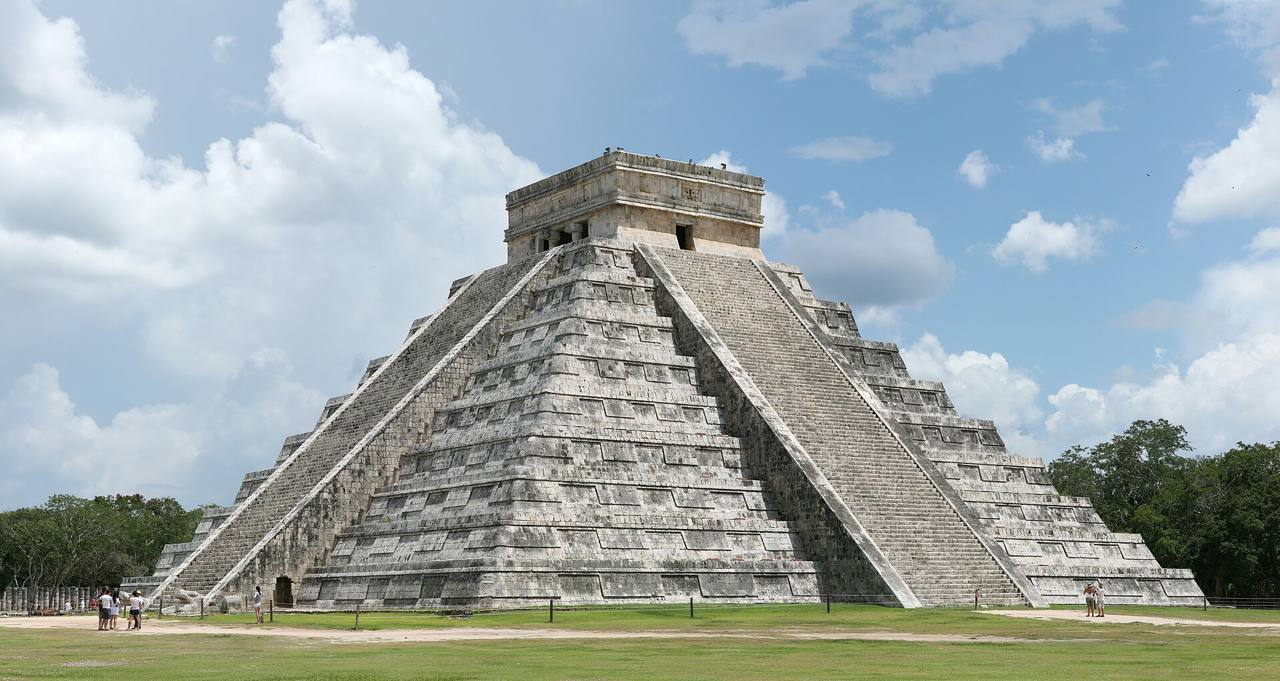
In the flat limestone north of the Yucatán Peninsula, Chichén Itzá was one of the greatest cities of the Maya world. Its name means 'at the edge of the well of the Itzá', after the natural sinkholes, or cenotes, that gave it water. From the 10th century the city blended Maya and central Mexican (Toltec) traditions into a new style, and it remained powerful until its decline around 1440. At its centre stands El Castillo, the Temple of Kukulcán, the feathered serpent: about 30 metres high with its temple, built between the 8th and 12th centuries, with roughly 91 steps on each side. Around it lie the Great Ball Court, where the sacred Mesoamerican ball game was played, and the Temple of the Warriors. Chichén Itzá has been a UNESCO World Heritage Site since 1988.
On the Caribbean coast of Quintana Roo, Cancún was chosen by the Mexican government in 1970 as the site for a new international holiday centre, and the coast to the south became known as the Riviera Maya. Long before the hotels, this was Maya land. Tulum, a walled port city on cliffs above the sea, was at its height between the 13th and 15th centuries; its old name may have been Zama, 'City of Dawn', because it faces the sunrise. For culture lovers the highlight is the evening show 'Xcaret México Espectacular' at the Xcaret park near Playa del Carmen: more than 300 performers tell the meeting of the Maya and Spanish worlds through the Maya ball game and dances from across Mexico, and Totonac voladores fly from their pole in the park. It is a staged spectacle, but a vivid first meeting with the country's living traditions.
Founded in the 16th century to guard a royal road into Mexico's interior, San Miguel grew rich in the 18th century and filled its steep streets with Baroque churches and mansions. Its symbol, the pink Parroquia de San Miguel Arcángel, got its fairy-tale neo-Gothic façade in 1880 from Zeferino Gutiérrez, an Indigenous bricklayer and self-taught architect who took European Gothic churches as his inspiration. Ignacio Allende, a hero of independence, was born on the main square, and the nearby Sanctuary of Atotonilco, 14 km away, is covered with Baroque murals; town and sanctuary became a World Heritage Site in 2008. Since art schools opened here in the 1930s and 1940s, San Miguel has attracted artists from around the world. It is also a town of danzantes: on the first Thursday and Friday of March, dancers in pre-Hispanic dress honour the Christ of the Conquest, and the patron saint's fiesta around 29 September brings processions and fireworks.
In the green hills of northern Veracruz, the land of the Totonac people, the ancient city of El Tajín flourished between about AD 800 and 1200. It was the most important city of the Gulf Coast in its time, with no fewer than 17 ball courts, and its Pyramid of the Niches, decorated with rows of square niches, is a masterpiece of ancient American architecture; the site has been on UNESCO's World Heritage List since 1992. Nearby Papantla is the town most closely tied to the Danza de los Voladores, the 'flyers'. Four men tied with ropes throw themselves backwards from the top of a pole 18 to 40 metres high and spin slowly to the ground, while a fifth, the caporal, plays flute and drum on the tiny platform above — a fertility ritual honouring the sun, the four winds and the cardinal directions, inscribed by UNESCO in 2009. At Takilhsukut Park, beside El Tajín, children learn to fly at the first school for voladores, and the Centre for Indigenous Arts there was recognised by UNESCO as a model of good safeguarding practice in 2012.
On the banks of the Grijalva River in Chiapas, Chiapa de Corzo was the first Spanish town founded in the state, and its main square is crowned by La Pila, a diamond-shaped brick fountain in Moorish style from 1562. Every January, from the 4th to the 23rd, the town celebrates its Fiesta Grande in honour of Our Lord of Esquipulas, Saint Anthony Abbot and, above all, Saint Sebastian. Through the streets dance the Parachicos, in carved and lacquered wooden masks, tall headdresses, serapes, embroidered shawls and coloured ribbons, shaking their chinchín rattles. They are led by the Patrón, in a stern mask, who plays a flute and carries a guitar and a whip; he sings praises to the saints and the dancers answer with cheers. The dance is a communal offering, and children learn it simply by joining in. UNESCO inscribed the Parachicos on its Intangible Cultural Heritage list in 2010.
In the pine-covered highlands of Michoacán, the colonial town of Pátzcuaro and its lake are the heartland of the Purépecha people. Bishop Vasco de Quiroga, who arrived in the 16th century, is remembered as the founder of the modern town, and nearby Tzintzuntzan was the Purépecha capital. The region is world-famous for the Day of the Dead, the Indigenous festivity that UNESCO inscribed in 2008, when families welcome the souls of their dead with food, flowers and candles. On the nights of 1 and 2 November, candle-lit boats cross the lake to the island of Janitzio, whose cemetery fills with people keeping vigil until dawn, while the fishermen's famous butterfly-shaped nets recall the lake's old way of life. Michoacán is also the home of the Danza de los Viejitos, the 'dance of the little old men', in which Purépecha dancers in masks of old men lean on their canes and tap out the rhythm on wooden-soled sandals.
Squeezed into a narrow mountain valley, Guanajuato was founded by the Spanish in the early 16th century and in the 18th century became the world's leading silver-mining centre. The silver paid for Baroque and Neoclassical churches and mansions, among them La Valenciana church (1765–1788), a masterpiece of the Mexican Churrigueresque style, and the old town and its mines have been a World Heritage Site since 1988. Every autumn Guanajuato becomes the cultural capital of Latin America during the Festival Internacional Cervantino. It began in 1953, when Enrique Ruelas of the University of Guanajuato staged the short comic plays of Cervantes in the city's squares, and became international in 1972; today thousands of artists from dozens of countries perform theatre, music and dance, and the Ballet Folklórico de México has appeared at the festival every year since its beginnings.