··EN · ES · FA
Tap a region to read its story
Swipe the timeline
In Mexico, dance has never been only entertainment. It was a prayer in Mexica temples, a lesson in colonial churchyards, a scandal for the Inquisition, a symbol of the young republic and, after the Revolution, a way to show the whole country to itself. This is the story of how Indigenous rituals, Spanish sones and the rhythms of Africa — Mexico's “third root” — mixed into the fandango, the folklórico and the contemporary stage; of the polkas of the north and the danzón halls of the capital; of the Mexicans who carried their dances across the border; and of why UNESCO has inscribed the Voladores, the Parachicos and mariachi among the intangible heritage of humanity.
In Nahuatl, the language of the Mexica (Aztecs), dance had its own word: macehualiztli, glossed in Alonso de Molina's 1571 dictionary as “danza o baile”. Dance was a public duty as much as a pleasure — the Florentine Codex, compiled by Fray Bernardino de Sahagún, describes a ruler deeply concerned with the dance and the feast, which he held to encourage both nobles and commoners.
Young people learned in the cuicacalli, the “house of song”. According to the Florentine Codex, youths were reared there, and after sunset they gathered to sing and dance into the night under the eye of the “rulers of the youths” — a true school where song and movement were learned together.
The Maya painted their dances. In the Temple of the Paintings at Bonampak, in the Chiapas rainforest — part of the tradition of Classic Maya painting (300–900 AD), with murals dated by specialists to 791 AD — Room 1 shows musicians accompanying richly dressed figures, while Room 3 is filled with a great festival of dances and sacrifices watched by groups of spectators.
The Spanish friars quickly understood that dance and theatre could teach faster than sermons. In 1539 Mexico City staged the Conquest of Rhodes, a spectacle of European origin, and the Tlaxcalans answered on Corpus Christi of that year with an enormous open-air performance, the Conquest of Jerusalem: armies of Spaniards and Indigenous allies fought until the archangel Michael brought the “infidels” to conversion. Motolinía described it in detail, and the play has been attributed to him.
Franciscans such as Fray Luis de Fuensalida and Fray Andrés de Olmos used these sacred plays to draw Indigenous people to Christianity, and performances often ended in baptisms and processions. At the same time the old dances were watched closely: ordinances issued in Cuauhtinchan (Puebla) in 1559 allowed dancing only in the church atrium or the marketplace, banned anything “diabolical” in the costumes and required the approval of the priests.
From these early plays grew a whole family of conquest dances and Moors-and-Christians dances. The dialogued version known as the Doce Pares probably dates from the 18th century, and the battle between Christians and Muslims — with Santiago (Saint James) on the Christian side — is still especially popular in Nahuatl-speaking villages of central Mexico, from Morelos and Puebla to Guerrero, Hidalgo and Veracruz, while conquest dances are also performed in Michoacán, Jalisco and Oaxaca.
The clearest symbol of Mexican syncretism is the Conchero dance. It emerged shortly after the Spanish conquest as an adaptation of the old mitote dance to Catholicism, and its origin is placed in the Bajío, Querétaro or Tlaxcala. Its name comes from the concha, a lute made from an armadillo shell — a European-style string instrument built from an American animal — played alongside drums, feathered regalia and Indigenous steps.
Conchero groups of Querétaro and Guanajuato call themselves “Hermanos de la Santa Cuenta” and speak of their devotion as “la obligación”. Some researchers link their tradition to the legendary miracle of the Cross of Sangremal, on 25 July 1531; their night vigils before 3 May honour the Holy Cross while also remembering the four winds and Mother Earth. Every 12 December they dance for the Virgin of Guadalupe at the Villa de Guadalupe in Mexico City, and many make the pilgrimage to Chalma, usually during Holy Week.
In the later 20th century a new branch, often called Mexica or Aztec dance, set out to strip away the European elements and return to what it saw as pre-Hispanic roots, sometimes with political goals; it reached the United States in the mid-1970s. Traditional Conchero associations do not recognise these groups — but together they have made the beat of their drums one of the most familiar sounds of Mexican plazas.
By the 18th century New Spain had a lively popular dance culture of its own. The jarabe took shape in colonial times as a flirtatious couple dance that drew on Spanish seguidillas and fandangos and on native couple dances said to imitate the courtship of doves; its music was a medley of earlier popular tunes. Sones mixed Spanish, African and Indigenous rhythms, and the people danced them at home, in the streets and at fiestas.
Not everyone approved. In September 1766 Fray Nicolás Montero, a preacher in the port of Veracruz, denounced the Chuchumbé to the Inquisition: a son with mocking verses danced in “ordinary houses, of mulattoes and people of colour” by soldiers, sailors and townsfolk, with swaying hips, embraces and touching. The Holy Office banned its verses and dance outright, and its edicts of 1766 and 1767 also targeted another son, El Animal.
The bans kept coming. Around 1779 the son Los Panaderos was denounced, and that year Viceroy Bucareli restricted dance schools and evening gatherings. In 1780 the bishop of Oaxaca, Alonso de Ortigosa, prohibited a whole list of sones — La Llorona, El Rubí, La Manta, El Pan de Manteca o de Jarabe, La Tirana, La Poblanita and others — for their “lascivious” verses and gestures. The lists only prove how popular these dances were: many of their names are still played today.
Alongside the Indigenous and the Spanish, Mexican dance has a third root, and for a long time it was the least told. During the colonial centuries enslaved Africans were carried to New Spain in great numbers — one INAH study speaks of more than half a million people — to work in mines, sugar mills, ports and cities. Anthropologists call their legacy “la tercera raíz”, the third root, and Gonzalo Aguirre Beltrán's classic work on the Black population of Mexico showed that by 1646 there were tens of thousands of Africans in the colony.
Their rhythms live on in the son jarocho of the Sotavento, the lowlands of southern Veracruz: a peasant music born in colonial times from the fusion of Spanish, African and Indigenous rhythms, verse, dance and instruments. Its heart is the fandango, a community fiesta that cannot exist without musicians, dancers, versifiers, cooks and public, where the zapateado is the dance par excellence. It is no accident that the Chuchumbé, the first Veracruz son we know by name, was denounced in 1766 as a dance of the houses “of mulattoes and people of colour”.
On the Costa Chica of Guerrero and Oaxaca, Afro-Mexican villages such as Cuajinicuilapa, El Quizá, Lo de Soto and Tapextla dance the Danza de los Diablos. From 31 October to 2 November the devils — the dead returning to visit the living — leave the cemeteries led by the Diablo Mayor and his wife, La Minga, to the sound of a harmonica, the charrasca (a donkey's or horse's jawbone scraped with a deer's hoof) and the bote, a friction drum of African origin. The coast's favourite couple dance, the chilena, tells another Pacific story: tradition says Chilean sailors brought the cueca to Acapulco in the 19th century, though no one knows exactly when, and it is still danced with zapateado and waving handkerchiefs.
Recognition came late. On 9 August 2019 a reform added a section C to Article 2 of the Constitution, which now “recognises the Afro-Mexican peoples and communities, whatever their self-designation, as part of the pluricultural composition of the Nation”. The following year, for the first time, the national census counted them: 2,576,213 people, about 2% of the population, identified as Afro-Mexican or Afro-descendant — and every fandango and every devil's dance on the coast is part of that history.
After Independence (1821), the sonecitos del país — the “little country dances” — became a signature expression of the mestizo population and helped shape a new national identity. Danced by couples, sometimes touching and sometimes apart, with guitars, harps and percussion, in Mexico they developed into the many regional sones and jarabes.
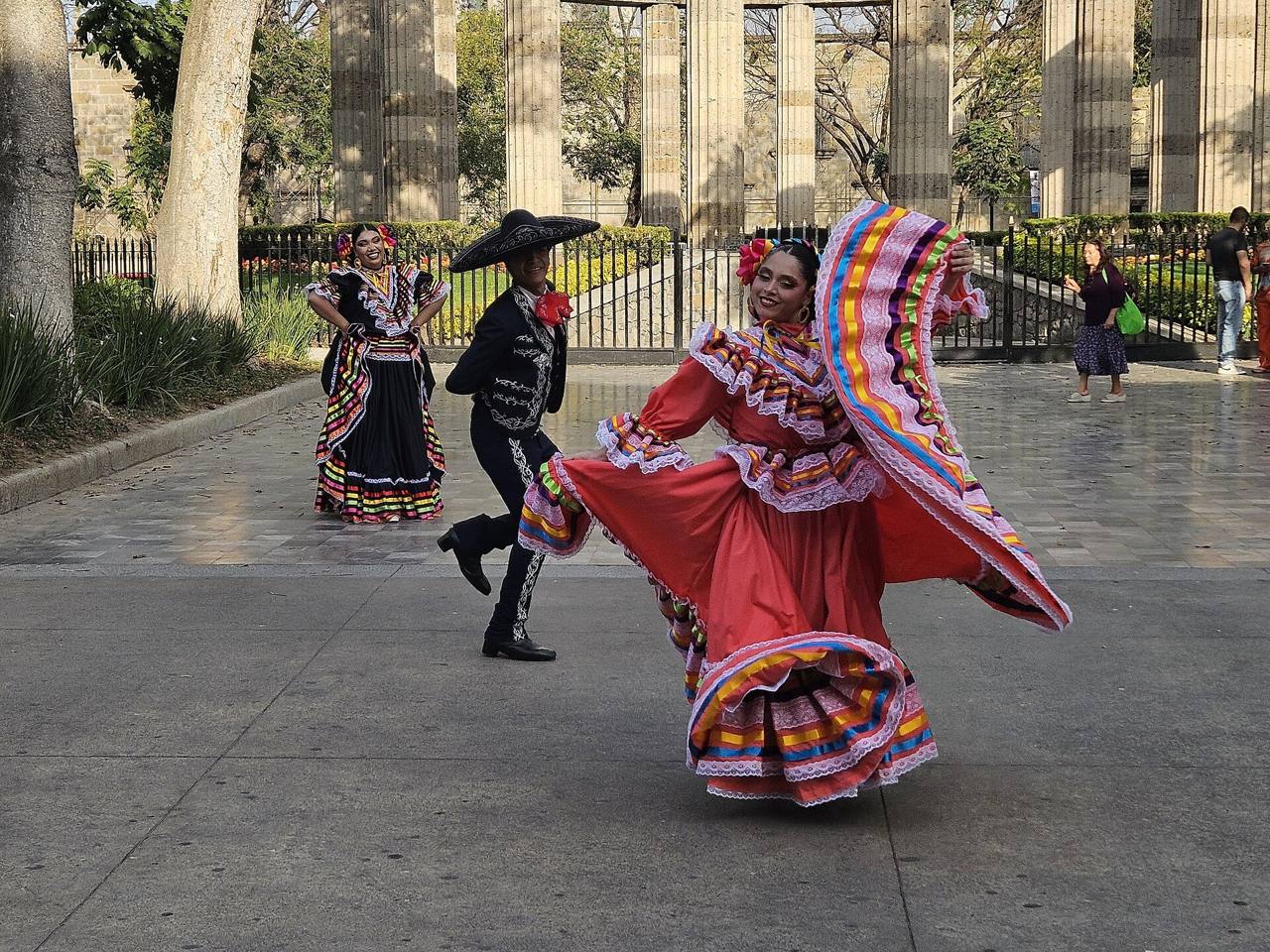
The most famous is the jarabe tapatío — “tapatío” means from Guadalajara — known abroad as the Mexican hat dance: in some versions the woman dances around the sombrero the man has tossed to the floor. In 1910 the newspaper El Imparcial already pictured it danced by a charro and a china poblana — the couple that still represents Mexico on stages around the world. In 1919 the Russian ballerina Anna Pavlova, after visiting Mexico, added it to her permanent repertoire, and in the nationalist years that followed the jarabe was consecrated as the national dance: Britannica dates its official status to 1921.
While the centre and the south danced sones and jarabes, the north learned to dance in a European accent. The polka, a popular dance of European origin, arrived in Mexico in the 19th century and took root so deeply that in Chihuahua it became one of the most representative dances of the regional tradition. With it came the redova — a skipping waltz step from Bohemia — the schottische, Mexicanised as chotís, and the waltz, and with them the instrument that would define the region: the button accordion, spread by German immigration to Mexico in the 1860s and by German and Czech settlers across the border in Texas.
The accordion found its partner in the bajo sexto, a deep-bodied guitar with doubled strings whose exact origin is unknown but which consolidated on the border. From the early 20th century the conjunto norteño took shape, and its music moved from the cantinas to the party halls of Monterrey's elites. In 1935 the accordionist Narciso Martínez, born in Reynosa, began recording with the bajo sexto player Santiago Almeida, and the sound of polka and redova on both sides of the Río Bravo became the soundtrack of northern fiestas and dances.
The north is also Indigenous ground. In the Sierra Tarahumara of Chihuahua, the Rarámuri dance the matachines, probably introduced by missionaries at the end of the 17th century and already present in the 18th; the name has been linked to the Spanish matachín of the Moors-and-Christians tradition. Danced to the violin with a palm in the hand, they belong to the winter cycle of feasts — 12 December for the Virgin of Guadalupe, Christmas Eve, Epiphany, Candlemas — alongside older Rarámuri dances such as the yúmari, the ritual of healing and fellowship.
Further west, in the eight Yaqui (Yoeme) pueblos of Sonora — Vícam, Pótam, Tórim, Bácum, Loma de Guamúchil, Ráhum, Huírivis and Belem — Lent and Holy Week have been celebrated for more than 400 years, through wars and persecution. The masked chapayekas, whose name means “long nose” in the Yaqui language, take part in the Passion drama, and the pascola and deer dancers are part of the preparations: ceremonies in which dance is still prayer, as it was before 1521.
After the Revolution (1910–1920) the new state wanted art to reach every school. In 1923 José Vasconcelos, Secretary of Public Education, created the Misiones Culturales, the most important nationalist strategy for bringing the arts into schools. The cultural missionaries travelled to rural communities, and the regional dances they left behind became a fixture of school festivals all over the country.
Mexico's first public dance school opened in 1932, after a trial run in 1930–1931 as the Escuela de Plástica Dinámica. Between 1932 and 1937 it began recording and cataloguing regional dances, music, costumes and customs, with fieldwork in the communities. Its most famous teachers were the sisters Nellie and Gloria Campobello: Nellie — also the author of the Revolution novel Cartucho (1931) — staged the mass ballet 30-30 in 1931, published Ritmos indígenas de México in 1940 and co-founded the Ballet de la Ciudad de México in 1942. Today the school bears both sisters' names.
The regions joined in. In 1932, for the 400th anniversary of the city of Oaxaca, the state organised a festival with dances from all its regions; in 1942 it took the name Guelaguetza, a Zapotec word for offering and mutual help, and in the 1950s it was joined to the July celebrations of the Lunes del Cerro.
Amalia Hernández, born in 1917, begged her father at the age of eight to let her learn “real dance”; he built her a studio at home. She trained in classical ballet, Spanish, modern and Mexican regional dance, and in 1952 she created her own company — then called the Ballet Moderno de México — which premiered Sones antiguos de Michoacán.
The company started with eight dancers, and weekly appearances on television in 1954 helped it grow fast. In 1959, with about 60 members, it represented Mexico at the Pan American Games in Chicago and merged with Felipe Segura's group to become the Ballet Folklórico de México. It debuted at the Palacio de Bellas Artes in January 1960, won first prize at the Festival of Nations in Paris in 1961 and has since visited more than 300 cities in 60 countries.
Hernández created more than 70 choreographies, including dances for the operas La traviata and Moctezuma. Since 1960 the company has performed at Bellas Artes on Sunday mornings and Wednesday evenings — more than 15,000 performances for over 22 million people — and when she died in November 2000, its next show at Bellas Artes became a farewell tribute to her.
Mexican modern dance has a founding mother: the dancer Waldeen, who first performed in Mexico City in 1934, at the Teatro Hidalgo with Michio Ito, and returned in 1939 at the invitation of the Ministry of Public Education to start a modern dance school. By 1940 she was directing the Ballet de Bellas Artes, and works such as La Coronela, with music by Silvestre Revueltas, brought Mexican themes into modern technique. Her students included Guillermina Bravo and Josefina Lavalle.
The state built the institutions. The law creating the National Institute of Fine Arts (INBA) was published on 31 December 1946, and its first director, Carlos Chávez, invited Guillermina Bravo to found and direct the Academia de la Danza Mexicana. At the end of 1948 Bravo founded the Ballet Nacional de México, which she co-directed with Josefina Lavalle until 1958.
Born in Veracruz in 1920, Bravo became the matriarch of Mexican contemporary dance. Mexico City's Teatro de la Danza, devoted entirely to dance, opened on 19 September 1969, and from 1991 her company moved to Querétaro as the Centro Nacional de la Danza Contemporánea, where she died in 2013.
The danzón was born in Cuba in the 19th century — its first manifestations, scholars now stress, were in the Black communities of Havana and Matanzas — and it reached Mexico through Mérida and Veracruz before travelling on to Mexico City. In the capital it found its temple: the Salón México, opened on 20 April 1920 at Pensador Mexicano 16, remembered as a “cathedral of danzón”, where orchestras such as Prieto y Dimas and Acerina played. From 1932 Dimas's danzón Nereidas helped give the Mexican danzón its own voice.
Mexico City became the capital of Afro-Caribbean dance music. The Cuban Dámaso Pérez Prado arrived in 1948, and late in 1949 his “¡Qué rico mambo!” set off the mambo craze that he spread to the world from Mexico; he became a Mexican citizen in 1980 and died in Mexico City in 1989. In 1953 another Cuban, Enrique Jorrín, launched the cha-cha-chá with La engañadora, and his first cha-cha-chá recordings in Mexico, made for RCA Victor with Los Tres Ases, started the rhythm's boom in the country.
The golden age ended by decree: in 1962, under the “iron regent” Ernesto P. Uruchurtu, the Salón México was closed and demolished. But the dancing never stopped. The Salón Los Ángeles, a 1930s ballroom, still holds weekly dances; in 1994 Arturo Márquez's Danzón No. 2 carried the genre into concert halls; sonideros spread cumbia through the barrios; and in the early 1990s the acrobatic quebradita, danced to technobanda, swept Mexican youth in Los Angeles and the US Southwest.
History has left Mexico not one dance but a map of them. In Jalisco the jarabe tapatío and mariachi became symbols of the whole country. On the Gulf, the son jarocho of the Sotavento is danced on the tarima at fandangos, while in the Huasteca — a region that overlaps six states — the trío huasteco of violin, jarana and huapanguera plays huapangos sung with leaps into falsetto.
Each July Oaxaca's Guelaguetza brings the dances of the state's regions to the capital. In Michoacán the P'urhépecha dance the Danza de los Viejitos, with old-man masks, canes and wooden-soled sandals; in Chiapa de Corzo the Parachicos dance every January for Saint Sebastian; and in Veracruz the Voladores still fly from their pole.
In Yucatán the jarana — zapateada in 6/8 or waltzed in 3/4, played by the orquesta jaranera of saxophones, trumpets, trombone and timbales — is the most representative music of the peninsula and sounds at the vaquería of the patron-saint fiestas. On the Costa Chica of Guerrero and Oaxaca the Diablos come out for the Day of the Dead, and in the north the polka reigns. Each region tells its own version of the same history: Indigenous, Spanish and African roots mixed differently in every valley.
Mexican dance has travelled far. The Ballet Folklórico de México has visited more than 300 cities in 60 countries, and wherever Mexicans settled, their dances followed. In the United States the Aztec or Mexica dance branch of the Concheros arrived in the mid-1970s, and its drums are now heard at festivals from California to Texas.
For Mexican Americans, folklórico became a way of saying who they were. Scholars have shown how the Chicano movement of the 1960s and 1970s turned to dance to celebrate its heritage and played a pivotal role in spreading folklórico across the United States, while the model of the Ballet Folklórico de México shaped how Mexican identity was staged there. The Asociación Nacional de Grupos Folklóricos, a national network organised at the peak of the Chicano movement, celebrated its 50 years in Albuquerque in 2024.
Today folklórico is part of school life in the US. In February 2024 more than 400 Texas students, from elementary to high school, competed in the North Texas Ballet Folklórico Contest in Dallas, and teachers are campaigning for it to become an official statewide school competition, following the path mariachi has taken. In Los Angeles, the Regional Organization of Oaxaca has organised its own Guelaguetza for more than 30 years — a free festival that draws over 15,000 people a year and keeps the dances of Oaxaca alive far from the Cerro del Fortín.
In 2009 UNESCO inscribed the Ritual ceremony of the Voladores on its list of the Intangible Cultural Heritage of Humanity: four young men, tied by ropes, “fly” down from a pole 18 to 40 metres high while a fifth plays flute and drum on the top — a fertility rite best known among the Totonac of Veracruz. In 2010 came the Parachicos of the Great January Feast of Chiapa de Corzo, where masked dancers make a communal offering to Saint Sebastian and other saints from 4 to 23 January.
In 2011 UNESCO added mariachi — string music, song and trumpet — calling it a fundamental element of Mexican culture. Its repertoire includes jarabes, polkas, schottisches, waltzes, regional songs and corridos, and on stage it is the classic partner of folklórico dancers.
Dance in Mexico keeps changing. In the barrios of Mexico City, sonidero culture — born in the late 1950s, when sound systems offered a cheaper alternative to live bands — fills streets in Tepito and Peñón de los Baños with cumbia, salsa and guaracha, and in October 2023 the city government declared it intangible cultural heritage of Mexico City. Meanwhile the folk dances that the Cultural Missions brought into schools still fill school festivals, and the bodies of a new generation carry centuries of rhythm into the future.