··EN · ES · FA
Tap a region to read its story
Swipe the timeline
Iran’s provinces are administrative units, while dance traditions belong to communities, languages and intersecting histories. This directory travels across all thirty-one provinces through thirteen cultural landscapes. For each province, it names a representative repertoire or research priority; it never invents a dance merely to fill a box.
Iranian Azerbaijan sits at a meeting place of languages, markets and musical exchange. Tabriz, Ardabil, Zanjan and western Azerbaijani-speaking areas preserve diverse repertoires, from communal line or circle forms to virtuoso solo displays. Yalli and Lezginka are labels used across a wider Caucasus–Anatolia cultural zone, so a dance name alone cannot locate a recording.
Movement vocabulary includes upright bearing, precise footwork and contrasting ways of using the arms, but gendered stage conventions should not be projected onto every village celebration. Music, local language and provenance are as important as the dancers’ posture.
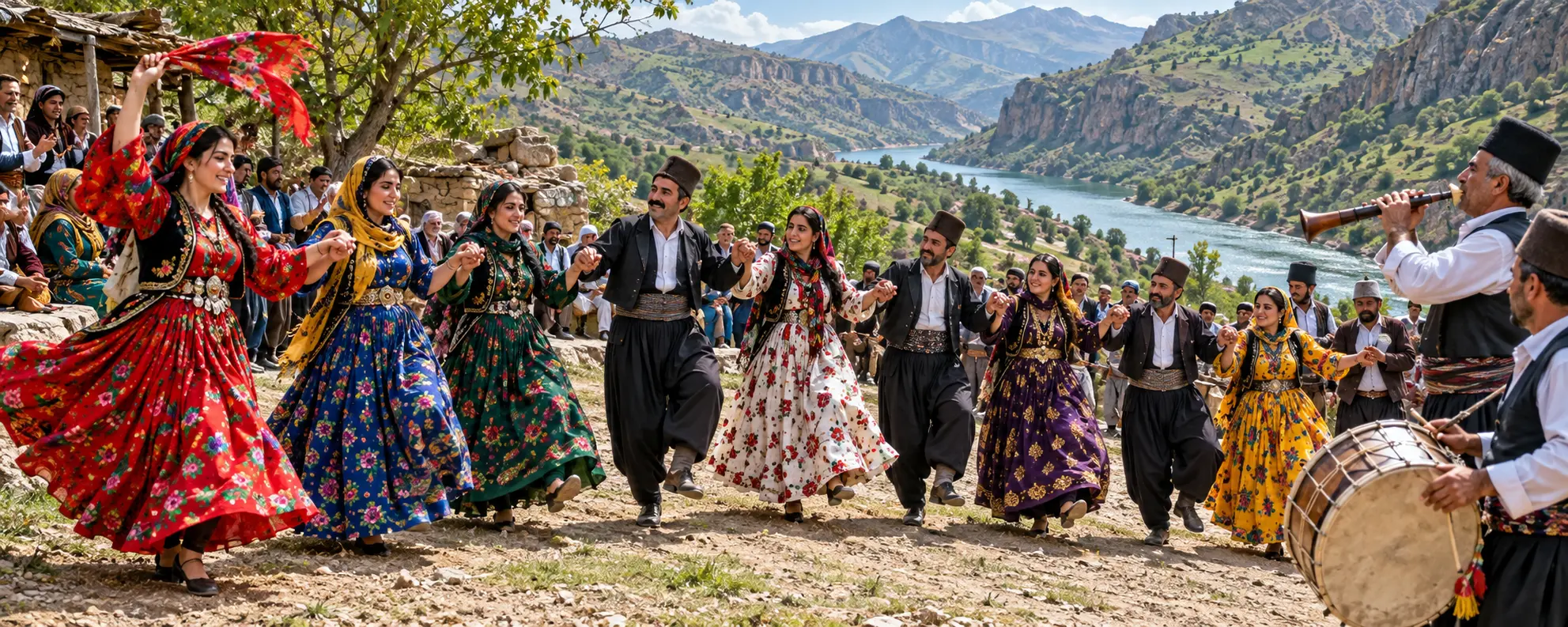
Across Kurdistan, Kermanshah, Ilam, West Azerbaijan and Kurdish communities in Khorasan, linked lines are a public language of social belonging. Halperke is not a single set of eight counts: pace, holds, leading handkerchief and melody vary between local names and dialects. The circle is a practical way to share timing and social presence.
Celebratory group dance and the dhikr or samāʿ of a particular Sufi order cannot be merged. A daf may sound in more than one context but does not make those contexts identical. Archive labels should state whether the filmed scene is a wedding, ensemble performance, festival or devotional gathering.
The Zagros are not only mountains in the background of a dance photograph. They are routes of pastoral migration, village festivals and intertwined Lur and Bakhtiari memories. At celebrations, sorna and dohol can call people into linked lines; the person at the head negotiates pace and improvisation while the whole chain keeps time. The precise sequence changes between communities.
Chupi, sangin-samâ, se-pâ, do-pâ and scarf-led variants should be heard in local dialects and not arranged into a false single syllabus. Bakhtiari dastmal-bazi belongs to a different ensemble of customs, even where musical instruments overlap. Choob-bazi brings a controlled playful encounter into wedding celebrations; it must not be represented as literal ancient combat training.
Mourning is a different chapter. In certain Lur communities, Chamari articulates grief, shared memory and honouring the departed. Even if outsiders notice circular motion or percussion, it is ethically wrong to collapse Chamari into a festive dance. DANZO asks custodians and families to define how their own observances may be described or filmed.
Khuzestan is not one folk costume. Arab Iranian communities, Lurs, Bakhtiaris and other groups live amid rivers, towns, plains and mountains, creating different wedding musics and social expressions. Some traditions connect to broader Gulf and Mesopotamian patterns; identifying a local performance demands attention to the community and its language.
For this reason a Bakhtiari scarf dance, a Lurish line or a coastal rhythm must each keep its own attribution. A provincial map is a navigation aid, not a claim that every resident shares the same dance heritage.
The Caspian slopes bind forests, paddies, trade routes and village ceremonies. Qasemabadi is associated particularly with Ghasemabad in Gilan, where colourful skirts and carefully patterned hand gestures have become visible emblems of local performance. Staged versions often amplify harvest imagery, but field practice and theatrical composition should be distinguished.
Gilaki and Mazandarani identities must not be blurred simply because both neighbour the sea. Their languages, songs, costume traditions and celebratory movements differ, and the Talish belt adds yet another network of community practice. The atlas shows the boundaries as overlapping cultural conversations rather than as a neat row of costume postcards.
To document a Caspian dance well, ask where it was performed, who taught it, what music accompanied it and whether its clothing was everyday, festive or designed for the stage. Those details reveal more history than a generic label “northern dance.”
Mazandaran has its own linguistic and musical traditions along the Alborz and southern Caspian, shaped by mountains, plains and village festivities. Calling every northern dance “Qasemabadi” erases differences: Qasemabadi belongs specifically to Gilan. This chapter therefore points to it only as a neighbouring comparison.
Community descriptions should distinguish music for seasonal work, wedding entertainment and dances composed for modern stages. DANZO invites Mazandarani practitioners to supply names, locally recorded videos and oral history before attaching more definitive labels.
Golestan’s Turkmen Sahra carries Turkmen-speaking identities, distinctive music, horses, textile artistry and communal celebration. Iranian Turkmen practice should be documented locally; simply embedding footage from Turkmenistan without identifying its origin would repeat a common atlas error.
The chapter keeps its own place even while the DANZO video archive grows. Where a specifically Iranian Turkmen dance video cannot be verified, the atlas offers a Persian YouTube discovery route rather than filling the gap with an unrelated performance.
Khorasan is a crossroads rather than one homogeneous repertoire. Bakhshis transmit narrated epics and music, while Turbat-e Jam, Torbat-e Heydarieh, Bojnord, Quchan and Birjand hold differing local practices. In the north, Kurmanji Kurdish communities preserve collective dance and movement games; in the south, stick dances have documented local terminology.
UNESCO inscription of the music of the Bakhshis does not automatically declare every local dance a UNESCO heritage dance. Bakhshi storytelling, choub-bazi, sepa/chorography and Kurdish line dancing should be named on their own terms. Researchers have documented military imagery in some North Khorasan Kurmanji movement games without claiming every present performance is combat.
From Isfahan and Kashan to Tehran, Yazd, Qom, Markazi, Semnan and Alborz, urban and oasis histories intersect with migration, professional entertainment, poetry and ritual athletics. Safavid and Qajar imagery belongs to some of these cities’ historical record; today’s Iranian classical stage technique is a researched modern language, not a preserved court score.
Cities also welcome families from distant regions, so seeing a Kurdish or Lurish dance at a Tehran wedding does not make it an indigenous “Tehran dance.” DANZO distinguishes where a performance happens from where its tradition is rooted; for poorly documented provinces it invites sources instead of inventing labels.
Qashqai communities in Fars and neighbouring highlands maintain their own lively social dance repertoire. Encyclopaedia Iranica records āqor haley as slower, heavier women’s dance, and lakke haley as lighter and faster. Scarves, gesture, musical phrasing and the changing geometry of a gathering carry meanings that cannot be read from costume alone.
Qashqai haley is not another name for Bakhtiari dastmal-bazi. Both may feature colourful cloth, yet music, community identity and movement structure differ. Local teachers and family archives are essential to build a responsible performance gallery.
The Persian Gulf coastline is a history of boats, fishing, pearl trades, migration and encounters with Arabia, East Africa and South Asia. Bandari is not a costume from a generic nightclub; festive movement takes shape through southern rhythmic accents, shoulders, arms and social improvisation in specific port communities. The clothes of Hormozgan, such as kandureh, decorated trousers and orni scarves, deserve careful local identification.
Bushehr, Bandar Abbas, Qeshm, Hormuz and the Makran coast cannot be reduced to one “southern” rhythm. Language and instrumentation change along the shores; public wedding music should be distinguished from ritual repertoires. A video from another Gulf country is not automatically evidence for a performance in Iran.
Zār ceremonies are part of specific community systems of belief and specialist-led care, not a tourist workshop. Their histories reflect Indian Ocean connections, but terms, protocols and permissions vary. No health outcome is implied by describing their cultural role.
Sistan’s borderlands and Helmand history connect eastern Iranian communities through music, migration and ritualized public display. Some sword and stick exhibitions are known in regional stage repertoires; their labels must be checked against the performers and locality rather than folded into a single invented ancient military dance.
This landscape and neighbouring Baluchestan share an administrative province today, but their community histories and dance terminology need separate treatment. DANZO’s Sistan chapter therefore does not use Guāti to stand for a public sword performance.
Baluchestan’s languages, clothing and music are inseparable from routes across Makran and the wider Baluch cultural world. There are festive, social and staged movement traditions beyond ceremonies. It would be a serious error to let Guāti—a specific specialist-led ritual—stand for all Baluch dance.
Coastal exchange, embroidery and instrumental combinations vary by place. Researchers should first establish which community performed a piece, what it calls the movement, and whether public display is appropriate. Sacred filming without consent does not count as heritage preservation.