··EN · ES · FA
Tap a region to read its story
Swipe the timeline
Twelve places where Iran’s history, landscapes and living music meet — from Persepolis and Isfahan to the stepped village of Masuleh, the Zagros, the Caspian and the Gulf.
The stone terraces of Persepolis were developed under Achaemenid rulers beginning with Darius I. Monumental stairs, columns and sculpted delegations offer a view of a court that brought many peoples and artistic traditions into one ceremonial setting. Its UNESCO designation recognizes extraordinary architecture and imperial history. The reliefs cannot, however, be read as an exact record of ancient dances.
For a dance atlas, Persepolis teaches an essential distinction: Iran possesses deep traditions of ceremony, music and representation, but modern choreography should never be passed off as a perfectly preserved Achaemenid performance. Explore its visual symbolism alongside Fars’s living Qashqai communities and the long history of Persian performance.
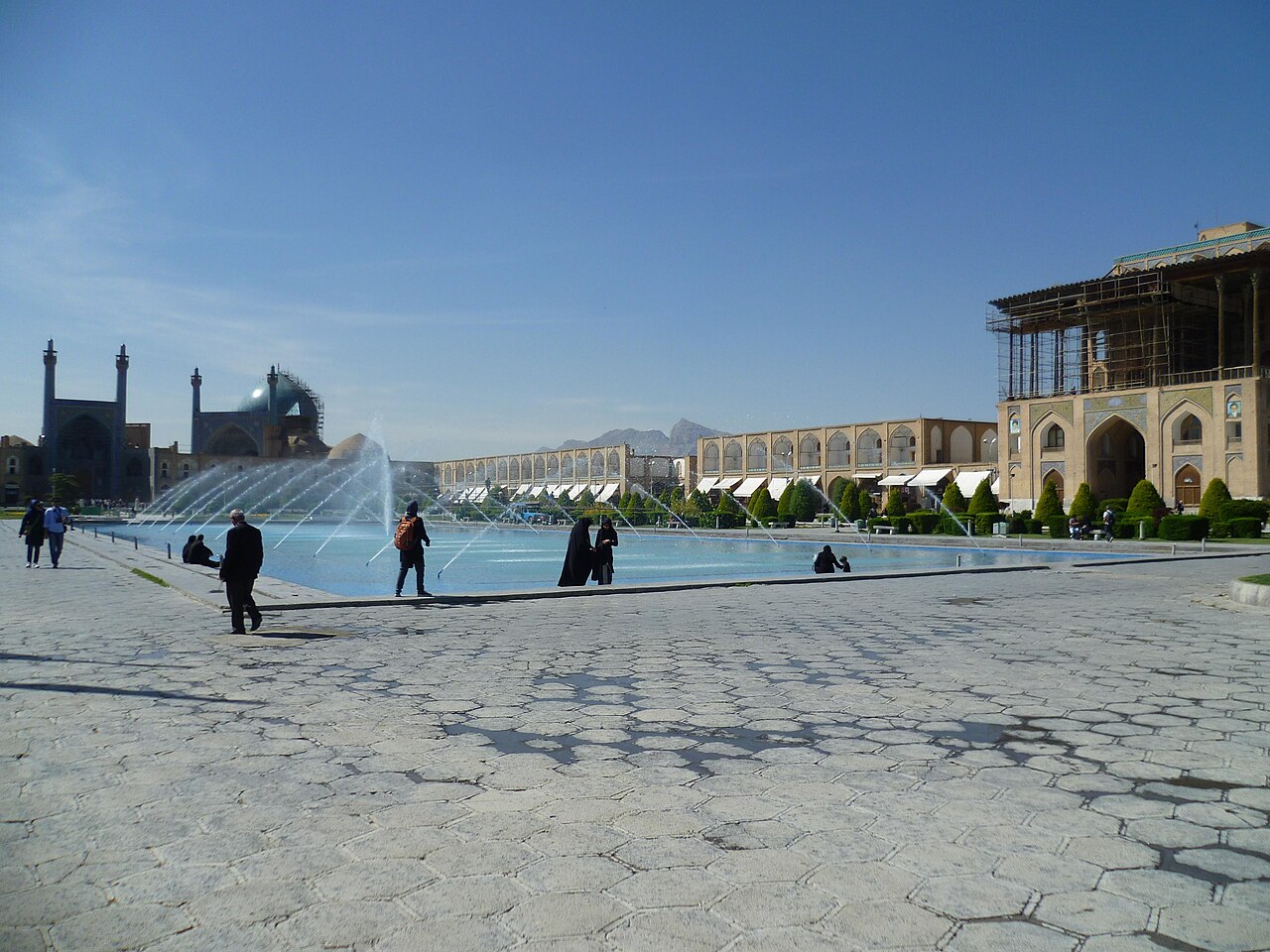
Naqsh-e Jahan, also known as Meidan Emam, is one of the great surviving urban compositions of Safavid Iran. Its arcades, Ali Qapu Palace, the mosque of Sheikh Lotfollah and the great royal mosque frame a public world of commerce, state ceremony, craft and devotion. Its UNESCO recognition belongs to this designed ensemble, not to one isolated building.
The acoustic rooms of Ali Qapu and Isfahan’s courtly artistic heritage invite questions about how music moved between palace, street and gathering. There is no need to invent dancing inside the square: the documented buildings and the city’s craft traditions are compelling enough. DANZO connects this place to the wider story of Persian court aesthetics, while keeping present-day dance reconstructions clearly labeled.
Hafezieh is the memorial garden of Hafez, the celebrated fourteenth-century lyric poet of Shiraz. The place acquired layers of patronage and redesign over centuries; the pavilion familiar to visitors today reflects a much later architectural history than the poet’s lifetime. It is a place of reading and remembrance, and a doorway into the lasting cultural life of the Persian ghazal.
Poetry and movement often meet through meter, gesture, musical phrasing and expressive interpretation. Hafez’s verse has inspired musicians and performers, but a modern Persian dance to a ghazal is an artistic interpretation—not evidence of a fixed medieval dance at this tomb. This distinction enriches rather than diminishes the experience.
Masuleh clings to a steep slope of the Talesh mountains, about 60 kilometres south-west of Rasht and roughly 1,050 metres above sea level. Its ochre houses are built one above the other, so the roof of one home becomes the courtyard or lane of the house above. Cars cannot enter; people move along terraces, stairways and narrow passages, just as they have for centuries.
The village grew as a mountain trading and iron-working centre between the Caspian lowlands and the uplands of Gilan. Its bazaar, mosques, wooden windows and teahouses make it one of Iran’s best-loved heritage villages, and Iran placed ‘The Historical City of Masouleh’ on its UNESCO World Heritage Tentative List in 2007.
Masuleh belongs to the Gilaki and Talesh cultural world of the Caspian. Come for the morning mist, local cookies and woven goods, and listen for Gilaki songs; the colourful Qasemabadi dance of eastern Gilan is the region’s best-known dance, though it was not born in Masuleh itself.
On a prominent rock above Khorramabad stands Falak-ol-Aflak, a fortress whose appearance records successive periods of Iranian history. The citadel served rulers and, in modern times, had darker institutional uses before becoming a heritage and museum setting. Its commanding position over the old city makes it a landmark of Lorestan, not merely a picturesque castle.
For DANZO, the castle is an invitation to explore the people of the surrounding Zagros. Lurish chupi, do-pâ, se-pâ, slower sangin-samâ and the distinct mourning rite of chamari should be learned from their own communities and settings. We do not claim those dances historically took place inside the fortress. The link is to Lorestan’s living landscape and social memory.
Damavand rises above the Alborz range as Iran’s highest mountain and a striking volcanic landscape. Beyond geography, it occupies a powerful place in Persian literature and mythology, including traditions concerning Zahhak and Fereydun. The legends are cultural narratives, not archaeological reports. Its snow, high pastures and seasonal flowers help explain why the mountain remains such a compelling national image.
The mountain’s presence in poetry and art inspires contemporary movement, yet Damavand is not a single traditional dance or an invented origin point for all Iranian folk styles. DANZO places it beside the varied cultures of the Alborz and Caspian regions, where music and dance have their own local names and histories.
Urban gateway to Iranian Azerbaijani cultural traditions. Tabriz is one of Iran’s oldest trading cities, and its covered bazaar is among the largest in the world.
Iranian Azerbaijan sits at a meeting place of languages, markets and musical exchange. Tabriz, Ardabil, Zanjan and western Azerbaijani-speaking areas preserve diverse repertoires, from communal line or circle forms to virtuoso solo displays. Yalli and Lezginka are labels used across a wider Caucasus–Anatolia cultural zone, so a dance name alone cannot locate a recording.
Ensembles from Tabriz and Tehran perform Azerbaijani dance at concerts, festivals and on international stages; El Goli park is a favourite setting for photos and filming.
Colourful Gilaki performance traditions and Caspian culture. Rasht, the capital of Gilan, is known as the ‘city of rain’; its Municipality Square with its clock tower is the heart of the city.
Rice landscapes, Gilaki identity and layered colourful costumes connect Qasemabadi to northern life. Stage performances may simplify or stylize local traditions.
Explore this place by listening for local language and sound, learning who maintains the tradition, and recognizing that performances for visitors differ from everyday community life.
An important centre of Kurdish music and collective dances. The capital of Kurdistan Province is home to famous musicians such as the Kamkar family.
Across Kurdistan, Kermanshah, Ilam, West Azerbaijan and Kurdish communities in Khorasan, linked lines are a public language of social belonging. Halperke is not a single set of eight counts: pace, holds, leading handkerchief and melody vary between local names and dialects. The circle is a practical way to share timing and social presence.
Explore Bakhtiari costume, wedding music and highland stories.
At about 2,070 metres, Shahrekord is one of Iran’s highest provincial capitals, surrounded by summer pastures used by Bakhtiari families.
Ports where dance rhythms bear traces of oceanic exchange.
Maritime exchange, percussion, Bandari festivities and Zār ritual coexist, but are not interchangeable. Respect differences between public celebrations and restricted ceremonies.
A gateway to Baluch language, embroidery, maritime exchange and regional music; sacred ceremonies require local guidance and consent.
Baluchestan’s languages, clothing and music are inseparable from routes across Makran and the wider Baluch cultural world. There are festive, social and staged movement traditions beyond ceremonies. It would be a serious error to let Guāti—a specific specialist-led ritual—stand for all Baluch dance.