··EN · ES · FA
Tap a region to read its story
Swipe the timeline
There is no single movement that can contain Iran. On a wedding night in the Zagros, people join hands and make a line move as one body. On the Caspian coast, a dancer’s bright skirt marks the rhythm of a village celebration. Across the Persian Gulf, the arms and shoulders speak with drums and port-city songs. These are different languages of belonging, not provincial versions of a supposed uniform national choreography.
To write Iran’s dance history fairly is to listen to its peoples—Lur, Bakhtiari, Kurd, Gilak, Mazandarani, Azerbaijani, Qashqai, Baluch, Turkmen, Arab, Persian and many others. Their cultural landscapes overlap; migration, marriage, trade, religion and changing borders have always complicated any simple map. DANZO therefore names the community, the place, the occasion and the reliability of the evidence whenever possible.
Paintings, vessels, reliefs and figurines from different eras of the Iranian cultural world portray musicians, acrobats and figures interpreted as dancers. Parthian-era terracottas and wall paintings are among the traces discussed by historians. Music occupied important places in Sasanian court life, but a surviving image of raised arms cannot tell us every step, melody or social purpose of an ancient performance.
Ancient heritage gives Iran a deep artistic history; it does not establish an uninterrupted, identical line from a specific prehistoric scene to today’s Chupi, Halperke or Bandari. The honest story is more fascinating: generations inherit rhythms and social ideas while changing the form. Where evidence is fragmentary, DANZO says so rather than assigning a legendary date of origin.
After the seventh century, musical practices did not simply vanish. Courts, cities, villages and spiritual communities developed distinct responses to song, bodily expression and the religious debates surrounding them. In Persian literature, movement and listening may signify delight, longing or devotion; literary metaphor must still be distinguished from a manual of actual dance steps.
Samāʿ means spiritual listening and, depending on an order and historical setting, may involve recitation, rhythm, swaying or turning. The widely photographed Mevlevi ceremony of Konya is an important Anatolian tradition, not a shortcut that represents all Iranian Sufi practices. Kurdish and other Iranian devotional gatherings require attention to their own orders, leaders and consent.
Travelers, paintings and accounts from Safavid Iran document performers in courtly and urban settings, where music, theatrical play and dance could accompany entertainment and ceremony. Isfahan was a major centre of this world, but the surviving material records selective views—often those of elites and outside observers—rather than the totality of rural movement traditions.
Modern reconstructions may draw inspiration from the painted sleeves, postures and expressive gestures of this art. They can be beautiful and historically informed, but a painting is not a preserved choreography. DANZO labels reconstruction, historical art and living village practice separately.
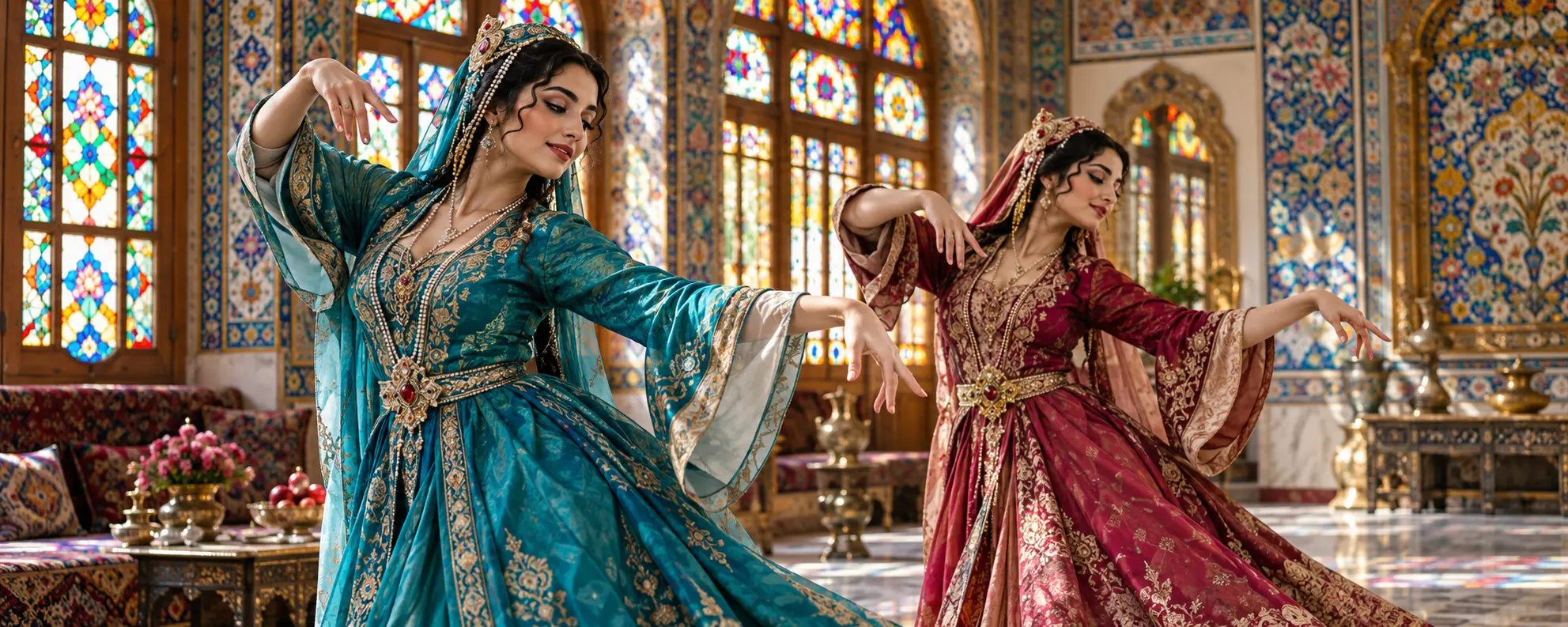
Nineteenth-century court painting and travel accounts make the Qajar world unusually visible: dancers, musicians and entertainers appear in both elite and public settings. Delicate wrists, facial play, shifting weight and expressive pauses are part of the vocabulary modern Iranian dance artists explore. Yet those artists are themselves creators, not mechanical replicas of Qajar figures.
The term “classical Persian dance” is modern and contested; scholarship asks how a genre can be defined when historical notation is absent and today’s staged vocabularies were assembled through interpretation and teaching. This does not diminish the art; it clarifies how its heritage and present-day invention interact.
Many regional dances were transmitted through participation rather than through written scores: a child watches relatives, a young person enters the line, a leader signals a change of pace, and the sound of sorna, dohol, daf or local strings draws the dancers together. Mountain pastoral life, rice agriculture, port trade and nomadic migrations shaped different occasions and different kinds of movement.
A chain dance is therefore a social architecture. The person at the front may show virtuosity; the linked bodies still negotiate rhythm and trust. But dances are not fixed ethnic museum objects. Families move, musicians borrow, costumes change, and a wedding dance in one village may have a different name or step sequence a valley away.
Some visible movement belongs to athletics, devotion, healing beliefs or mourning rather than to festive dance. UNESCO-recognized Pahlevani and Zoorkhanei rituals combine rhythmic exercise, drumming, poetry and ethical instruction; they are not simply a “war dance.” Samāʿ concerns spiritual listening. Zār and Guāti have local specialists and beliefs concerning affliction; no medical effectiveness should be inferred from their traditional accounts.
Among some Lur communities, Chamari mourning involves music, collective presence and a distinct emotional language. It must not be marketed as a joyful “Lurish dance show.” The right to film sacred or grieving communities belongs to the people involved; preserving heritage begins with consent, accurate names and recognition of loss.
In the twentieth century, urban institutions and folklore ensembles began moving regional traditions onto national and international stages. The state-supported Iranian folklore organization established in 1967 helped circulate choreographed versions, costumes and theatrical combinations. Stage preservation brought visibility, but it could also standardize practices that differed from community to community.
After 1979, conditions for public dance in Iran changed sharply; private celebrations, local cultural practices and artists abroad followed different paths. Diaspora teachers have developed formal pedagogies and new artistic work. Neither a polished stage troupe nor a family wedding should be treated as the single authentic version: each answers to its own context, permissions and history.
A painting establishes what an artist depicted; an archival film records one event; a practitioner’s account preserves situated knowledge; a new stage production is a creative interpretation. These sources answer different questions. Our regional directory presents representative practices, not an exhaustive inventory of every village, family and ceremony in thirty-one provinces. Names and boundaries will evolve as community historians contribute.
The ambition is not to freeze Iranian dance under glass. It is to make a careful, multilingual meeting place where people can recognize themselves, correct mistakes, share a permitted recording and pass a rhythm forward without losing the community that gave it meaning.