Tap a region to read its story
The History of Dance in Greece
Eight illustrated chapters · living people and changing traditions
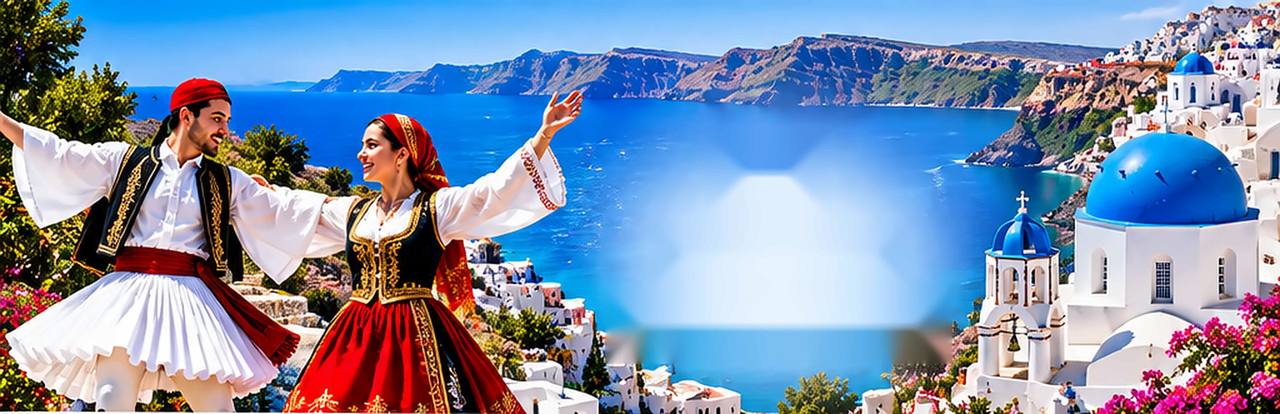
Follow the music from village squares to island celebrations, from the streets of Piraeus to the theatre stage. These chapters introduce the people and moments behind the dances. The images are artistic interpretations.
A country that gathers in dance
Imagine a summer evening in a Greek village. The musicians begin playing, someone offers a hand, and the circle slowly grows. Grandparents recognize a tune they have loved for decades; younger dancers learn by watching the feet beside them. In another city, a solitary dancer listens to a rebetiko song and moves in a completely different way. Both scenes belong to the story of Greece.
There is no single dance that tells the whole story. Island melodies, Cretan steps, mainland circles and the memory carried by Pontic families have developed in different places and eras. Even the internationally famous Sirtaki has a modern cinematic beginning. To understand Greek dance is to meet the people who keep these many traditions alive.
Village circles, participation and memory
Kalamatianos is among the best known Greek communal dances, widely taught and adapted in villages, diaspora gatherings and public celebrations. Its name is associated with Kalamata, but local performers use it across regions. Like other circle dances, it is a way of making room for a changing group of participants rather than presenting a fixed national costume or a single village version.
The connected line makes a visual image of community continuity and celebrates local differences within a broad dance family. Photographs should name the island or region and not present all whitewashed village festivals as interchangeable.
Mainland leadership and measured movement
Tsamiko is a stately dance associated with parts of the Greek mainland, including Epirus and central Greece. The performance is shaped by village histories and the public roles of lead dancers rather than simply by spectacular leaps. Festival ensembles may use formal dress such as the foustanella, but ordinary village participation and stage presentations need to be distinguished.
In the shared line, individual virtuosity is held within collective support. The dance can honor resilience and memory, but meaning is shaped by the occasion and the people present, not by a single modern nationalist narrative.
Crete: lyra, music and movement
Pentozali belongs to the lively dance traditions of Crete. Local musicians, especially the Cretan lyra and the laouto, drive the quick movement heard at village celebrations and staged folk performances. Stories about its historical origin are often retold, but the cultural evidence of living dancers, musicians and families matters more than treating any single legend as proven fact.
Pentozali is a public expression of Cretan togetherness, with energetic leadership framed by group discipline. A respectful atlas names the village, the musicians and the performers rather than using the dance as a timeless postcard of all Greece.
Island panigyria: culture held together
Ikariotikos is closely associated with the island of Ikaria and its beloved panigyria, the village festivities that bring relatives, residents and visitors together. The Greek tourism authority describes the island gatherings as a living community practice rather than a concert with dancers on a distant stage. Violin, laouto, food and all-night social life help form this tradition.
For many islanders, dancing together supports relationships across generations and reconnects people who have moved away. Visitors are often welcomed, yet participation involves listening, patience and respect for the hosts. The event belongs to the village, not to a tourism photo opportunity.
Urban dance and rebetiko
Hasapiko is part of the social dance history of the Greek urban world and the musical environment later associated with rebetiko. It is remembered in small groups of friends and tavern performance rather than as a single rural harvest dance. Its layered history reaches through changing port cultures and urban identities; it should not be confused with the later film choreography called Sirtaki.
Zeibekiko belongs to the layered histories of Greek urban song, rebetiko and cultural exchange around the eastern Mediterranean. Rather than a formal couple or chain dance, it is commonly approached as an intense personal solo. Its circulation across cities and communities should be described with care, acknowledging historical exchange rather than inventing a pure, isolated origin.
How Sirtaki became a modern symbol
Sirtaki is world famous, but it is a modern choreographic creation associated with the 1964 film Zorba the Greek. It draws on Greek dance elements, particularly slow Hasapiko and faster related steps, yet it should not be presented as an unchanged ritual of ancient Greece. After the film, communities and tourist venues made the line dance a new, widely recognized symbol.
Sirtaki illustrates how cinema can create a living social symbol without replacing older local dance families. It can be enjoyed enthusiastically while giving proper attention to Kalamatianos, Tsamiko, island Syrtos and the communities whose dances long preceded the film.
Pontic and Thracian continuity
Serra is a forceful dance within the heritage of Pontic Greek communities whose historical roots lie around the Black Sea. Experiences of migration and displacement have made dance and the Pontic lyra important vehicles of memory in Greece and the diaspora. It has its own repertoire and movement vocabulary; it should not be visually confused with Cretan Pentozali or other vigorous group dances.
Zonaradikos is strongly associated with Greek Thrace, where a dancer can connect with neighbors by holding their waist belt or sash. Village celebrations have local variants in tempo and pattern, and the term refers to a manner of group connection as well as a dance family. Its northern regional character should be recognized rather than presenting all Greek lines as identical.
Sources
- Visit Greece — Ikaria village festivals — Visit Greece — Ikaria village festivals
- Visit Greece — Pentozali, Crete — Visit Greece — Pentozali, Crete
- UNESCO — Tranos Choros and Syrrako Festival — UNESCO — Tranos Choros and Syrrako Festival
- UNESCO — Rebetiko — UNESCO — Rebetiko
- Greek Dances Theatre — Dora Stratou — Greek Dances Theatre — Dora Stratou
- Lyceum Club of Greek Women — Lyceum Club of Greek Women
- Greek National Opera Ballet School — Greek National Opera Ballet School
- Greek Ministry of Culture — State School of Dance — Greek Ministry of Culture — State School of Dance
- AKTINA Professional Dance School — AKTINA Professional Dance School
- Thessaloniki YMCA Folkloric Dance Classes — Thessaloniki YMCA Folkloric Dance Classes
- Lyceum Club of Greek Women — Lemnos — Lyceum Club of Greek Women — Lemnos
- Dionisos Traditional Dance — CIOFF — Dionisos Traditional Dance — CIOFF
- Megaron Athens — 2026/27 dance season — Megaron Athens — 2026/27 dance season
- Pina Bausch Foundation — Athens dates — Pina Bausch Foundation — Athens dates
- Greek National Opera — Giselle — Greek National Opera — Giselle
Traditions through the year
Dance history in numbers
Timeline
Swipe the timeline