··EN · ES · FA
Tap a region to read its story
Swipe the timeline
France is a country of regions, and each one dances in its own way. On the Atlantic, Breton chains wind through the night; in the mountains of the centre, couples face each other in the bourrée; in the south, lines of dancers snake through Provençal streets and Pyrenean squares. Use the map to choose a region, or travel from Brittany in the west to Paris at the heart.
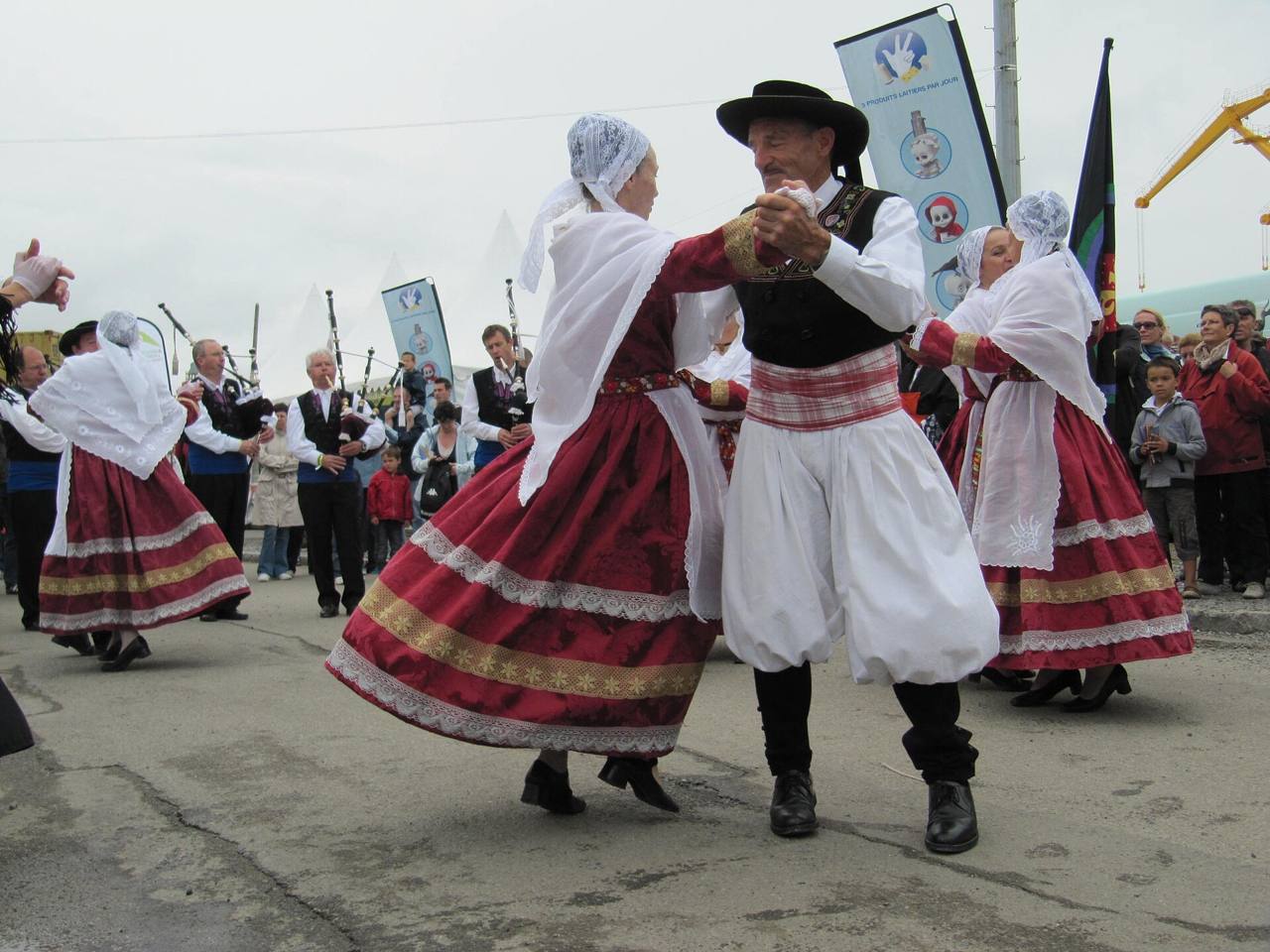
West of a line from Saint-Brieuc to Vannes, the gavotte — gavotenn in Breton, once simply dañs-tro, “round dance” — is a whole family of dances. Dancers link in a closed ring, an open chain or couples, on an eight-beat phrase with one step per beat, and a typical suite has three parts: a gavotte in the round, a “bal” of walking and figures, and a return. Each pays has its own style — Cornouaille, the Montagnes around Carhaix and Poullaouen, the Fisel country of Rostrenen — and the Dañs Plinn is a separate dance of its own.
Gavottes, the an dro, the hanter dro and the plinn are among the best-known dances of the fest-noz, sung a cappella in the call-and-response kan ha diskan or played on the bombarde and biniou, the clarinet, the accordion or the fiddle. About a thousand fest-noz take place every year, gathering from a hundred to several thousand people, and in 2012 UNESCO added the fest-noz to its list of the Intangible Cultural Heritage of Humanity.
Auvergne is the heartland of the bourrée, a dance of quick, skipping steps that is mentioned as a popular dance at Clermont-Ferrand in 1665 and still survives across the Massif Central and in Ariège. Lower Auvergne dances the montagnarde in triple time, High Auvergne the auvergnate in double time; couples face each other, often improvising freely over the musical phrases, and dancers sometimes wear wooden clogs to make their feet heard.
Its instrument is the cabrette, the bagpipe of the Massif Central, which gained its bellows around the middle of the 19th century and whose core repertoire is the bourrée. Auvergnat emigrants carried it to Paris, where cabrette players founded their own union in 1895 — and where their dances became the seed of the bal musette.
The farandole is Provence's signature dance: an open chain of dancers, each holding hands with their neighbours, following a leader who sets the steps and makes the line turn, coil and pass under raised arms — as the poet Frédéric Mistral described it. The music is in a lively 6/8, played by the tambourinaire on the galoubet, a small three-holed flute, together with the tambourin drum. Related to the medieval carole, the dance belongs to a wide family of Mediterranean chain dances.
The farandole went on stage in the 19th century: Gounod set one in front of the Roman amphitheatre of Arles at the start of Act 2 of Mireille (1864), and Bizet closed his second L'Arlésienne suite (1872) with a farandole. In Tarascon, one of the French towns whose processional giants and dragons are inscribed by UNESCO, the farandole follows the effigy of the legendary Tarasque monster through the streets.
North of the Pyrenees, in Labourd, Lower Navarre and Soule, the jauziak — also called mutxikoak or sauts basques — are circle dances in which no one holds hands: the dancers face the centre and follow sequences of steps, some that keep the circle moving and some that turn it back. Dance masters once taught them at home, often paid in kind, starting with the shortest dances; knowing a whole jauzia by heart was a point of pride. Txistu and drum accompanied them, and from the 19th century the accordion. Some see in them descendants of the old French branles — and Soule still has its bralea.
At every fête, couples dance the fandango, almost always followed by the quicker arin-arin, a pair often called the national dance of the Basques. In Soule, the mascarades tour the villages on Sundays from January to April: the “Reds”, led by the Zamalzain horse-man and the Txerrero, stand for order, the ragged “Blacks” for disorder, and the show on the village square includes the codified godalet dantza. In summer, Soule stages its pastorales — open-air sung theatre in Basque lasting three to four hours.
Alsace sits between French and German worlds, and its dances show it. In the 19th century peasant society built its repertoire by combining fashionable ballroom dances with older traditions, adding turning steps from German and Slavic dances. A good example is D'r Meisethàler, the “glassmakers' polka”, reconstructed for the folk group of Berstett from a melody collected by the priest Louis Pinck; dancers of the Kochersberg are said to love it for its turns, partner play and chains.
Today folk groups keep this heritage alive. D'Kochloeffel of Souffelweyersheim, near Strasbourg, has some ninety members and dances pieces such as the Valse de Munster, the Polka des conscrits and the Branle des Bergers, mostly in couples arranged in circles, with walks, jumps, swaying, waltz, polka, schottische and mazurka steps to live accordion. Filmed in 2015 for the Centre national de la danse, the group worked with a contemporary choreographer to open its circles to the audience — “an astonishing example of a restored memory”.
The rondeau is Gascony's own dance, a cousin of the Renaissance branles and of the medieval carole. In the Landes it is danced in chains of four or five, in the south of the Gironde and the north of the Landes by couples with a gliding, rocking step, and in the Gers by two dancers in a livelier style. Regularly danced until the First World War, it almost vanished, then came back with the traditional dance revival of the 1970s; today it is taught in classes and danced at bals folk.
In the Pyrenees the branle is still alive. At Laruns, in the Béarn valley of Ossau, the patronal feast of 15 August opens with dawn aubades and a mass in traditional costume — scarlet jackets for the men, the red silk capulet hood for the women. Each ball begins with the solemn branlo baish, followed by the saut, a men's circle dance once danced by conscripts, and the branlo airejan, to the three-holed flute and string drum, the accordion and Pyrenean polyphony. Around the summer solstice, villages on both sides of the range light the fire festivals inscribed by UNESCO in 2015.
Poitou gave the court one of its favourite dances: the branle de Poitou is said to be an ancestor of the minuet. On the marshy Atlantic coast, people danced the maraîchine, in a line or in a circle, with local variants known as the pas de Challans in the Marais breton-vendéen and the pas du Marais poitevin; postcards from Saint-Jean-de-Monts, Challans and Croix-de-Vie, dated 1905 to the 1930s, show it at weddings and village fêtes.
Inland, Berry is bourrée country too: collectors such as Pierre Panis recorded dozens of forms — for two dancers face to face, for groups of four, for six, in rounds and in lines — with two-beat bourrées in the south of Lower Berry and three-beat ones elsewhere. Since 1990 the Grand Bal de l'Europe has turned the hamlet of Les Gauthiers in Gennetines, near Moulins, into the capital of bal folk: for two weeks each summer, eight wooden dance floors host workshops by day and balls by night — some two thousand dancers came in 2016.
Paris is the capital of ballet: the Opéra's company performs in Charles Garnier's masterpiece, the Palais Garnier, which celebrated its 150th anniversary in 2025 under its ceiling painted by Marc Chagall. Up the hill in Montmartre, the Moulin Rouge opened as a dance hall in 1889 and made the cancan its signature — a dance born in the 1820s from improvised breaks in the quadrille and, since 1868, danced to Offenbach's Infernal Galop.
Working-class Paris danced in the bals musette. Auvergnat migrants brought the cabrette, and Italian accordionists settled in the same streets; around 1904, near the Bastille, the cabrette player Antoine Bouscatel — who ran a café on the rue de Lappe — met the accordionist Charles Péguri, a meeting that symbolises the birth of the musette style. In 1935 the Balajo opened on the same street, and the accordion slowly replaced the bagpipe.
The bal musette had its own dance: the java, a fast, close-held waltz with small steps, danced between about 1910 and 1960 and so intimate that some respectable halls banned it. On Sundays Parisians went out to the guinguettes, riverside taverns along the Marne and the Seine that had grown up beyond the old customs barrier, where wine was cheaper; they declined in the 1960s, but a small revival began in the 1980s, especially along the Marne.