··EN · ES · FA
Tap a region to read its story
Swipe the timeline
France gave the world the language of ballet, the high kicks of the cancan and hundreds of village dances, and each of them belongs to a place: the court of Versailles, the stage of the Paris Opera, the cabarets of Montmartre, the night festivals of Brittany, the squares of Provence and the mountain villages of Auvergne. Here are ten famous places every visitor — and every dance lover — should know.
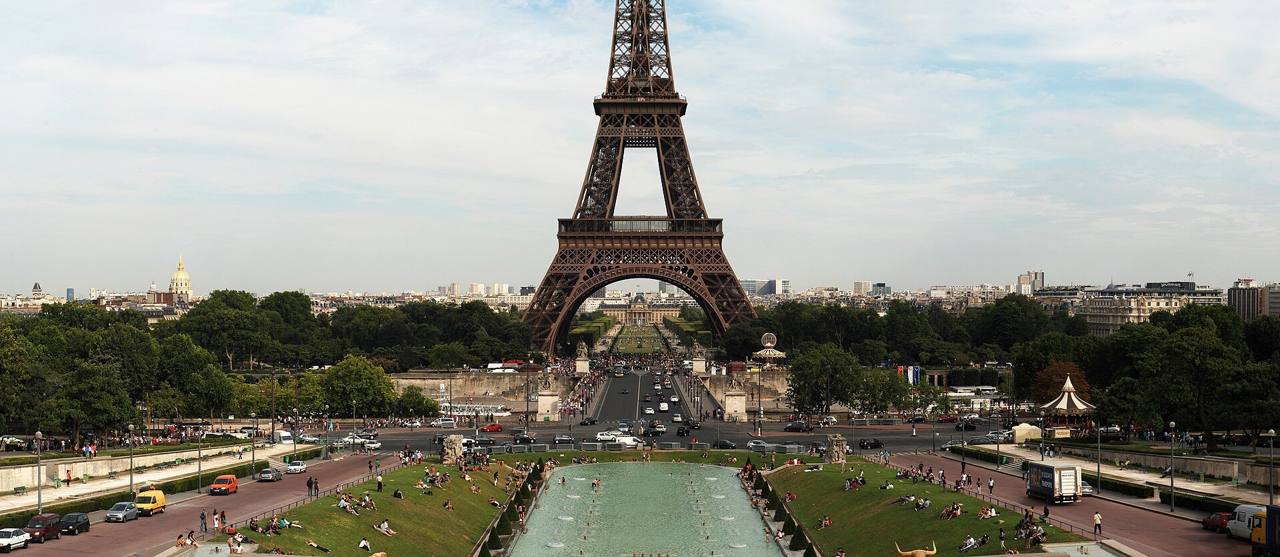
The banks of the Seine in Paris, from the Eiffel Tower to Notre-Dame, have been a UNESCO World Heritage Site since 1991. The tower itself was built by Gustave Eiffel's company for the Exposition Universelle of 1889 and was the tallest structure in the world until 1930. Facing it across the river, the Palais de Chaillot on the Trocadéro houses Chaillot – Théâtre national de la Danse, one of the country's main stages for dance. But Paris is also a city of bals, popular dances. In the 19th century Auvergnat migrants around the Bastille danced the bourrée to the cabrette bagpipe in the back rooms of their cafés; Italian accordionists then turned it into the bal musette of waltzes and the java, and in 1936 the Balajo opened on the rue de Lappe, where it still stands. Every 21 June since 1982 the Fête de la Musique fills the streets with music, and on the nights of 13 and 14 July fire stations open their courtyards for the famous firemen's balls.
In 1861 a young architect, Charles Garnier, won Napoleon III's competition for a new opera house, and his gilded palace of marble, velvet and bronze was inaugurated on 5 January 1875. Its horseshoe auditorium seats 1,979 people under a seven-tonne crystal chandelier and a ceiling painted by Marc Chagall in 1964, and under the building lies a real water tank that inspired the legend of the 'underground lake' in Gaston Leroux's The Phantom of the Opera. Garnier is above all the home of the Paris Opera Ballet, the oldest national ballet company in the world: its roots go back to the Académie Royale de Danse founded by Louis XIV in 1661, and its school opened in 1713. About 150 dancers climb a strict ladder — quadrille, coryphée, sujet, premier danseur — and only the director can name an étoile, the company's highest rank. Behind the stage, the mirrored Foyer de la Danse is still where dancers warm up, and the Opera's Library-Museum keeps nearly 600,000 documents.
On a rocky islet in a vast bay between Normandy and Brittany, Mont Saint-Michel has drawn pilgrims for thirteen centuries. A sanctuary to the Archangel Michael was founded here in 708, a Benedictine abbey followed in 966, and between the 11th and 16th centuries the monks stacked church, cloister and halls on top of the rock; the Gothic ensemble called La Merveille, the 'Marvel', was begun in 1204. The bay has some of the strongest tides in Europe: at high tide the mount becomes an island, at low tide it stands in an immense plain of sand. With its bay it has been a UNESCO World Heritage Site since 1979 and welcomes around three million visitors a year. It is not a dance venue, but it is the threshold of dance country: just west of the bay begins Brittany, where the gavotte and the fest-noz live on, and medieval pilgrims arriving here once sang and danced along the roads.
Provence is the land of the farandole, a long open chain of dancers, hand in hand, that winds through the streets behind a single musician playing the galoubet, a three-holed pipe, with one hand and beating the tambourin drum with the other, in a lively 6/8. Its stage is Arles, whose Roman amphitheatre and ancient theatre have been World Heritage since 1981. Every first Sunday of July the Fête du Costume, begun by the poet Frédéric Mistral in 1903, fills the ancient theatre with women in the Arlesian costume, and every three years a new Queen of Arles is crowned. On 1 May the Camargue cowboys of the Confrérie des gardians, founded in 1512, ride through town for their festival, and in nearby Tarascon the dragon Tarasque parades each June, part of a tradition of processional giants on UNESCO's list since 2008. Upriver, Avignon's Palais des Papes became World Heritage in 1995, and every July since 1947 the Festival d'Avignon, created by Jean Vilar, turns the city into a vast stage for theatre and dance.
On France's Atlantic tip, Brittany keeps its Celtic language and one of Europe's liveliest dance traditions. Its heart is the fest-noz, the 'night festival': hundreds of people in long chains and circles dancing gavottes, an dro and plinn to bombarde and bagpipe or to kan ha diskan, a call-and-response song. Revived in the 1950s, it was inscribed by UNESCO in 2012, and about 1,000 are held every year. In July, Quimper, capital of Cornouaille, hosts the Festival de Cornouaille, born in 1923 as a festival of queens and devoted to Breton culture since 1949, with costumed cercles celtiques and dance contests. In early August, Lorient's Festival Interceltique, founded by Polig Monjarret in 1971, gathers musicians and dancers from Brittany, Ireland, Scotland, Wales, Galicia, Asturias and beyond; its Grand Parade brings more than 3,500 performers into the streets, and the finals of the national championship of bagadoù, Breton pipe bands, are played in its stadium. Groups such as Kevrenn Alre of Auray, both band and dance troupe, have won it many times.
In the heart of the Massif Central, Auvergne is a green countryside of extinct volcanoes, cheese farms and stone villages. Around eighty volcanic cones of the Chaîne des Puys, crowned by the Puy de Dôme (1,465 m), line up above Clermont-Ferrand, and with the Limagne fault they became a UNESCO World Heritage Site in 2018. This is the homeland of the bourrée, first mentioned as a popular dance in Clermont-Ferrand in 1665: couples face each other, advance and cross with light, hopping steps while the women turn and the men stamp and shout, to the cabrette bagpipe, the hurdy-gurdy and the accordion. The tradition is very much alive: Les Brayauds, an association founded in 1980 and now the Puy-de-Dôme centre for traditional music and dance, runs workshops and bals and holds the Les Volcaniques festival every July at Saint-Bonnet-près-Riom. Further north, in the Allier, the Grand Bal de l'Europe has gathered dancers at Gennetines for fifteen days each summer since 1990, on eight dance floors; and in September Le Puy-en-Velay becomes a Renaissance town again, with branles and pavanes in the streets.
In the 19th century the hill of Montmartre, then just outside Paris, was a village of windmills, cheap wine and open-air dance halls. At the Moulin de la Galette, Parisians danced on Sunday afternoons, and in 1876 Pierre-Auguste Renoir painted the scene in his Bal du moulin de la Galette, now in the Musée d'Orsay. At the foot of the hill, on the Boulevard de Clichy, Joseph Oller and Charles Zidler opened the Moulin Rouge, with its red windmill, on 6 October 1889. There the cancan, a dance of the Parisian public balls since the 1830s, became a show: La Goulue, Jane Avril and the double-jointed Valentin le Désossé kicked, cartwheeled and dropped into the splits, and Henri de Toulouse-Lautrec made them famous on his posters, starting with 'Moulin Rouge – La Goulue' in 1891. The original building burned in 1915 and reopened in 1925. Today the Doriss Dancers, a troupe created in 1957, still end each night of the revue Féerie, running since 1999, with a thunderous French cancan.
Ballet as we know it was born at the court of Louis XIV, and Versailles is its monument. In 1653 the fifteen-year-old king danced the role of the rising Sun in the Ballet royal de la Nuit, a spectacle that lasted about thirteen hours — the origin of his nickname, the Sun King. Louis took dance lessons almost every day for more than twenty years from Pierre Beauchamp, who is credited with fixing the five positions of the feet still taught in every ballet class, and in 1661 he founded the Académie Royale de Danse. He turned his father's hunting lodge into a vast palace, remodelled by Le Vau and Hardouin-Mansart, with gardens by Le Nôtre and the Hall of Mirrors, where balls opened with branles and filled with minuets, gavottes and bourrées. Versailles became the seat of the monarchy until the Revolution and has been a UNESCO World Heritage Site since 1979. Today baroque operas and ballets return to the Royal Opera, opened in 1770, and on summer evenings music and lights fill the gardens.
Where the Rhône meets the Saône, Lyon was founded by the Romans as Lugdunum and grew rich on silk; its old town, with Renaissance houses and secret passages called traboules, has been a UNESCO World Heritage Site since 1998. For dance lovers Lyon is a capital of its own. In 1980 the Maison de la Danse opened, one of the first theatres in Europe devoted entirely to dance, and in 1984 its director Guy Darmet launched the Biennale de la Danse, held every two years in September, alternating with the city's contemporary art biennial. In 1996, inspired by the carnival of Rio, Darmet added the Défilé, a huge parade in which thousands of amateur dancers from Lyon and its suburbs, coached for months by choreographers, dance through the city centre. The Lyon Opera Ballet, known for its modern repertoire, and the Roman theatres of Fourvière, which host the Nuits de Fourvière festival each summer, complete the picture.
The Middle Loire, from Sully-sur-Loire to Chalonnes — some 280 km of river, vineyards and royal castles — has been a UNESCO World Heritage Site since 2000. In the 16th century the kings of France lived here, and their châteaux of Amboise, Blois, Chenonceau and Chambord saw the Renaissance court at play: tournaments, masquerades and evenings of dance where branles, pavanes and galliards were danced in long processions through candle-lit halls. A century later Chambord, the vast hunting palace begun by Francis I in 1519, hosted a landmark of dance history: on 14 October 1670 Molière's comédie-ballet Le Bourgeois gentilhomme was first performed there for Louis XIV, with music by Lully — who himself danced the comic Mufti — and choreography by Pierre Beauchamp. South of the river, in the Berry countryside of George Sand's novels, the bagpipe and hurdy-gurdy tradition is still alive: every July since 1976 instrument-makers and musicians have met at the festival now called Le Son Continu — first at Saint-Chartier, now at the Château d'Ars — with concerts and bals where Berry bourrées are danced late into the night.