··EN · ES · FA
Tap a region to read its story
Swipe the timeline
Ballet speaks French. Plié, jeté, pas de bourrée: the vocabulary that dancers use from Tokyo to Buenos Aires was written down at the court of Louis XIV. But France's dance story is much wider than the palace. It begins with villagers singing in a ring, passes through the dance halls of Montmartre and the wedding floors of Brittany, and reaches today's battles of hip hop dancers in Paris. This is the story of how court, stage and village kept borrowing from one another.
The oldest French dance we can name is the carole, a chain or ring dance accompanied by the dancers' own singing. It is first mentioned in the 7th century, had spread across Europe by the 12th and declined in the 14th. In medieval French the word carole meant only these sung chain and ring dances; a danse was something else — a couple dance with instruments.
From the carole grew the branle — from the French branler, “to sway”. A chain of dancers, usually couples linked by the arms or hands, moved in a circle or a winding line: about four large steps to the left, then the same number of smaller steps to the right. Between roughly 1450 and 1650 the aristocrats of Europe adopted it, and in England its name became “brawl”. Some branles were mimed — dancers scolded one another like washerwomen — and the lively branle de Bourgogne was kept for the youngest dancers.
In 1588 a canon of Langres, Jehan Tabourot, published under the pen name Thoinot Arbeau the Orchésographie, a dance manual written as a dialogue between a master and his student. It describes the pavane, the gavotte, the allemande and many branles step by step, usually with pictures and with their music, along with the manners of the age. Its principles became, more than a century later, the basis of the five positions of the feet in classical ballet.
At the court of Catherine de' Medici, dance became theatre. In 1581 the Ballet comique de la Reine was performed to celebrate a court marriage, with the queen, her ladies and the nobles of the court as dancers; its printed account followed in 1582. Conceived and staged by Balthazar de Beaujoyeulx, Catherine's director of festivals, it told the story of Ulysses' escape from Circe and joined music, dance, plot and design in one dramatic work. It is considered the first ballet and the first with a printed libretto, which circulated through the courts of Europe.
In 1653 the fourteen-year-old Louis XIV appeared as the rising Sun in the Ballet royal de la Nuit — the image that gave him his nickname. In the ballet de cour, kings and courtiers danced side by side; Louis trained with the dancing master Pierre Beauchamp and appeared on stage until 1669. With Molière and the composer Jean-Baptiste Lully, dance also entered comedy: Le Mariage forcé (1664) opened a series of comédies-ballets.
In 1661 the king founded the Académie royale de danse, and Beauchamp became its director. Beauchamp is credited with defining the five basic positions of the feet, still the alphabet of ballet; he also devised a notation that his pupil Raoul-Auger Feuillet developed and published in 1700. In 1672, under Lully, the dance academy was joined to the Académie royale de musique — today's Paris Opéra — and dance moved from the courtiers to trained professionals.
The ballroom changed too. The minuet — from menu, “small”, and said to come from the folk branle de Poitou — ruled aristocratic ballrooms from about 1650 to 1750 and was especially loved at Louis XIV's court, where couples danced in order of rank, opening with bows and curtsies. The gavotte, a lively peasant dance supposedly named after the Gavots of Gap in the Dauphiné, and the bourrée of Auvergne were also polished for the court; the bourrée even gave ballet one of its basic steps, the pas de bourrée.
In 1760 the Parisian ballet master Jean-Georges Noverre (1727–1810) published his Lettres sur la danse et sur les ballets. He attacked empty virtuosity and asked that every step serve the drama, calling this new kind of work the ballet d'action. He put his ideas into practice in Stuttgart from 1760 to 1767, with masterpieces such as Médée et Jason, and in 1776 he became ballet master of the Paris Opéra.
In the ballrooms, the 18th century belonged to the contredanse, a French development of the English country dance danced by aristocrats and the bourgeoisie in France, England and Germany. It began with couples in long lines; later versions borrowed the square formations of country dancing and turned into the cotillion and the quadrille. Because the steps were not standardised, dancers had to cooperate to make the figures work — a social dance in the full sense.
On 12 March 1832 the Paris Opéra premiered La Sylphide, created by Filippo Taglioni for his daughter Marie. She was one of the first women to rise onto the tips of her toes, using pointe sparingly within a style of floating leaps and poised arabesques, and the bell-shaped white dress she wore became the prototype of the tutu. Audiences from Paris to St Petersburg hailed her as one of the greatest dancers in history.
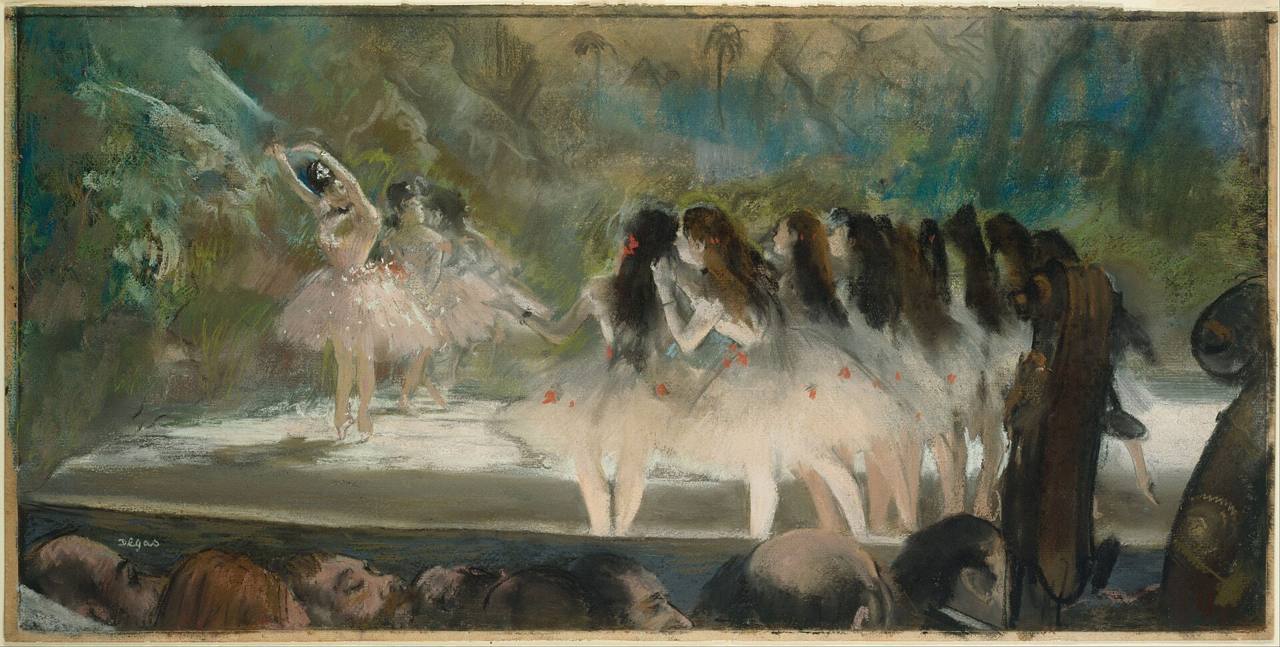
On 28 June 1841 the Opéra premiered Giselle, with music by Adolphe Adam and a libretto by Jules-Henri Vernoy de Saint-Georges, built around the Italian ballerina Carlotta Grisi. About half of the original was mime and action — the story of a peasant girl who dies of a broken heart and returns among the ghostly wilis. The Opéra later found a new home in Charles Garnier's masterpiece, the Palais Garnier, which opened in 1875 and celebrated its 150th anniversary in 2025; its auditorium is crowned by a ceiling painted by Marc Chagall.
While ballet ruled the Opéra, Paris danced in its public ballrooms. The cancan grew out of the quadrille: in the 1820s some men began to break away for short improvised solos called chahuts or cancans, and women soon joined them. A law of 1831 tried to ban it without success; by the 1830s it was popular in Parisian dance halls, and in the 1840s it moved into variety shows and revues, danced in a lively 2/4 to quadrille or galop music.
Its anthem came from the theatre. Jacques Offenbach's Infernal Galop, from the operetta Orpheus in the Underworld (1858, Théâtre des Bouffes-Parisiens), was taken up by cancan dancers in 1868 and has been inseparable from the dance ever since. In 1889 the Moulin Rouge opened as a dance hall in Montmartre; the cancan became the heart of its show, and the posters of Henri de Toulouse-Lautrec made the place immortal.
Working-class Paris had its own ballrooms. Auvergnat migrants brought their bagpipe, the cabrette, to the capital, and on 31 December 1896 Léon Chanal opened a bal musette in his café at 13 rue Au Maire; by then the city had more than two hundred such dance halls. Around 1904 the cabrette player Antoine Bouscatel met the Italian accordionist Charles Péguri — a meeting that symbolises the birth of the accordion-led musette style.
In 1909 Serge Diaghilev brought his first Russian season to the Théâtre du Châtelet, and Paris became the home stage of the Ballets Russes. The Firebird (1910) was Stravinsky's first commission for the company, Nijinsky's L'Après-midi d'un faune appeared in 1912, and in 1913 The Rite of Spring premiered at the new Théâtre des Champs-Élysées. The company dissolved after Diaghilev's death in 1929 — and one of its young stars, Serge Lifar, became ballet master of the Paris Opéra Ballet (1929–45 and 1947–58), restoring its reputation and raising the status of male dancers.
After the war new companies broke away from the Opéra. Roland Petit co-founded the Ballets des Champs-Élysées in 1945, created Le Jeune Homme et la Mort in 1946, founded the Ballets de Paris in 1948 and made a sensation with Carmen (1949); later he directed the Ballet de Marseille. Marseille-born Maurice Béjart choreographed Symphonie pour un homme seul for his Ballets de l'Étoile and, from 1960, led the Ballet du XXe Siècle in Brussels, where his Boléro became a world classic.
In the early 1980s, with Jack Lang at the Ministry of Culture, a generation of young author-choreographers — Dominique Bagouet, Jean-Claude Gallotta, Régine Chopinot, Maguy Marin, Philippe Decouflé — created the nouvelle danse française. Decouflé trained at the Centre national de danse contemporaine (CNDC) in Angers. In 1984 the ministry launched the centres chorégraphiques nationaux, placing choreographers in the regions: today there are 19 CCNs, and since 1998 the Centre national de la danse in Pantin has served as the art's national home, with studios, training and archives.
In Brittany, dances were once held in farms, on threshing floors and at pardons, weddings and fairs. In 1954 a kan ha diskan singing contest organised by Loeiz Ropars at Poullaouen gave birth to the modern fest-noz and carried the dance from private life into public space. Cercles celtiques — associations of dancers who perform, teach the gavottes and run competitions — grew into two confederations, Kendalc'h and War'l Leur (created in 1967), and in 1972 the association Dastum began collecting the region's oral heritage.
Across France, the ethnologists Jean-Michel and Hélène Guilcher documented folk dances between 1941 and 1976, and after May 1968 young city people began to dance them again. In Paris the folk club Le Bourdon, opened in 1969, was one of the first places to hold regular bals folk, and La Chanterelle in Lyon was another early centre. Bourrées, schottisches, mazurkas, circassian circles and Breton dances like the an dro became a shared repertoire that later spread to Belgium, the Netherlands and beyond.
On 5 December 2012 UNESCO inscribed the fest-noz on its Representative List of the Intangible Cultural Heritage of Humanity. Around a thousand take place every year, from a hundred to several thousand people each, with a repertoire of several hundred dance variations and thousands of tunes; tens of thousands of regular dancers learn the old way — by joining in, watching and imitating.
Hip hop entered French theatres in the 1990s. In 1991 the Centre Pompidou hosted a hip hop festival, in 1992 the company Black Blanc Beur created Rapetipas at the Opéra-Comique, and in 1993 Olivier Meyer founded the Suresnes Cités Danse festival. Mourad Merzouki, who began with the company Accrorap in 1989, founded Käfig in 1996, opened the Pôle Pik in Bron in 2009 and the same year became director of the CCN of Créteil — a hip hop artist at the head of a national choreographic centre.
French dancers also won on the world's battle floors: Pockemon Crew took the breaking world title at the Battle of the Year in Germany in 2003. In Paris, Bruce Ykanji created Juste Debout in 2002, an international competition of standing dances — locking, popping, hip hop new style and house — whose final has been held at the AccorHotels Arena in Paris.
Breaking was born in the Bronx in the 1970s and reached Europe in the 1980s and 1990s; in Paris, the concrete plaza of the Forum des Halles became a meeting ground for French breakers. In August 2024 it made its Olympic debut at the Paris Games, on the Place de la Concorde: 16 B-Girls on 9 August and 16 B-Boys on 10 August, in head-to-head battles — in the same city where, three and a half centuries earlier, a king had danced as the Sun.