··EN · ES · FA
Tap a region to read its story
Swipe the timeline
Finland is a small nation with a big map: from the Swedish-speaking coast in the west to the Russian border in the east, and from the Helsinki seafront to the Arctic fells. Each region shaped its own way of making music and moving together. Some kept dances that vanished everywhere else in Europe; others invented new ones. Use the map to choose a region, or read the journey from west to north.
The flat fields of Ostrobothnia, on the west coast, are Finland's folk-music heartland. In the village of Kaustinen, fiddle playing has been handed down by ear for more than 250 years, with hundreds of local tunes whose accented, syncopated rhythms are made for dancing. Since 1968 the Kaustinen Folk Music Festival has turned the village into the biggest folk music and dance gathering in the Nordic countries, and in 2021 Kaustinen fiddle playing was inscribed on UNESCO's list of the Intangible Cultural Heritage of Humanity.
Further along the coast, in the Swedish-speaking parishes of Vörå, Oravais, Munsala, Jeppo, Nykarleby, Lappfjärd and Tjöck, something remarkable happened: the 18th-century minuet never died. At weddings the bride and groom open the dancing with a ceremonial minuet before the guests join in — in the 1930s guests could dance up to 30 minuets on the first day. Several villages have their own local variant, and in Jeppo young dancers still learn it today.
Inland, in South Ostrobothnia, the town of Seinäjoki became the summer capital of a very different dance. Since 1985 its Tangomarkkinat festival has crowned a Finnish tango king and queen every year, and tango in Finland is listed in the national inventory of living heritage.
Karelia stretches across the Finnish–Russian border, and its dance tradition is usually grouped into South Karelia, Ladoga Karelia and Viena Karelia. Village gatherings, weddings and youth evenings were opened by quadrilles — four couples dancing figures in a square, like the Sappu of South Karelia — followed by contra dances, circle games, song dances and the sola, in which one couple at a time dances down a line of others.
Contra dances reached Russia in the time of Peter the Great and later spread to Karelia, while quadrilles arrived in the late 19th century. Dancers add their own flourishes, such as quick ripaska footwork borrowed from the Russian trepak. South Karelia also gave Finland one of its most famous dance tunes, the Säkkijärven polkka, played in the region before it even had a name.
Karelian dancing became more popular in Finland from the 1980s, inspired among others by the Petrozavodsk teacher Viola Malmi. Today groups such as Motora in Joensuu and Rajan Nuoret in Lappeenranta keep it alive, along with folk dance associations wherever Karelian families settled.
In Finland's Lakeland, where forests and thousands of lakes meet, summer dancing moves outdoors. Open-air dance pavilions were built at scenic spots by the water and used mostly in summer; at the Sivakka pavilion in Kaavi, North Savo, dances have been held since 1907.
After the wartime dance ban ended in 1944, pavilions were built all over the country as Finns made up for the lost years. Geographers have shown that for decades these wooden floors were where couples met, shaping marriage patterns across whole regions. A summer evening here still means a live band, tango, waltz and humppa, and couples circling under the pale night sky.
Tampere, Finland's big inland city, hosts the Folk Dance Festival TRADI every April — the festival known for years as Pispalan Sottiisi, named after the schottische (sottiisi) and the hillside district of Pispala. It is organised by Pispalan Sottiisi together with Suomen Nuorisoseurat, the Finnish Youth Association.
North-west of Tampere, the small town of Ikaalinen turns into Finland's accordion capital each June during Sata-Häme Soi. The festival hosts the Finnish entertainment accordion championships, a diatonic-accordion folk musician championship and an international competition — in 2009 it counted around 37,000 visits in six days.
The capital region is where Finnish dance went on stage. The Finnish National Ballet was founded in 1922 and remains the only Finnish company that regularly performs the classical repertoire. In 2022 Dance House Helsinki opened in the old Cable Factory — a dream first voiced in 1932 by the modern-dance pioneer Maggie Gripenberg.
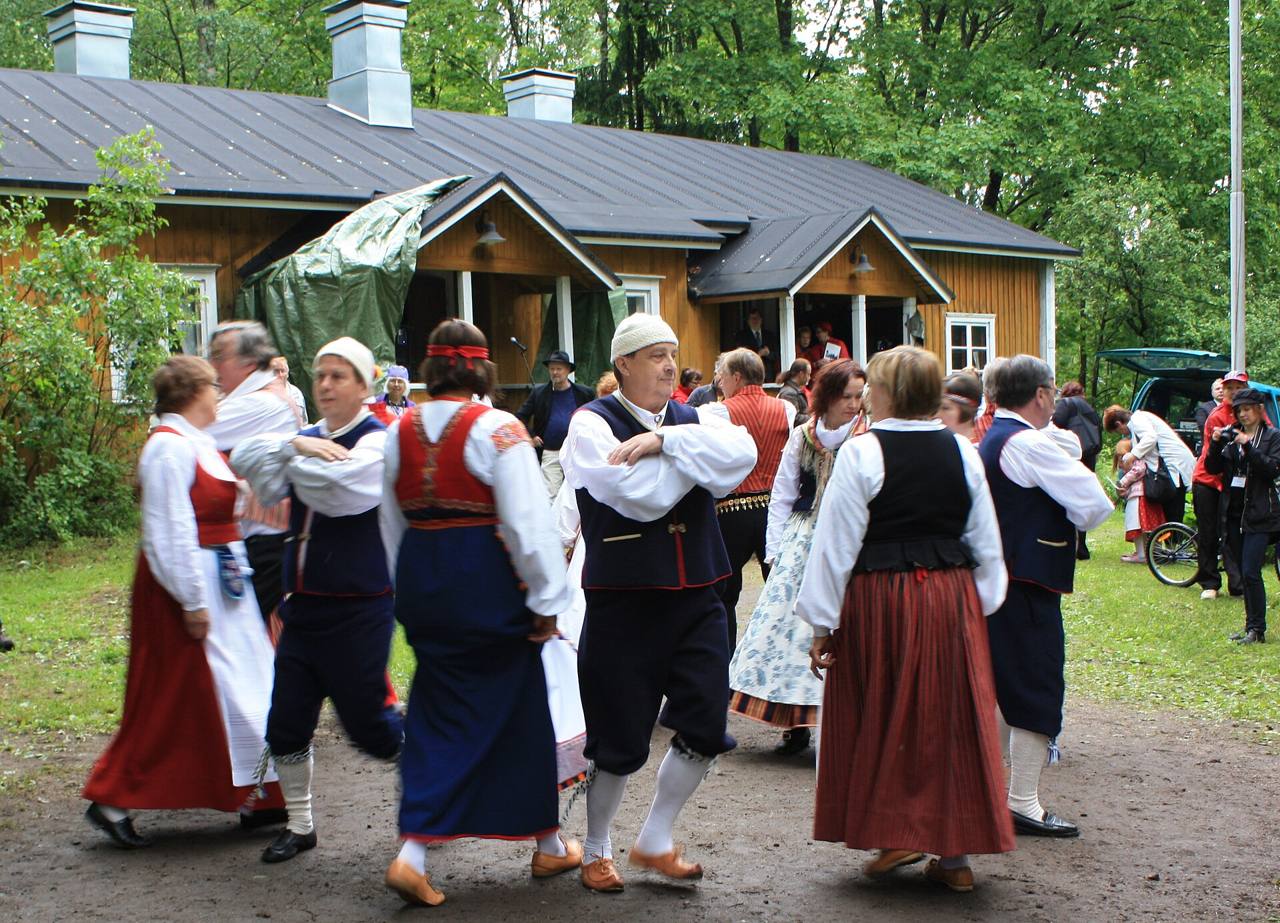
Folk dance has its stage here too: in summer, folk dance groups perform several days a week at the Seurasaari open-air museum, with public lessons for visitors. In Eastern Uusimaa, Finland-Swedish folk dance associations even specialise in the old minuet.
In the Turku archipelago and on Åland, Swedish-speaking island communities danced the minuet and the polska like their neighbours across the sea. Here the minuet faded mainly in the 1870s, although the island parish of Nagu kept it longer. The Finland-Swedish folk dance movement — today about 2,000 members in the Finlands Svenska Folkdansring — keeps these island dances alive.
Each January the sea itself becomes a dance floor: Folklandia, Finland's largest winter folklore event, sails from Turku, with several hundred performers and about two thousand guests dancing and playing folk music around the clock.
Kainuu, the forested east of this region, was one of the places where Elias Lönnrot collected the old poetic songs on his field trips — songs that became the Kalevala, Finland's national epic, first published in 1835.
In northern Ostrobothnia the minuet gave way to a dance medley called the purpuri as early as the 1870s. Today the city of Oulu is one of the two main hubs of Finnish folk partner dancing, together with Helsinki: Oulu University of Applied Sciences teaches dance, local groups hold regular jam sessions, and an annual dance retreat is held on the island of Hailuoto.
In the far north, the Sámi homeland of Sápmi has its own great tradition — but it is a tradition of song rather than dance. The joik is sung, traditionally without instruments, and each joik evokes a person, an animal or a place; a person may even receive their own joik at birth.
For a long time the joik was condemned by the church and discouraged in schools, but a joik renaissance began in the 1970s. Today it lives on in modern music, including the Finnish Sámi group Angelit — a reminder that Finland's rhythms are not only danced but also sung.