··EN · ES · FA
Tap a region to read its story
Swipe the timeline
Finland is a country of extremes: winters of long darkness and summers when the sun barely sets. Dance has always followed that rhythm — quiet gatherings indoors in winter, and in summer whole villages heading to the lakeside pavilion. This is the story of how Finnish dance grew from ancient sung games into polskas, jenkkas and tangos, survived a five-year ban, and became living heritage recognised far beyond Finland's borders.
Long before ballrooms, Finns moved to the human voice. In the villages of the east, young people gathered in rings for sung games, walking and turning as the verses told them. The old poetic songs of Karelia and Kainuu were so rich that the physician Elias Lönnrot travelled there on eleven field trips to write them down.
From these songs he created the Kalevala, published first in 1835 and in its final form in 1849. It became Finland's national epic, and 28 February is still celebrated as Kalevala Day. The epic gave Finns a proud sense of their own culture — and that pride later fuelled the collection and revival of folk dance.
Partner dancing has been part of Finnish life since at least the 17th century, and over time it became the main form of Finnish folk dance. In the 1700s the fashionable music was the minuet, the polska and the polonaise. They came from European courts via Sweden, and spread from manors and towns to the villages.
In the 1800s a second wave arrived: the waltz, the polka, the schottische and the mazurka. Many melodies travelled from aristocratic salons all the way to farmhouse kitchens. Village fiddlers gave them a Finnish accent — the schottische became the jenkka — and in Ostrobothnia the old minuets and polskas survived into the 20th century, long after they had vanished elsewhere in Europe.
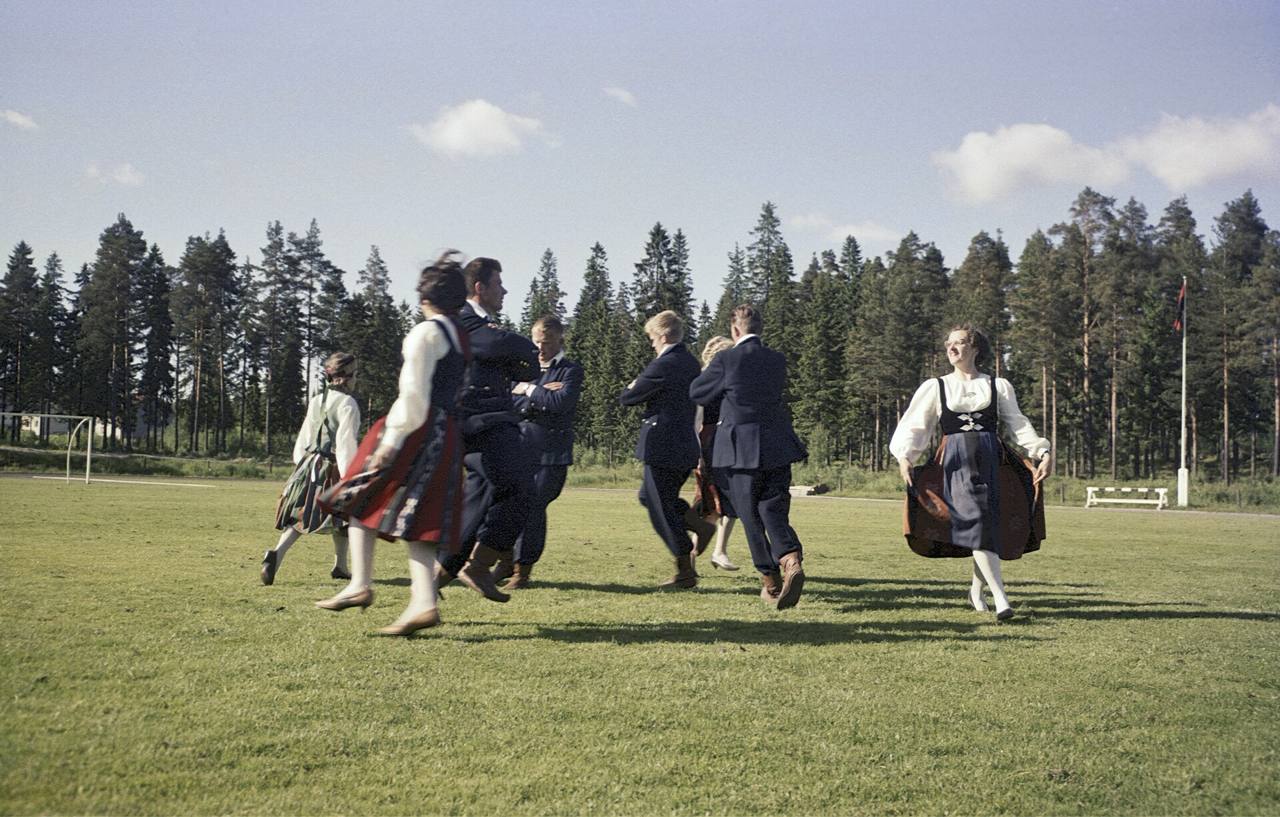
As Finland built its national identity in the 19th century, people began to record the songs and dances of the countryside. Systematic collecting of Finland-Swedish traditions started in the 1840s: the teacher J. O. I. Rancken and his pupils wrote down songs and dances, and one of those pupils, Jakob Wefvar, recorded about 1,500 songs and games and some 600 melodies.
In 1906 Otto Andersson founded the Brage association to preserve folk poetry, music, dance and costume, and in 1909 it began recording fiddlers on a phonograph. Folk dance groups, youth associations and organisations such as Suomalaisen Kansantanssin Ystävät turned these collections into living practice that is still taught today.
In 1905 a young Helsinki woman, Maggie Gripenberg, saw Isadora Duncan dance in Dresden and was transformed. She trained with Émile Jaques-Dalcroze in Geneva, made her debut at the Finnish National Theatre in 1911 and became the pioneer of Finnish modern dance, teaching at the Sibelius Academy from 1914 and winning a first prize for choreography in Brussels in 1939.
The Finnish National Ballet was founded in 1922 and is still the only Finnish company that regularly performs the classical repertoire. Gripenberg had dreamed of a stage just for dance as early as 1932; that dream finally came true when Dance House Helsinki opened in the Cable Factory in 2022.
On 2 November 1913 the dancers Toivo Niskanen and Elsa Nyström performed the tango at the Apollo Theatre in Helsinki; in total around 2,400 people in the city saw the show. The first Finnish-composed tango, by Emil Kauppi, followed in 1914, and in the 1930s Finns began writing tangos of their own in great numbers.
By the 1940s about half of the songs on the popular charts were tangos, and the golden age came in the late 1950s and 1960s with stars such as Olavi Virta and composers such as Toivo Kärki and Unto Mononen, whose “Satumaa” is the best-known Finnish tango of all. Finnish tango is slower and simpler than the Argentine original, usually in a minor key, singing of nature, longing and lost love.
When the Winter War began, Finland banned public dancing in December 1939. It was allowed again briefly between the wars, returned in 1941, and lasted until the end of 1944; dancing in restaurants stayed forbidden until 1948. Officials argued that celebrating at home while soldiers fought would be like “dancing on the soldiers' graves”.
Young people did not stop dancing — they went underground. Secret “corner dances” (nurkkatanssit) were held in barns, cabins and houses, and between 1942 and 1944 several thousand people were prosecuted, mostly with fines. When the ban ended, dancing exploded: pavilions were built across the country as Finns made up for the lost years.
The open-air dance pavilion (lava) is one of the most Finnish places there is: a wooden platform by a lake or in the forest, an accordion or a dance band, and couples turning under the light summer sky. Some have a long history — dances have been held at the Sivakka pavilion in Kaavi since 1907 — and after the war they became the heart of summer life in the countryside.
Researchers have even shown that pavilions shaped Finnish society: for decades they were where couples met, influencing marriage patterns across whole regions. Tango, waltz, humppa and foxtrot fill the evening, and tango in particular has helped bring a new generation back to pavilion dancing in recent years.
In 1963 Erik Lindström launched a new jenkka-based party dance, the letkajenkka, and half a year later Rauno Lehtinen's song “Letkis”, recorded in August 1963, became the biggest hit of the genre. Dancers form a line, hold the person in front by the waist or shoulders, kick left twice, right twice, jump forward and back, and finish with three hops.
Between 1963 and 1965 Letkis swept the world: four instrumental versions reached number one in the Netherlands in 1965, Kyu Sakamoto recorded it in Japan, and it charted across Europe and Latin America. It is still a favourite at Finnish weddings and school parties.
Since 1968 the small town of Kaustinen has hosted the biggest folk music and dance festival in the Nordic countries: a week of more than 1,000 performances, around 40,000–50,000 visits and thousands of amateur dancers and musicians. Since 1970 it has named Master Folk Musicians, Singers and Dancers, and in 2021 Kaustinen fiddle playing was inscribed on UNESCO's list of the Intangible Cultural Heritage of Humanity.
Tango has its own summer capital: since 1985 the Tangomarkkinat festival in Seinäjoki has crowned a tango king and queen every year, and tango in Finland is listed in the national inventory of living heritage — as is folk partner dancing, from the polka and the jenkka to the polska. Dance houses have grown since the 1990s, and youth programmes such as Näppäri bring the tradition to children.