Tap a region to read its story
Dance Regions & Traditions of England
Eight original illustrated regional chapters
The music changes when you cross a county. Listen for Lancashire clogs, Yorkshire swords and lively dances from East Anglia and the Cotswolds.
Cotswolds · village Morris
On an English village green, a fiddler strikes up a tune and six dancers in white spring into motion. Cotswold Morris is a family of traditions associated with communities of the Cotswold region; named villages have their own figures and repertoires. The practices documented and revived during the nineteenth and twentieth centuries continue to grow in living dance teams.
The Welsh-border counties · Border Morris
In the counties beside the Welsh border, English Morris takes on a bolder character. Border Morris teams use expressive movement, powerful stick patterns and costumes that differ widely between groups. Some modern sides favor rag coats and bright ribbons; this is a living practice with local variations, not a single standardized ancient form.
Lancashire & Cheshire · processional dance
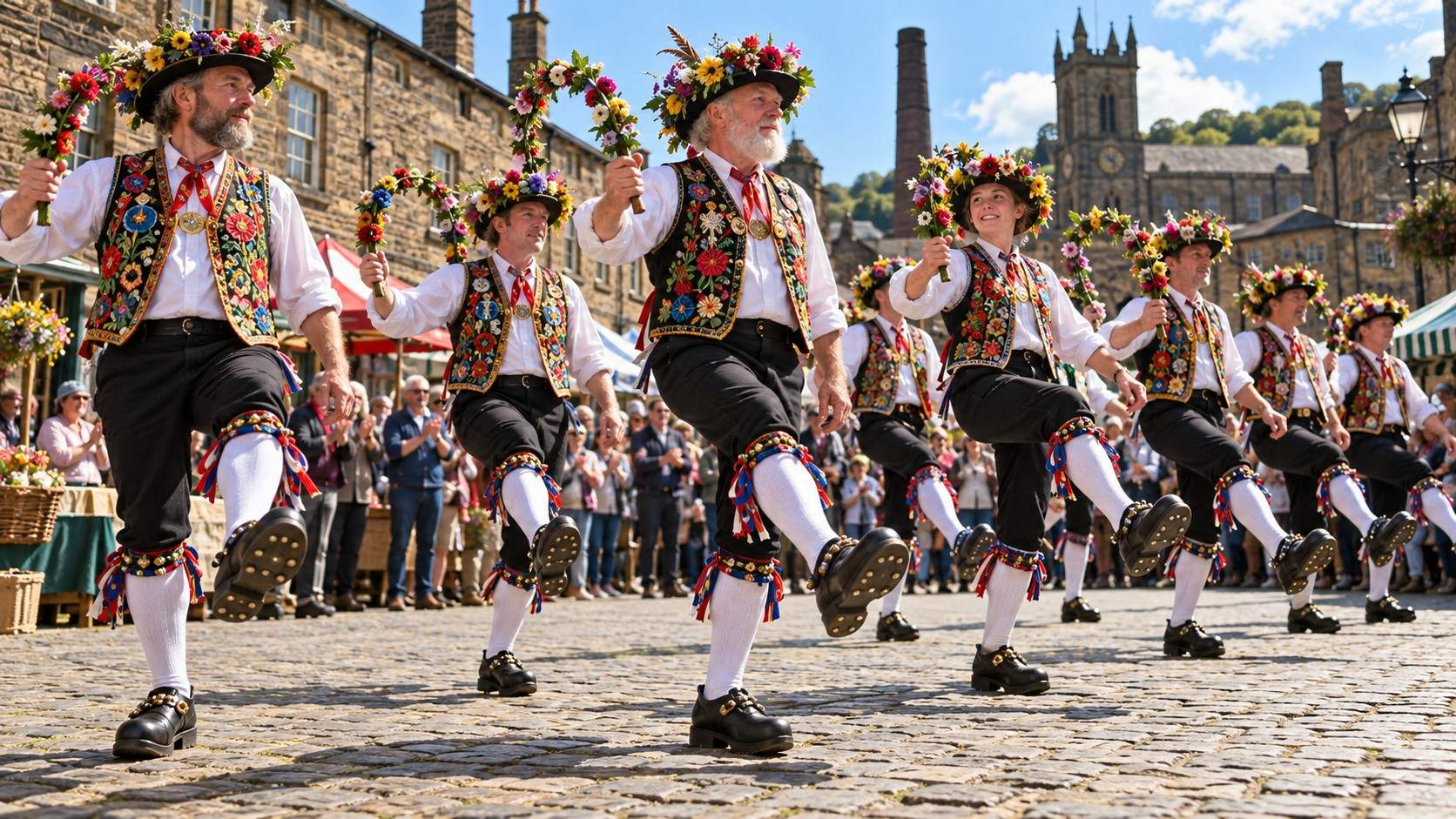
In the towns and former industrial communities of Lancashire and its neighbors, a team may arrive with decorated garlands, rich costumes and a strong walking rhythm. North West Morris emerged from local procession and celebration traditions. Teams today adapt their style while acknowledging the close ties between performance, local pride and industrial history.
North East · rapper swords
In the mining communities of Northumberland and Durham, dancers developed a fast, tightly linked form unlike the sweeping Morris on a village green. Five people join one another using flexible, short, two-handled blades called rappers. Their shared circle becomes a moving puzzle, carried by local music and team traditions.
Yorkshire · long sword circles
In Yorkshire villages, groups of dancers maintain a linked sword tradition different from the short flexible rappers farther north. They carry long, rigid ceremonial dance swords and create figures that depend on everyone moving together. Some repertoires are associated with named places, and dedicated teams pass their local ways from one generation to another.
East Anglia · Molly and the Fens
In the flat landscapes of East Anglia, especially the Cambridgeshire Fens, Molly dancing became associated with local seasonal visiting and festive community life. Many teams today revive or reinterpret a partly documented history through playful figures, vivid clothes and shared musical performance. The dancers tell their own stories; there is no single compulsory costume or choreography.
Across England · country sets and barn dances
A caller begins with a few friendly instructions, the fiddles take up a tune and a hall full of strangers becomes a dance floor. In England, barn dances and English ceilidhs are popular social events that draw on traditional figures and newer arrangements. The exact repertoire varies from event to event and is not limited to one historic period.
London, Leeds & more · contemporary dance
In studios and theatres from London to Leeds, contemporary dance in England has developed through generations of choreography, education and artistic exchange. Companies and conservatoires have welcomed international ideas and new movement languages. Its rich history cannot be reduced to one national style: the strength of the scene lies in experimentation, collaboration and change.
Sources
- English Folk Dance and Song Society — dance styles — English Folk Dance and Song Society — dance styles
- Morris Federation — types and team finder — Morris Federation — types and team finder
- English Folk Dance and Song Society — North West Morris — English Folk Dance and Song Society — North West Morris
- English Folk Dance and Song Society — Border Morris — English Folk Dance and Song Society — Border Morris
- English Country Dancing at Cecil Sharp House — English Country Dancing at Cecil Sharp House
- The Royal Ballet School — The Royal Ballet School
- Rambert School — Rambert School
- London Contemporary Dance School · The Place — London Contemporary Dance School · The Place
- Northern School of Contemporary Dance — Northern School of Contemporary Dance
- Trinity Laban · Dance — Trinity Laban · Dance
- Academy of Northern Ballet — Academy of Northern Ballet
- Dance City Newcastle — Dance City Newcastle
- DanceEast Suffolk — DanceEast Suffolk
- Sadler’s Wells — official schedule — Sadler’s Wells — official schedule
- Dance City — official performances — Dance City — official performances
- English Folk Dance Calendar — English Folk Dance Calendar
Traditions through the year
Dance history in numbers
Timeline
Swipe the timeline