Tap a region to read its story
The History of Dance in England
Nine illustrated chapters · people, music and memory
Travel with English dance from village greens through industrial towns and community halls to today’s creative stages. Each chapter tells a different story, with original artistic illustrations.
Where a tune becomes a gathering
Imagine walking through an English town on a summer afternoon. A fiddle begins playing outside a centuries-old pub, bells answer from the dancers’ legs, and neighbors stop to watch. Farther north, a sword team practices its clever linked figures; somewhere else, a caller is welcoming nervous first-time dancers into a barn. There is no single English dance that contains all of these experiences.
English dance belongs to many communities: rural and urban, traditional and experimental. The archive preserves part of the story, while people continue creating the next chapter every time they rehearse, perform or teach. To appreciate the forms, begin with the voices of their living practitioners.
Morris and the changing village green
A village green fills with the sound of bells and fiddle music, and a team of Morris dancers begins to leap and turn. Morris is not one uniform choreography: Cotswold, Border, North West and other styles have different local histories. Written references reach back centuries, while today’s teams continue to invent and share new material.
For many communities, Morris belongs to the calendar of local gatherings, seasonal celebrations and friendly meetings between dance teams. It brings people into public spaces to watch, learn, talk and laugh. Its meaning comes from that continuing relationship with place and people, not a single speculative story about ancient origins.
Cotswolds: handkerchiefs, bells and local tunes
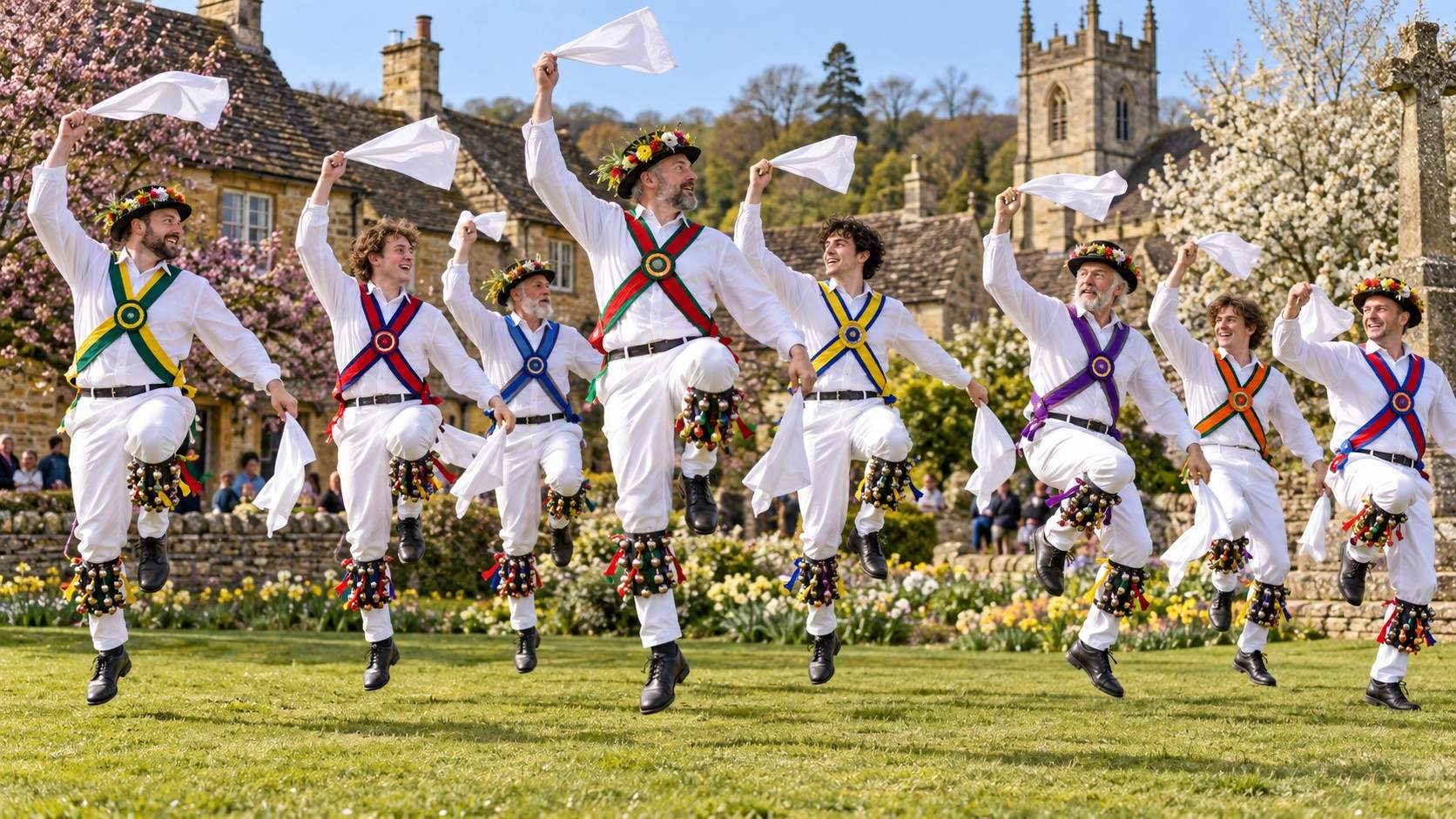
On an English village green, a fiddler strikes up a tune and six dancers in white spring into motion. Cotswold Morris is a family of traditions associated with communities of the Cotswold region; named villages have their own figures and repertoires. The practices documented and revived during the nineteenth and twentieth centuries continue to grow in living dance teams.
Cotswold Morris brings families and neighbors into the open air; it can turn a quiet village green into a meeting place. Teams visit one another, teach newcomers and continue old village names with care. It is best understood through the people who practice it today, not through confident claims about undocumented ancient rites.
Border Morris and the joy of teamwork
In the counties beside the Welsh border, English Morris takes on a bolder character. Border Morris teams use expressive movement, powerful stick patterns and costumes that differ widely between groups. Some modern sides favor rag coats and bright ribbons; this is a living practice with local variations, not a single standardized ancient form.
For many Border Morris groups, the shared effort is as rewarding as the show itself. Friends spend evenings rehearsing and weekends traveling to meet other teams. The tradition connects people through music, humor and movement while leaving room for new artistic ideas.
Lancashire: processions and proud communities
In the towns and former industrial communities of Lancashire and its neighbors, a team may arrive with decorated garlands, rich costumes and a strong walking rhythm. North West Morris emerged from local procession and celebration traditions. Teams today adapt their style while acknowledging the close ties between performance, local pride and industrial history.
The sight of neighbors moving as a team can make a street feel like a shared home. North West Morris keeps alive a special form of local memory through social dances and public appearances, while welcoming newcomers to learn the discipline and joy of the group.
Fenland Molly: folklore with a playful heart
In the flat landscapes of East Anglia, especially the Cambridgeshire Fens, Molly dancing became associated with local seasonal visiting and festive community life. Many teams today revive or reinterpret a partly documented history through playful figures, vivid clothes and shared musical performance. The dancers tell their own stories; there is no single compulsory costume or choreography.
Molly dance reminds us that folklore is not only solemn preservation. Communities can remember, laugh and make something new together. Respectful study includes the complicated history of performance and disguise as well as the ways current dancers choose to represent their tradition.
Two sword traditions, two histories
In the mining communities of Northumberland and Durham, dancers developed a fast, tightly linked form unlike the sweeping Morris on a village green. Five people join one another using flexible, short, two-handled blades called rappers. Their shared circle becomes a moving puzzle, carried by local music and team traditions.
In Yorkshire villages, groups of dancers maintain a linked sword tradition different from the short flexible rappers farther north. They carry long, rigid ceremonial dance swords and create figures that depend on everyone moving together. Some repertoires are associated with named places, and dedicated teams pass their local ways from one generation to another.
A place for everyone on the dance floor
Picture a long room where partners face one another as a fiddle begins a familiar tune. English country dancing has appeared in printed collections since the seventeenth century, including works associated with John Playford. Its patterns travelled through assemblies and communities and are still enjoyed at modern social dances.
The heart of an English barn dance is hospitality. Friends, grandparents, children and guests share the same floor and help newcomers feel at ease. The choreography matters, but the larger achievement is a room in which everybody finds a place to belong.
Contemporary England: new movement languages
In studios and theatres from London to Leeds, contemporary dance in England has developed through generations of choreography, education and artistic exchange. Companies and conservatoires have welcomed international ideas and new movement languages. Its rich history cannot be reduced to one national style: the strength of the scene lies in experimentation, collaboration and change.
Contemporary dance gives artists space to ask questions that ordinary speech cannot always hold. Audiences may feel surprise, grief, tenderness or joy, even without a conventional plot. Across Britain, theatres and community projects invite new audiences to discover that movement can tell many kinds of stories.
Sources
- English Folk Dance and Song Society — dance styles — English Folk Dance and Song Society — dance styles
- Morris Federation — types and team finder — Morris Federation — types and team finder
- English Folk Dance and Song Society — North West Morris — English Folk Dance and Song Society — North West Morris
- English Folk Dance and Song Society — Border Morris — English Folk Dance and Song Society — Border Morris
- English Country Dancing at Cecil Sharp House — English Country Dancing at Cecil Sharp House
- The Royal Ballet School — The Royal Ballet School
- Rambert School — Rambert School
- London Contemporary Dance School · The Place — London Contemporary Dance School · The Place
- Northern School of Contemporary Dance — Northern School of Contemporary Dance
- Trinity Laban · Dance — Trinity Laban · Dance
- Academy of Northern Ballet — Academy of Northern Ballet
- Dance City Newcastle — Dance City Newcastle
- DanceEast Suffolk — DanceEast Suffolk
- Sadler’s Wells — official schedule — Sadler’s Wells — official schedule
- Dance City — official performances — Dance City — official performances
- English Folk Dance Calendar — English Folk Dance Calendar
Traditions through the year
Dance history in numbers
Timeline
Swipe the timeline