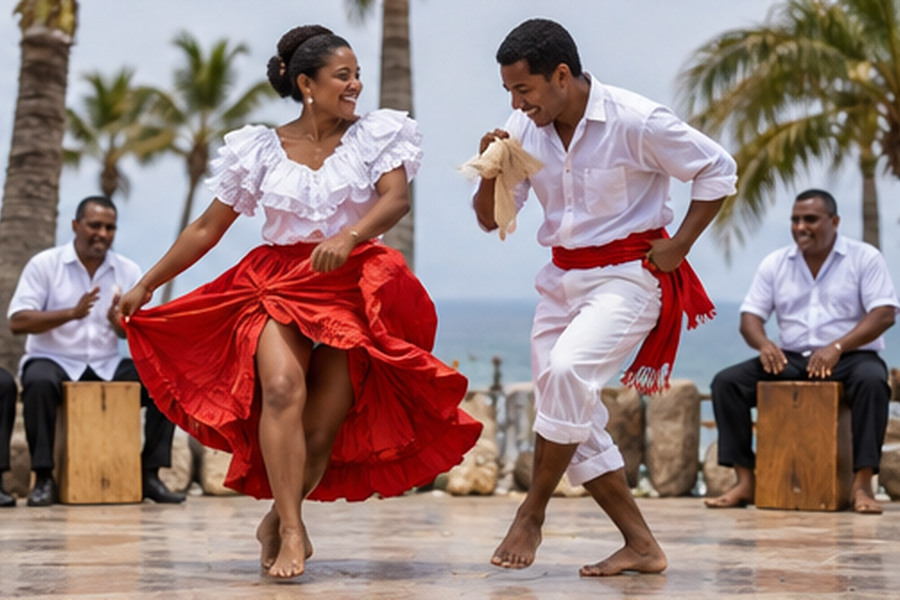
Festejo is the best-known Afro-Peruvian dance: fast, joyful and full of hip movement, played on cajón, quijada (a donkey’s jawbone rattle), guitar and voice. Dancers in white and colourful skirts move with energy and humour, and the festejo has become a symbol of Afro-Peruvian pride on the coast, especially in Lima and El Carmen in Chincha.
Africans were brought to Peru in slavery from the 16th century to work on coastal haciendas and in cities. They created music and dances with whatever was at hand — the cajón grew from wooden boxes and crates, the quijada from an animal’s jaw. After abolition in 1854, many traditions survived in families but were rarely seen in public. In the 1950s–70s a revival led by José Durand, Nicomedes and Victoria Santa Cruz and the company Perú Negro (founded 1969) researched and staged festejo, landó and other forms, giving them national visibility. Today 4 June is the Day of Afro-Peruvian Culture, and the summer festival ‘Verano Negro’ in Chincha draws visitors to El Carmen, heart of Afro-Peruvian music.