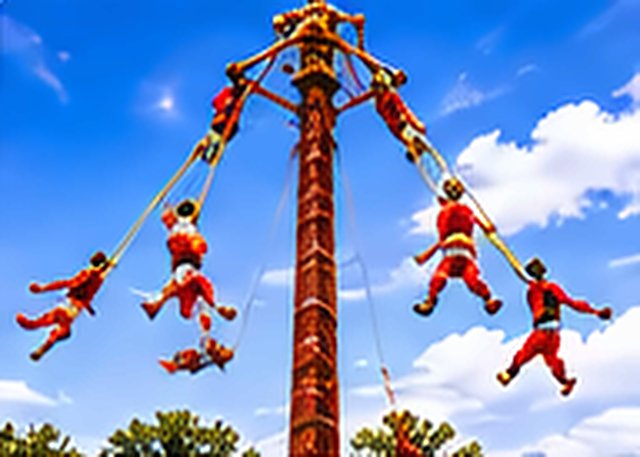
The Voladores (“flyers”) of Papantla climb a pole up to 30 metres high and spin down head-first on ropes — an ancient Totonac prayer for rain and fertility.
The ceremony goes back to pre-Hispanic times and was practised by several Mesoamerican peoples; today it is most closely tied to the Totonac people of Papantla and El Tajín in Veracruz. It starts on the ground: the dancers ask permission of the forest, cut a tall straight tree and raise it as the pole. Then five men climb. Four sit on a small wooden frame at the top, tie ropes around their waists and lean backwards into the air, while the fifth — the caporal — stands on a tiny platform no bigger than a plate, playing a reed flute and a small drum to the sun and the four directions. The four flyers drop and circle down, the ropes unwinding, thirteen turns each: 4 × 13 = 52, the number of years in a Mesoamerican calendar cycle. In 2009 UNESCO inscribed the Ritual ceremony of the Voladores as Intangible Cultural Heritage of Humanity, and the Centre for Indigenous Arts in Papantla trains children to keep it alive.