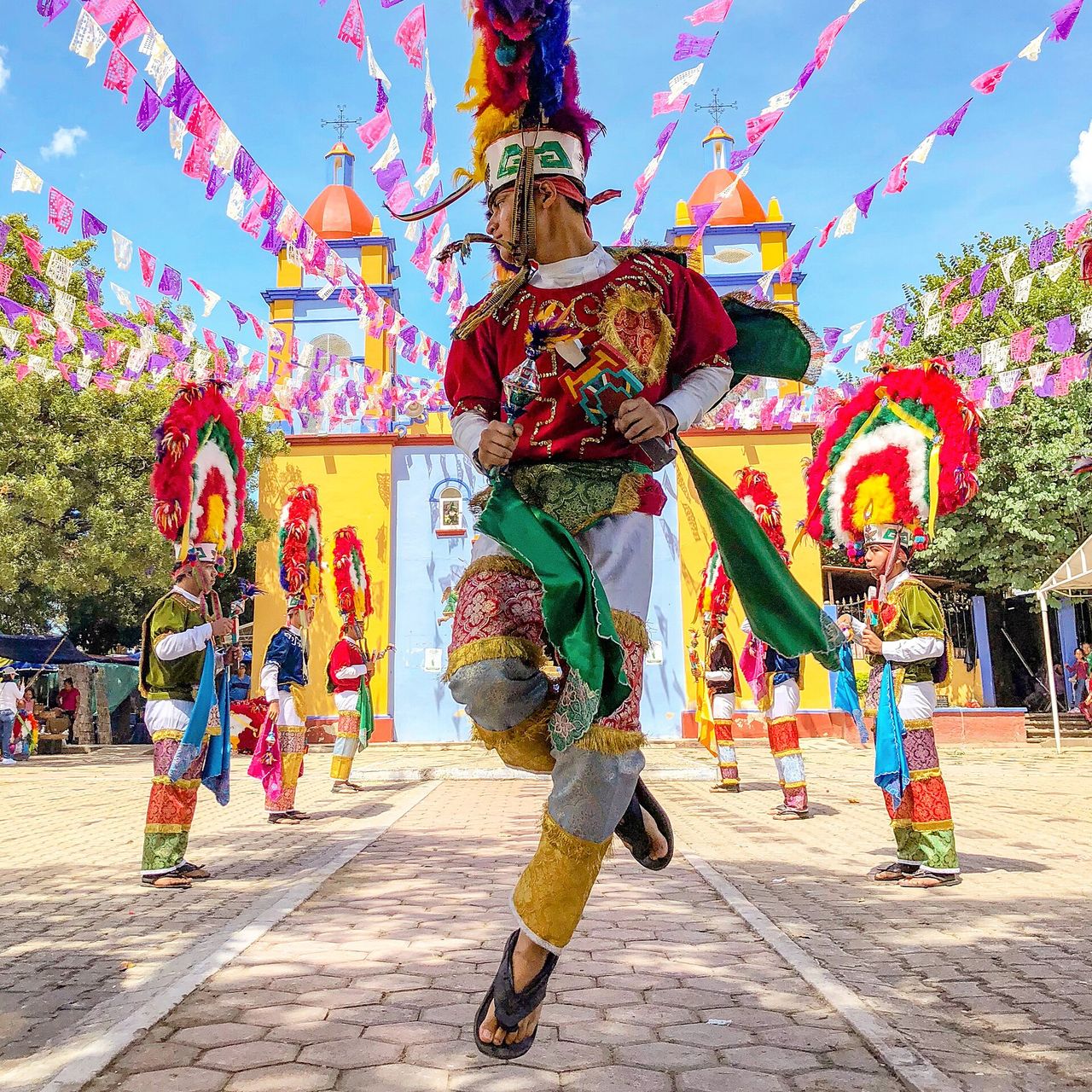
Under huge, round feather crowns, the dancers of Oaxaca's Central Valleys leap, kneel and spin to tell the story of Moctezuma and Cortés — the spectacular finale of the Guelaguetza.
The Danza de la Pluma, the “feather dance”, belongs to Zapotec and Mixtec towns of Oaxaca's Central Valleys: Cuilápam de Guerrero, widely seen as its cradle, Teotitlán del Valle, Zaachila, Zimatlán, San Bartolo Coyotepec and others. It is a danza de conquista: on one side Moctezuma with his teotiles (priests), captains and kings; on the other Hernán Cortés, Pedro de Alvarado and their soldiers; between them the Malinche and the Cihuapilli. Its origin is not fully clear. It is usually linked to the Dominican friars who evangelised the valleys in the 16th century and used dance-dramas to teach, while some historians see an older seed in a 17th-century account of a Mixtec–Zapotec “dance of the hanged man”, and dancers in Teotitlán — where it is called Guyach — also read it cosmically: Moctezuma is the sun, the dancers around him the planets. What everyone sees is the penacho: a great fan of dyed feathers on a cane frame, decorated with mirrors and ribbons, tied under the chin and so heavy that dancers must stop to re-tie it. Dancers carry a rattle in one hand and a small wand or shield in the other, and leap and kneel with surprising agility while a wind band plays sones, marches, waltzes and polkas; in its home towns a full performance can stretch over two or three days. In Teotitlán men promise to dance it for three years for the town's patron, and some migrants return from the United States just to keep that vow. Today it is the grand finale of the Guelaguetza on Oaxaca's Fortín hill.