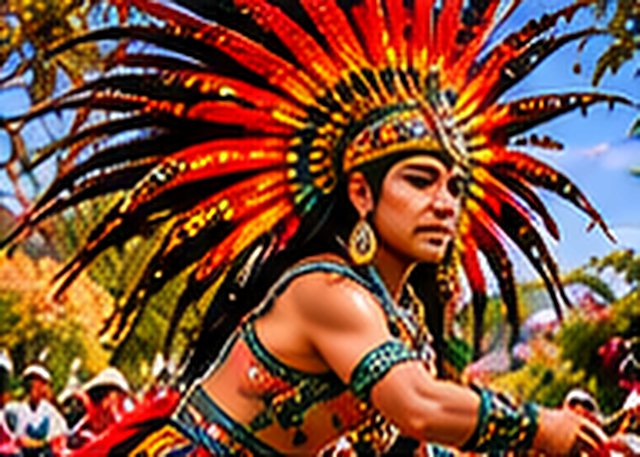
Mexica dance — often called “danza azteca” — fills plazas with drums, rattling ankle seeds, feathered headdresses and copal smoke in honour of the ancient Nahua world.
Before 1521, dance was a form of prayer in Tenochtitlan, the Mexica (Aztec) capital: dancers moved in great circles to the huehuetl drum and the teponaztli slit-drum during calendar festivals. After the conquest, much of this was banned or folded into Catholic feasts — which is how the Conchero tradition arose. In the 20th century, especially from the 1950s, the Mexicanidad (Mexicayotl) movement set out to recover a pre-Hispanic identity, and groups (calpullis) created a Mexica dance without the Catholic elements: no mandolin-like concha, no saints, but drums, conch-shell trumpets, ayoyote seed rattles, feather headdresses and Nahuatl names. Each dance opens by saluting the four directions, sky and earth, and many steps imitate animals or natural forces — the eagle, the serpent, fire, wind. You can see Mexica dancers daily in Mexico City's Zócalo, at ancient sites on the spring equinox and at Chicano gatherings in the United States, where the tradition spread from the 1970s.