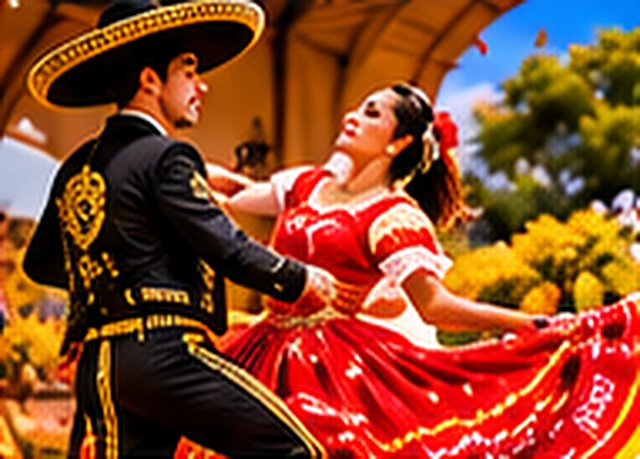
The Jarabe Tapatío is a courtship told in steps: the charro woos, the china poblana teases, and they finish around his sombrero — all danced to the music of the mariachi.
First, a common mix-up: mariachi is not a dance. It is the musical ensemble and genre of western Mexico — Jalisco, Nayarit, Colima, Michoacán — that UNESCO inscribed in 2011 as “Mariachi, string music, song and trumpet”; its repertoire, says UNESCO, includes jarabes. The jarabe and the sones jaliscienses (“El Son de la Negra”, “Las Alazanas”, “El Carretero”) are the dances people perform TO mariachi music: violins, trumpets, guitar, vihuela and the deep guitarrón, which the dancers' heels answer. Jarabes — lively medleys of sones — were danced in New Spain by the late 1700s, and around 1800 the viceregal authorities banned versions such as the “jarabe gatuno” as indecent. In the 19th century the Guadalajara version (“tapatío” means from Guadalajara) became a symbol of the young nation; the tune most people know is credited to the Guadalajara musician Jesús González Rubio. In 1919 the Russian ballerina Anna Pavlova danced it on pointe, dressed as a china poblana, in the ballet “Fantasía mexicana”, staged with the Mexican dancer Eva Pérez Caro and designed by Adolfo Best Maugard, before thousands at the Toreo bullring in Mexico City. After the Revolution, the new Secretaría de Educación Pública (SEP, 1921) under José Vasconcelos used folk dance in its nationalist education programme, and in 1924 hundreds of couples danced the jarabe at the opening of the Estadio Nacional — from then on it was taught in schools across Mexico. Its title of “national dance” comes from this history and custom; an official decree is often claimed but rarely documented. The classic costumes are the charro suit for him and the china poblana for her (a wide, ribboned Jalisco dress is also common); the escaramuza riding dress belongs to charrería and the “adelita” look to the Revolution, not to this dance. The story unfolds in scenes — the flirting, a tipsy “borracho” section, the dove-and-suitor steps of “el palomo” — until he throws his sombrero down, she dances around its brim and picks it up, usually read as her “yes”. They finish with the triumphant “diana”.