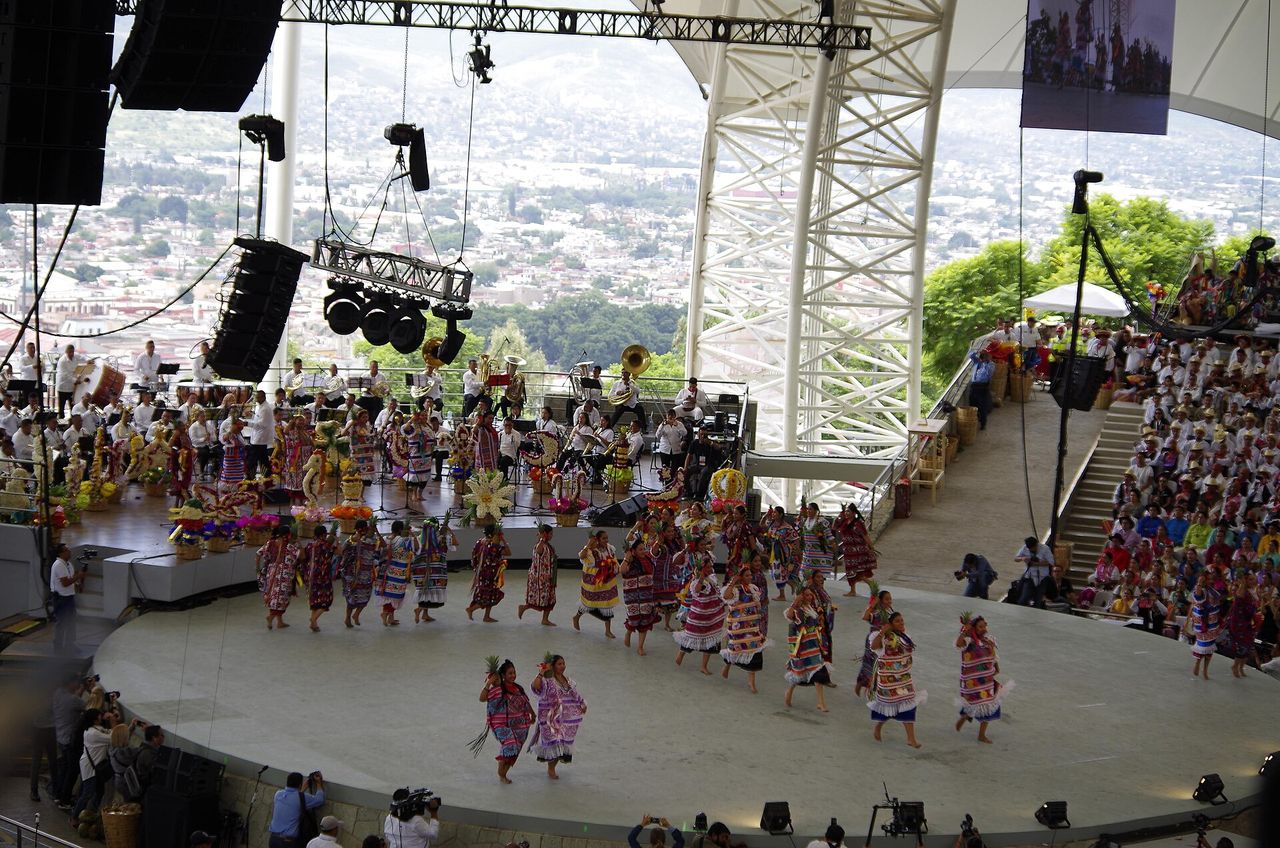
Rows of women in brilliant huipiles, each with a pineapple on her shoulder, stamp and sway to a lively son: Flor de Piña, Tuxtepec's dance at the Guelaguetza and one of the festival's most applauded moments.
Unlike many Oaxacan dances, Flor de Piña has a known author and date. In 1958 the governor Alfonso Pérez Gasga wanted the Tuxtepec region, in the Papaloapan basin bordering Veracruz, to bring a dance of its own to the Guelaguetza instead of the son jarocho it was associated with. Composer Samuel Mondragón wrote a son called “Flor de Piña”, and at the request of the town council the Tuxtepec teacher Paulina Solís Ocampo (1925–2023) created the choreography within a few months; it premiered at the Guelaguetza that same July. (Some websites call her “Paulina Solís Gutiérrez” or say the dance is ancient — both are wrong.) She chose to dress the dancers in the huipiles of the region's Chinantec and Mazatec towns — Valle Nacional, Usila, Ojitlán, Jalapa de Díaz, Ixcatlán, Soyaltepec and others — and to give each a pineapple, the crop of Tuxtepec and Loma Bonita. A poem by Felipe Matías Velasco is recited before the dance, and in 1979 he also designed a huipil for Tuxtepec itself, with a “hill of the rabbit” motif from the Nahuatl name Tochtepec. Flor de Piña has also been debated for decades. Critics — writers, researchers and community voices — point out that it was created for the stage rather than inherited, that its movements stylise rather than reproduce Chinantec and Mazatec dance, and that the delegation has mostly been formed by young mestizo women from the city of Tuxtepec while the Indigenous communities whose huipiles it displays have often been left out; some essays have discussed it as cultural appropriation. Defenders answer that it gave the whole basin a shared identity and has kept huipil weaving in demand. In 2023 Paulina Solís died aged 98, and Oaxaca's Congress declared her birthday, 22 June, the State Day of the Flor de Piña dance.