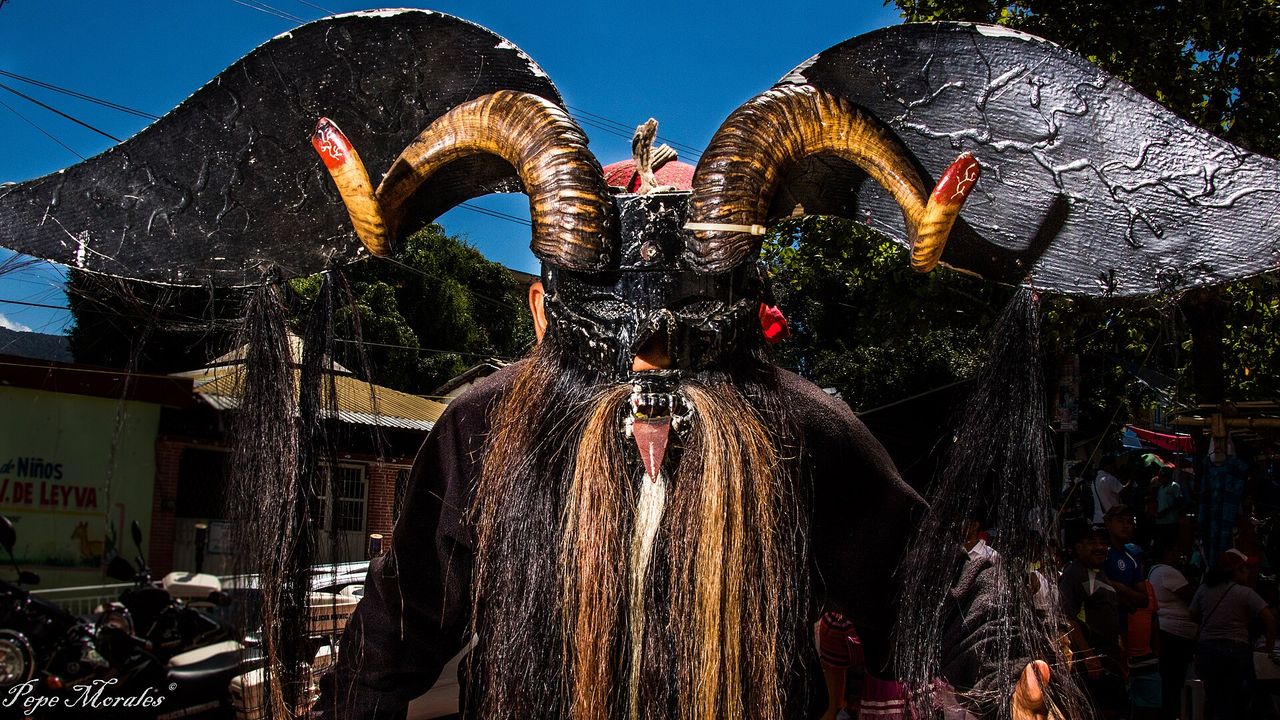
Every Day of the Dead, Afro-Mexican communities of the Costa Chica send out their diablos: horsehair-bearded devils led by the Tenango and the cross-dressed Minga, stamping from house to house to harmonica, friction drum and donkey jawbone.
The Costa Chica, the coastal strip shared by Guerrero and Oaxaca, is the heart of Afro-Mexico: in colonial times enslaved Africans and their descendants worked its cattle ranches, and their descendants still live in towns such as Cuajinicuilapa (Guerrero) and Collantes and Lo de Soto (Oaxaca). From 31 October to 2 November groups of diablos leave the cemetery and dance through the streets; local writers describe them as the dead themselves, returning to visit the living before going back to the graveyard. A group has around a dozen dancers. The leader, called Tenango or, in Collantes, Terrón, gives the shout that starts the music and calls the figures; beside him dances the Minga (from María Dominga), a man dressed as a woman who carries a doll as her baby and teases the crowd. The devils wear masks of leather, felt or cardboard with goat horns and beards of horsehair, and some carry whips. The music is unusual: a harmonica (locally called the “flauta”), the charrasca — a donkey or horse jawbone scraped like a güiro — and the bote or tigrera, a friction drum played by rubbing a waxed stick, whose growl recalls a jaguar. Where the dance comes from is debated. Local tradition and Mexico's Secretaría de Cultura link it to a colonial ritual in which enslaved Africans asked a deity called Ruja for freedom, and to the satire of cruel masters. Anthropologists who studied Collantes, however, recorded other readings — honouring dead cowhands, warding off harm — and warn that the dance blends African, Indigenous and Spanish elements rather than proving a single African origin. Either way, it is a cornerstone of Afro-Mexican identity, which Mexico recognised in Article 2 of its Constitution in August 2019; the 2020 census counted about 2.5 million Afro-descendant people.