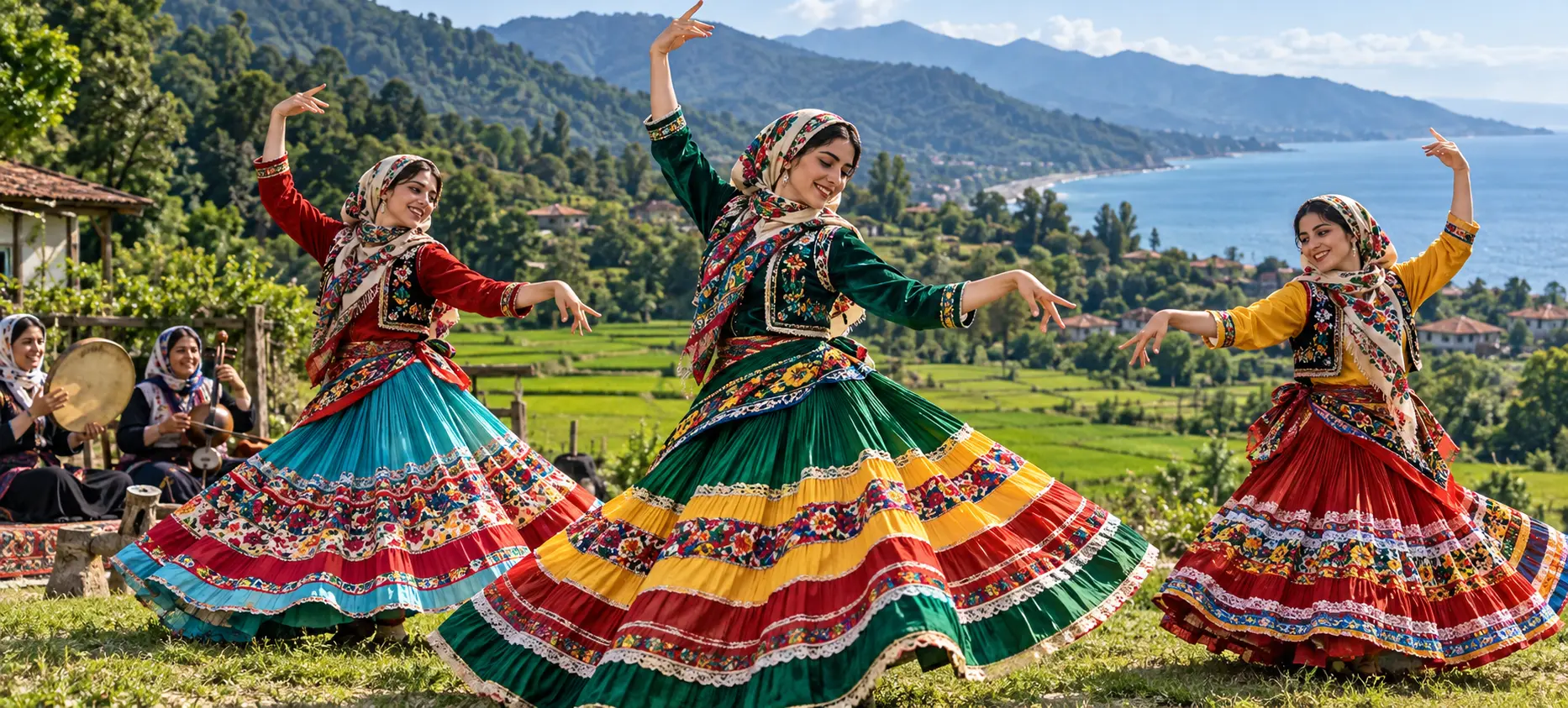
Its association with Ghasemabad and Gilaki cultural expression makes costume, village context and local music as important as the visible choreography.
The colourful layered skirt is a key visual marker; a Gulf-coast costume or white-robed stick dance is not Qasemabadi. Qasemabadi is associated with the village of Qasemabad and the Gilaki cultural world of coastal Gilan. Its colourful layered skirts and festive movement have become a recognizable image of northern Iran. Agricultural life and rice-growing landscapes are important interpretive contexts, but a literal harvest narrative should not be assigned to every modern performance without checking local testimony. A stage ensemble often makes the patterns symmetrical for the camera; a local gathering may differ in tempo, gestures and social roles. The dance is not a label for every dance of the Caspian coast, and Mazandarani traditions deserve separate documentation. DANZO names the village and community rather than flattening the north into one costume.