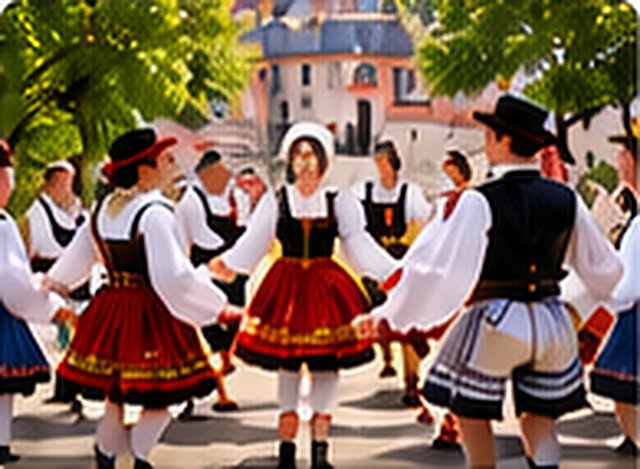
In the farandole, dozens of dancers hold hands in a long open chain and follow a leader through streets and squares, weaving spirals and arches to the pipe and drum of Provence.
The farandole is the community dance of Provence. A leader, often waving a handkerchief, draws a long chain of men and women, hand in hand, through the town, and the chain coils into a snail-shell spiral, unwinds, and passes under arches made by raised arms. Its music is played by the tambourinaire, one musician with two instruments: the galoubet, a three-holed pipe played with the left hand, and the tambourin, a long drum hanging from the arm and struck with a stick, in a lively 6/8. Some writers have linked it to ancient Greek dances, but the name itself only appears in the 18th century, and the farandole was danced above all at village festivals, processions such as Corpus Christi and the Tarasque festival in Tarascon, and around Christmas cribs. In the 19th century the poet Frédéric Mistral and the Félibrige movement made it a symbol of Provençal identity; Gounod opened the second act of Mireille (1864) with a farandole and Bizet ended his music for L'Arlésienne (1872) with one. Today it closes the Fête du Costume in Arles and many town festivals, and anyone can join the end of the chain.