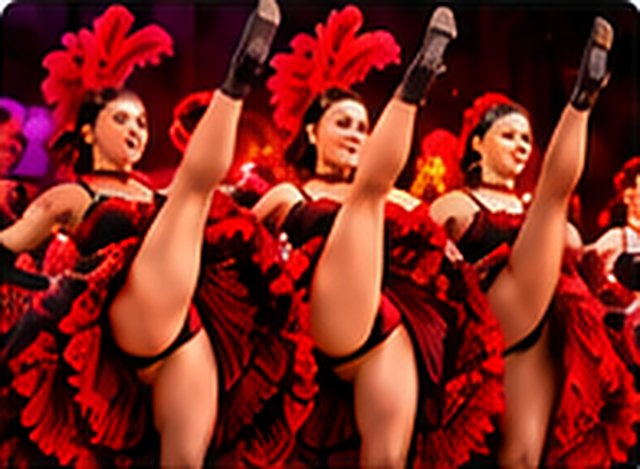
The cancan was born in the noisy public dance halls of 1830s Paris and became, at the Moulin Rouge, the most famous show dance in the world: a line of dancers kicking, spinning and dropping into the splits.
In the 1830s, young Parisians at public balls began to break the polite figures of the quadrille with wild improvisations: high kicks, leaps and cheeky gestures. Called the chahut or cancan, it scandalised the authorities, and police watched the dance halls, but it spread quickly and by the 1840s it was appearing on stage. In 1858 Jacques Offenbach ended his operetta Orpheus in the Underworld with a frantic galop, the Galop infernal, which became the cancan's anthem. The dance reached its peak at the Moulin Rouge, opened at the foot of Montmartre in 1889: in the 'quadrille naturaliste', stars such as La Goulue, Jane Avril and the boneless Valentin le Désossé improvised in front of the crowds, and Toulouse-Lautrec painted them on his posters. London music halls then turned it into the 'French cancan', a precise chorus line of women. Its signature moves are the battement (high kick), the port d'armes (holding one leg up by the ankle and hopping), the rond de jambe (fast circles of the lower leg), cartwheels and the grand écart, the final jump into the splits. Jean Renoir's film French Cancan (1955) celebrated its legend, and the Moulin Rouge still dances it every night.