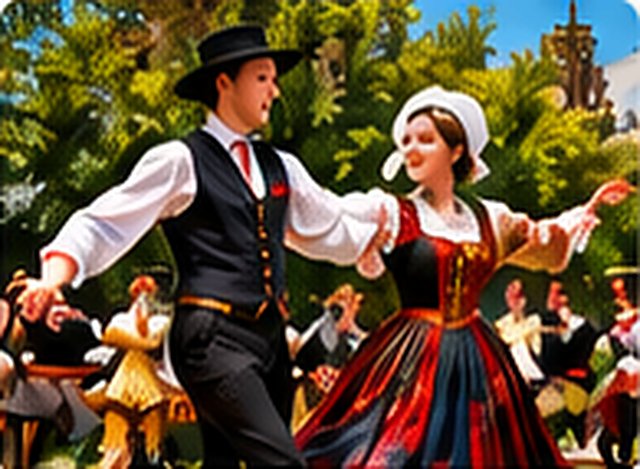
The bourrée is the great dance of central France: couples face each other, advance, cross and turn with light, bouncing steps to the cabrette bagpipe and the hurdy-gurdy — a village dance that also found its way into Bach's suites.
The bourrée belongs to the uplands of central France — Auvergne, Limousin, Berry, Bourbonnais and the Morvan — and it was already a popular dance in Clermont-Ferrand in 1665. In the villages it is danced by couples or in sets of two facing lines: partners advance towards each other, retreat, cross and change places, women turning lightly while men stamp and sometimes shout. In Auvergne it is usually in a lilting three-time, while in Berry and the Bourbonnais it has two beats. The bourrée also went to court: in the age of Louis XIV a refined version in quick double time became a dance of the ballroom and the stage, and composers such as Bach and Handel wrote bourrées in their suites; ballet still uses the 'pas de bourrée', a quick linking step. In the 19th century thousands of Auvergnats moved to Paris and danced bourrées to the cabrette, a bellows bagpipe, in their cafés near the Bastille — the seed of the bal musette. After a long decline, the folk revival of the 1970s brought the bourrée back to life, and today associations such as Les Brayauds in Auvergne and the summer bals of Gennetines fill the dance floors again.